
Diagnose a P1450 Ford Edge Code: Tips and Tricks
Fixing a Ford Edge P1450 Code: Causes and Solutions
A P1450 Ford Edge code is defined as: Unable To Bleed Up Fuel Tank Vacuum. The code is set when the PCM sees excessive fuel tank vacuum while the engine runs but not when idle. Or, the PCM conducted a fuel tank vacuum test and could not bleed off the vacuum after the test was completed. This article explains how the system works and the most common cause of a Ford Edge P1450 code.
The most common causes of P1450 Ford Edge
The purge valve is located in the engine compartment. It’s a solenoid valve and can fail electrically or mechanically. A stuck open purge valve is the most common cause of a Ford Edge P1450 code. Start your diagnostic by locating the purge and valve and disconnecting the electrical connector from the valve. Next, follow the hose from the purge valve back to the rear of the vehicle. You’ll find a hose connection. Disconnect that hose connection so the purge valve can’t suck any fuel vapors from the charcoal canister.
Then start the engine. Check for a vacuum at the hose end you just disconnected. If you feel vacuum, that confirms the valve is stuck open.
Before you replace the purge valve, check it for the

Ford purge valve
presence of charcoal particles. If you find those, the charcoal canister has ruptured and must be replaced, the hoses flushed, and the valve replaced.
If there’s no vacuum when conducting this test, check the vent valve and the fuel tank pressure sensor, using the tests below.
Stuck closed vent valve
The vent valve allows fresh air into the canister during a purge cycle. If it’s stuck closed during a purge, it will cause a high vacuum reading at the FTP. Check the vent valve inlet for spider nests (yes, they like to build nests there).
Diagnose P1450 by testing the fuel tank pressure sensor
The code is set when the PCM finds a fuel tank pressure sensor (FTP) reading that’s out of spec. With the key on and the engine off, the FTP sensor should read 2.4-2.8 volts. You can check that with a meter or live data on a scan tool.
If your reading is lower than the expected reading, remove the gas cap. If your vehicle is equipped with a capless filler neck, just push the valve open at the filler neck with the funnel included with the vehicle.
If the FTP sensor reading changes after removing the cap, chances are there’s a restriction somewhere in the EVAP emissions system. The possibilities are the charcoal canister, dust separator, vent solenoid, or vent hose.
If opening the gas cap doesn’t change the FTP sensor reading, check the sensor connections and voltages.
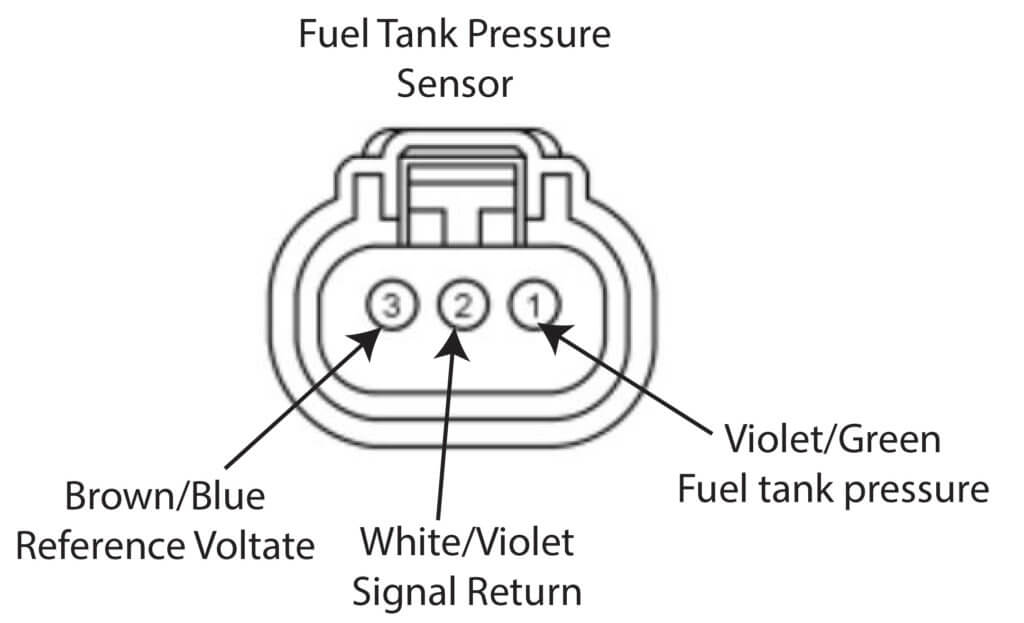
The FTP sensor is located above the fuel tank. Check the Brown/Blue wire for the 5-volt reference. Then check White/Violet wire for ground. The Violet/Green wire should be the same low value as the live data on your scan tool.
If the FTP sensor readings are in the normal range, start the engine and look at the FTP sensor readings to see if the voltage is dropping. If so, disconnect the connector to the purge valve (in the engine compartment). The check the purge valve to see if there’s vacuum on the EVAP side of the valve. There should be no vacuum. If you feel a vacuum, the purge valve is leaking. Replace the purge valve.
Next, check the vent valve.
Supply vacuum to one side of the vent valve. Then, apply/remove power and ground to the vent valve. The valve should open and close and not leak the vacuum or be stuck shut.
The most common causes of Ford P1450
A Leaking purge valve
The purge valve is located in the engine compartment. It’s a solenoid valve and can fail electrically or mechanically. Locate the valve and remove the hoses. Check for the presence of charcoal particles. If you find those, the charcoal canister has ruptured and must be replaced, the hoses flushed, and the valve replaced.
If there are no particles, connect a handheld vacuum pump to the valve and see if it holds the vacuum. If not, replace it.
Stuck closed vent valve
The vent valve allows fresh air into the canister during a purge cycle. If it’s stuck closed during a purge, it will cause a high vacuum reading at the FTP. Check the vent valve inlet for spider nests (yes, they like to build nests there).
2022 Rick Muscoplat
Posted on by Rick Muscoplat