
Do you have to replace a catalytic converter heat shield?
Learn why it’s a good idea to replace a catalytic converter heat shield
If you hear a metallic rattling sound as you drive or notice a piece of metal dangling down around your exhaust, you might be dealing with a failing catalytic converter heat shield. Over time, heat shields corrode, loosen, and sometimes even fall off entirely. Car owners often ask: Do I need to replace a catalytic converter heat shield? Or can I just ignore it and keep driving? Many shops will tell you that you don’t need it and can drive fine without one. But carmakers didn’t install it for kicks. It serves an important purpose. In this article, I’ll explain what the heat shield does and why it’s a good idea to either reattach your old one or replace your catalytic converter heat shield.
What Does a Catalytic Converter Heat Shield Do?
Your catalytic converter gets extremely hot, often exceeding 1,000°F under heavy driving conditions. The heat shield’s purpose is mainly to protect surrounding components from this intense heat, but it also protects the converter itself.
A missing or damaged heat shield can lead to several problems, including:
• Increased Risk of Fire: Without a heat shield, the extreme heat generated by the catalytic converter can ignite flammable materials such as leaves, grass, or debris that may come into contact with the undercarriage of the vehicle. This is particularly hazardous when driving on dry or grassy terrain.
• Component Damage: The absence of a heat shield exposes the vehicle’s undercarriage and nearby components to excessive heat. This can lead to the premature failure of critical parts such as fuel lines, brake lines, and electrical wiring. Repairing or replacing these components can be costly and time-consuming.
• Reduced Passenger Comfort: Heat from the catalytic converter can transfer into the passenger cabin, making it uncomfortable for the occupants, especially during long drives or in hot weather conditions.
• Potential Legal Issues: In some regions, driving without a catalytic converter heat shield may be considered illegal, as it poses a safety hazard. This can result in fines or penalties during vehicle inspections or routine traffic stops.
The Heat Shield Also Promotes Catalytic Converter Efficiency and Protects it From Cold Shock
Helps Maintain Converter Efficiency— The heat shield improves the Catalytic Converter’s Efficiency and extends its life. A catalytic converter works most efficiently in the 800°F to 1,400°F range. So, the heat shield also keeps the heat in to maintain converter efficiency. That’s true, especially in cold weather when snow and ice can splash onto the hot converter, reducing its operating temperature.
Reduces the Likelihood of Cold Shock— Cold shock damage is rare, but a large cold water splash can rapidly lower the temperature, shocking the ceramic structure, and causing it to crack. The heat shield slows down and reduces the amount of cold water that hits the converter as you drive over puddles.
What happens to heat shields? Why do they go missing?
Over time, the heat shield fasteners rust and break off, causing the heat shield to rattle. Once that starts, it’s just a matter of time before all the fasteners break off and the shield falls off the vehicle.

A typical broken off heat shield
Why many shops don’t recommend replacing the heat shield
Many shops tell you not to replace the heat shield. But there’s a practical reason: replacement heat shields are hard to come by. Most car dealers don’t stock OE replacements, so they’re always a special order with long delays. Worse yet, some carmakers don’t even sell the heat shields separately from the catalytic converter, which is insane. Why would anybody spend thousands on a new catalytic converter to get a new heat shield?
Some aftermarket suppliers, like DormanProducts.com, offer direct-fit replacements, but again, most auto parts stores don’t stock them. That’s why shops tell you to forget about the heat shield and be careful not to part over dried leaves and grass.
What are other options for replacing a catalytic converter heat shield?
Several aftermarket companies make universal heat shield products that wrap around the converter or clamp to it.
Heatshield Products makes a wrap-around heat shield that blocks up to 70% of the radiant heat coming off your catalytic converter. The BioCool material can withstand up to 1,800°F. It is easily installed by wrapping it around the converter and securing it with stainless steel ties (included in the kit). The kit costs less than $50, a fraction of the cost of a factory heat shield. Find the replacement heat shield at Sumit Racing.

DesignEngineering also makes an aftermarket heat shield that sells for less than $30. Their universal catalytic converter shield prevents possible fires and is less expensive than replacing the entire converter when all you need is the shield.
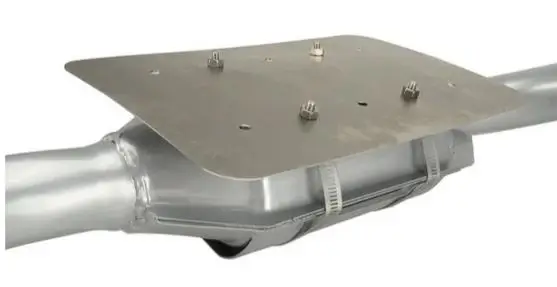 Consider this easy-to-install universal catalytic converter heat shield replacement from DesignEngineering.com. It’s easy to install and fits most converters. Includes all installation hardware and instructions.
• Easily bends to conform to the converter
• Shield measures 12″ x 8″
©, 2024 Rick Muscoplat
Posted on by Rick Muscoplat