
Does a dent puller really work? The truth about dent pullers
A dent puller can work in some situations, but most users aren’t happy with the results
A DIY dent puller can effectively address minor dents and dings on your vehicle. They offer a potentially cost-effective alternative to professional repairs for certain types of damage. However, they are not a magic solution for all dents, and their effectiveness is highly dependent on the nature of the dent and the skill of the user.
Where a DIY puller works and where it doesn’t
DIY dent pullers don’t work on all dents. Before buying one, consider whether your dent is a candidate based on size, location, and vehicle age. Here are the factors to consider.
Assess whether your dent is a candidate
The effectiveness of a puller largely depends on several factors, including the type and severity of the dent, the location of the dent, and the quality of the tool being used. Here are some of the candidates for DIY dent repair
• The dent must be small— These tools are most effective on shallow, smooth-surfaced dents without deep indentations.
• The paint must be in good condition— Neither type will work on dents with scratches or rust.
• The dent can’t have a creased edge around the perimeter—If it does, you may be able to pull out the dented portion, but you’ll still have a sharp line.
• The vehicle can’t be more than ten years old—After that time, the paint has lost its elasticity and will most likely crack as you use the dent puller.
Location of the Dent
The location of the dent also plays a crucial role in determining the effectiveness of a dent puller. Dents on flat, accessible car body areas, such as the hood, roof, or doors, are candidates for repair with DIY dent puller. On the other hand, dents located near the edges of panels, on complex curves, or in hard-to-reach areas are almost impossible to fix with a dent puller.
Quality of the Tool
Not all dent pullers are created equal. High-quality tools are more effective and easier to use than cheaper, low-quality ones. Investing in a well-reviewed, reputable dent puller can significantly increase the chances of successfully removing a dent.
Learn the pros and cons of the two types of dent pullers
• Suction Cup Design—This type uses a suction cup to adhere to the surface of the dent and pull it out. It is best suited for large, shallow dents on flat surfaces, which are usually rare except for the roof, hood, and truck.
Pros—They’re inexpensive and can work on large dents
Cons— • The suction cups are too large for small dent repair.
• The cups usually pop off the paint when performing a hard pull.
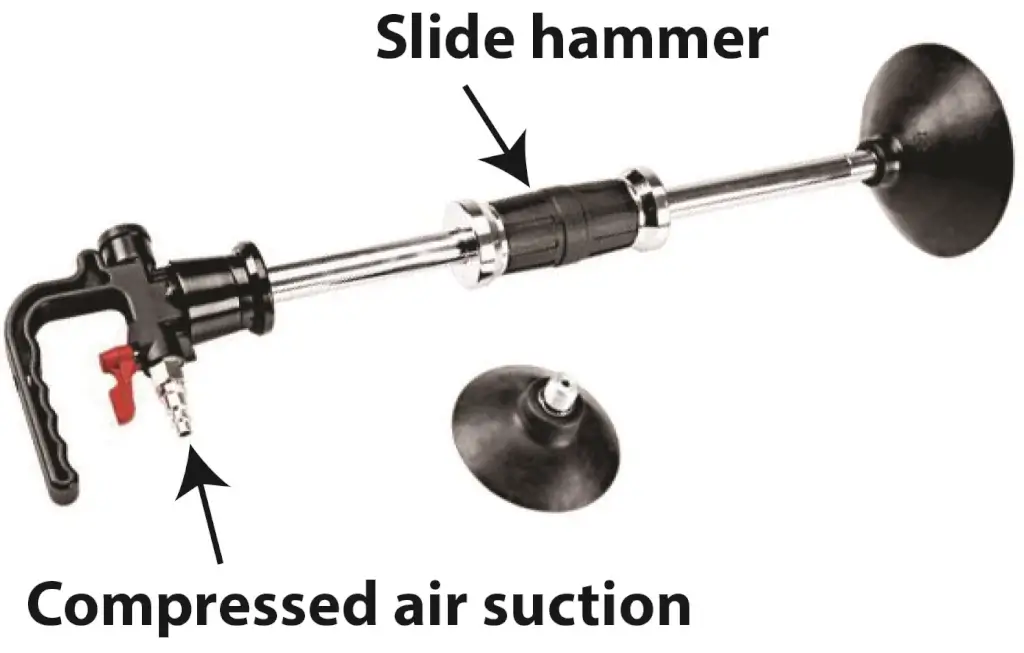
Air-operated suction cup dent puller and slide hammer from Harbor Freight
• Glue Tab Design— These tools involve using a glue tab that sticks to the dented area. A pulling mechanism, often a slide hammer or a bridge puller, pulls the dent out. Glue dent pullers are more versatile and can work on various dent sizes and shapes.
Pros— • When used as recommended, they can gently pull out a small dent in stages. However, they can’t remove a crease
Cons— • Cleaning off all wax is critical. If there’s any residual wax on the paint, the glued on puller will pop off.
• Even if you prep the paint properly, the puller will pop off if you use too much force.
• This puller works in stages, so you’ll use a lot of glue and a lot of pullers.
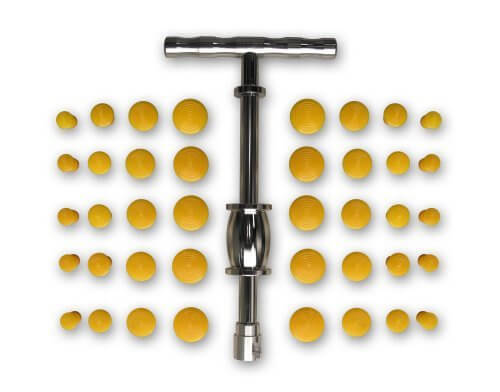
Typical glue-on dent puller with a slide hammer.

This is a bridge puller. Glue on the tips, load into the puller, and apply pressure to the handles. You can’t do a single pull in the middle of the dent. This tool is designed to lift small sections all around the dent.
Tips for using a DIY dent puller
1) Don’t rush through the cleaning process— The suction cup or glue tabs have to stick to the paint and then can’t stick if you haven’t removed all the wax. Follow the directions on the wax remover product to get the best sticking power.
2) It takes practice— Most DIYers apply too little force to a slide hammer tool on their first try. After not getting any results, they go to the opposite extreme and slam the hammer back, pulling the dent out too far and creating an entirely different problem.
The opposite happens with the bridge dent puller design. DIYers try to pull the entire dent out with a single pull, which pops the tab off the paint.
Using too much or too little force can worsen the dent and damage the paint, resulting in a more expensive professional repair.
3) It takes patience— Avoid the temptation to pull the dent out in a single pull. Follow the directions that come with the tool and pull in small sections.
4) Know when to throw in the towel— If you’re not getting the results you want, stop. Don’t make it worse by continuing.
Will You Be Happy with the Results?
If the dent puller is used as directed and on a suitable dent, you can get an acceptable result. It’ll never be the same as a professional repair, but it can be close. However, you’ll still notice the repaired area. If you can live with that, go for it.
©, 2015 Rick Muscoplat
Posted on by Rick Muscoplat