
Does Premium Gas Last Longer? Myths vs. Facts
Does Premium Gas Last Longer in Your Tank?
Quick Summary
• Premium gas does NOT last longer than regular gas.
• Premium gas does NOT contain more detergent than regular gas from the same brand.
• Premium gas does NOT improve fuel economy unless your engine specifically requires high octane.
Article
I’ll walk you through the science behind octane, detergent standards, and combustion efficiency so you know exactly when premium fuel is worth the extra money.
As an automotive expert, I’m constantly asked: Does premium gas last longer in storage than regular gas? The answer is simple—no. Both fuels degrade at the same rate because the shelf life of gasoline is determined by its chemical composition and storage conditions, not its octane rating.
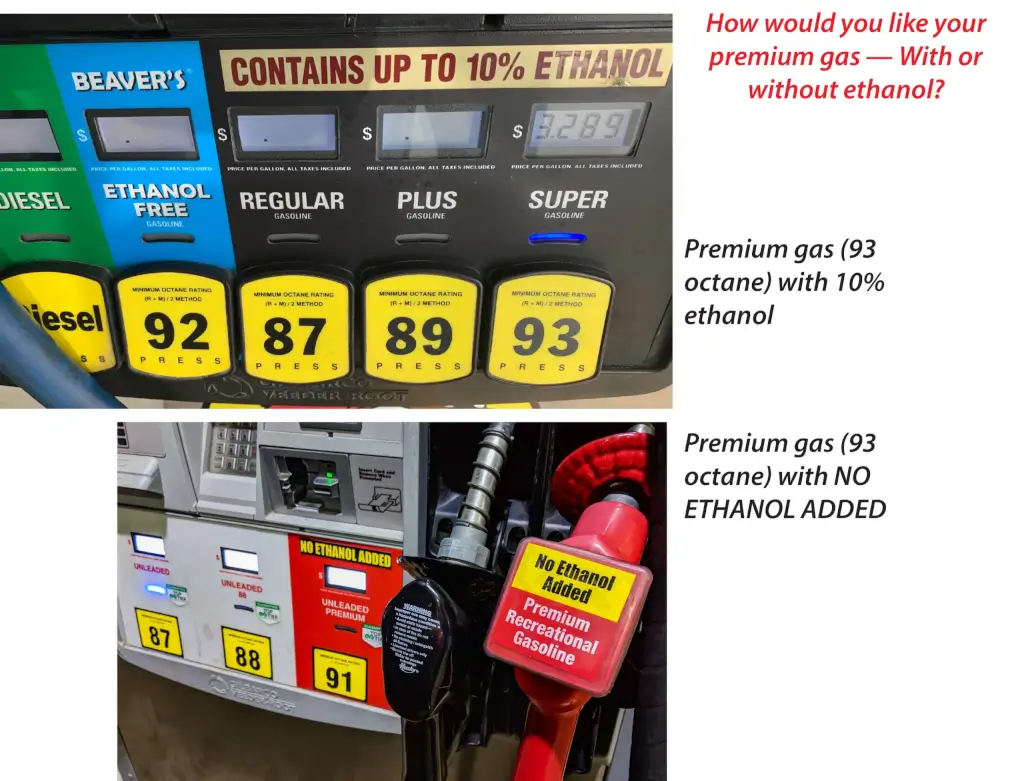
Not all premium gas is ethanol-free
Gasoline begins to oxidize and absorb moisture within 30–45 days, especially when ethanol is present. The octane rating (87 vs. 91–93) has zero impact on how quickly gasoline breaks down. So when people ask, “Does premium gas last longer?” they’re mixing up octane with fuel chemistry. Premium fuel is merely more resistant to knock, not more resistant to aging. Whether it’s premium or regular, the fuel will degrade at the same speed unless a stabilizer is added.
This means if you’re storing equipment—like a lawn mower, generator, or classic car—using premium gas doesn’t buy you more storage time. I
Detergent Levels — Does Premium Gas Have More Detergent?
Another common misconception is that higher octane gas is automatically “cleaner.” So let’s tackle the question: Does premium gas have more detergent than regular gas? The answer: not usually.
All gasoline sold in the U.S. must meet the EPA minimum detergent requirement, regardless of octane. That means the same station’s 87, 89, and 93 octane fuels typically have the same detergent package. So, premium gas does not have more detergent than regular.
Some brands—especially TOP TIER brands—add extra detergents to all their fuel grades, not just their premium grades. Others add a slight premium as a marketing distinction. But this varies by brand, not by the octane rating itself. So you can’t extrapolate the detergent content of one brand’s premium gas to conclude that all premium gas contains more detergent.
Fuel Economy — Does Premium Improve Mileage?
Many drivers assume premium fuel will give them better MPG. But unless your vehicle was engineered to run on high-octane fuel, it won’t.
Engines designed for 87 octane gain no fuel-economy benefit from premium, because the engine’s compression ratio, ignition timing, and knock-control strategy are optimized for regular fuel. Adding premium doesn’t change those calibrations.
Premium’s only job is to prevent knock in high-compression or turbocharged engines that require it. In the right engine, premium prevents timing retard, ensuring peak efficiency. But in an 87-octane-rated engine, you will not see a mileage boost.
So if you’re hoping that premium fuel answers the mileage mystery, thinking that premium gas lasts longer or burns slower, the truth is it won’t. Fuel economy is determined by engine design—not octane rating.
Storage Myths — Does Premium Gas Make Small Engines Run Better?
Another misunderstanding is that premium gas keeps small engines cleaner or helps them run longer in storage. Again, this goes back to the misconception that premium lasts longer. Ethanol content and oxidation rate determine fuel stability—not octane.
This means premium fuel will gum up a carburetor just as quickly as regular if left sitting.
What actually helps:
• Non-ethanol gas
• Quality fuel stabilizer
• Keeping tanks full to reduce air exposure
• Storing your gas in a metal container to avoid the permeation that occurs in plastic gas cans.
Octane has nothing to do with how long fuel remains fresh.
When Premium Gas Is Worth It
There are situations where premium fuel is the right choice—just not for the reasons many assume. You should use premium when:
• Your owner’s manual explicitly states 91+ octane required
• You have a turbocharged or high-compression engine
• You experience knocking or pinging under load
Final Word — What You Should Actually Do
Here’s the practical takeaway:
• Does premium gas last longer? — No. Same shelf life as regular.
• Does premium gas have more detergent? — Not automatically. Depends on the brand.
• Does premium fuel improve mileage? — Only in engines specifically designed for it.
If your car recommends 87 octane, stick with it. You’ll get the same detergents, the same MPG, and the same storage life—without paying extra.
© 2012 Rick Muscoplat
Posted on by Rick Muscoplat