
Fuel System Cleaning Service Recommended by shop: Worth it?
Are Fuel System Cleaning Services and Air Induction Services a Scam? Here’s the Truth
I’ve been in this industry long enough to spot a gimmick when I see one. If you’ve ever taken your car in for an oil change and been pitched a fuel system cleaning service, a fuel induction service, or an air induction service, you’re not alone. Shops push these services hard, but the truth is, most of the time they’re completely unnecessary—and not even recommended by your car’s manufacturer.
They’re pitched as a preventative service to keep your fuel injectors running properly. Unless you have an engine performance problem that has been diagnosed as fuel-related, these are unnecessary services, often referred to in the trade as ‘wallet-flushing’ services. The service writers push these services because they get a bonus spiff for every one they sell.
In addition to fuel system cleaning service, shops also recommend air induction service and engine flush services. Read on to find out when to say no to these wasteful services.
Routine fuel system cleaner service is never worth it
Let me be blunt—not a single carmaker recommends a routine fuel system cleaning service as part of regular maintenance. Not one. In fact, several automakers have issued technical service bulletins telling dealerships not to perform these services unless there’s a specific, diagnosed problem.
Here’s the bottom line on fuel system cleaner: It’s never needed unless you are experiencing a performance issue that has been diagnosed as clogged or carboned fuel injectors. Even then, fuel injector cleaning has limited value. In cases of severe clogging, the cleaner won’t resolve the issue, and the injectors must be replaced.
If the dealer or shop recommends a fuel system cleaner service, ask them why and ask them to show you where that service is listed in your owner’s maintenance guide, because it isn’t.
If you really want to add a fuel system cleaner service, consider adding a bottle of Chevron Techron to your tank.
The Dealer Push for Fuel System Cleaning Service — Call Them Out
If your dealer or shop recommends a fuel system cleaning service, ask them a straightforward question:
“Can you show me where this is listed in my owner’s manual?”
I guarantee it’s not there. Because it doesn’t exist as part of the manufacturer’s maintenance schedule, it’s pure profit for the shop.
Always say no to engine flushing or “oil conditioning” service
The Engine Flush Scam: Stay Away
Right alongside the fuel system cleaning service, shops often push engine flushes or “oil conditioning” services. Let me be crystal clear: engine flushes are never recommended, even for engines with sludge. The only safe fix for sludge is more frequent oil changes with high-quality oil. An engine flush risks loosening large deposits that can clog oil passages and do real damage.
What Is an Air Induction Service?
An air induction service is designed to clean carbon buildup from the intake system, specifically the throttle body, intake runners, and the backside of intake valves. This is especially relevant on engines prone to carbon buildup, like gasoline direct injection (GDI) engines.
It usually involves spraying a chemical solvent directly into the intake system while the engine is running, allowing the solvent to dissolve carbon deposits.
When Is an Air Induction Service Needed?
This is the one area where things get nuanced. Some gasoline direct injection (GDI) engines—especially those from Audi, VW, and BMW—are prone to carbon buildup on their intake valves. That’s because GDI doesn’t spray fuel over the intake valves, so nothing is washing them clean.
Carbon buildup on the intake valves is due to crankcase blow-by and oil vapors that are routed back into the engine through the positive crankcase ventilation system (PCV). The soot and oil deposits are deposited on the backside of the intake valves. Audi, VW, and BMW vehicles are known to have more carbon buildup problems than Asian or Domestic engines due to the design of their PCV system. If you don’t own one of those vehicles, you’re less likely to accumulate carbon buildup.
Most air induction service jobs involve spraying a chemical into the intake. It may reduce some buildup, but the results are inconsistent.
The most effective solution for severe carbon buildup is walnut blasting, where the intake manifold is removed and crushed walnut shells are blasted directly onto the valves to clean them thoroughly.
Should You Ever Agree to an Air Induction Service?
Here’s my professional advice:
If your engine has been diagnosed with carbon buildup (causing poor acceleration, misfires, or hard starts), then a spray air induction service is worth a try. However, it’s far less effective (and less costly) than walnut shell blasting, which is the Gold Standard.
If your car is running fine, reject any offer of a routine air induction service. It’s a waste of your money.
However, some companies make a liquid cleaning method where the solvent is administered into the intake and left to soak. These chemical treatments have yielded mixed results.
If your engine has poor starting, poor acceleration, and misfires, AND it has gasoline direct injection, you may have carbon buildup on the intake valves. If the problem has been diagnosed as carbon, consider chemical cleaning. But you should reject routine air induction service.
How to Perform an Air Induction Service at Home
Tools and Supplies Needed:
• A can of spray throttle body cleaner and clean soft rags
• A screwdriver and socket set to remove intake hose clamps and the throttle body.
• A new throttle body gasket from the auto parts store.
• A shop manual with torque specifications for the throttle body bolts
• A can of intake system cleaner (e.g., CRC Intake Valve & Turbo Cleaner)
• Safety glasses and gloves
• A helper (optional but helpful)
Step-by-Step Guide to Cleaning a Carboned Throttle Body
1) Remove the air duct leading from the air filter box to the throttle body.
2) If the throttle body has cooling hoses running to it, clamp them off

CRC brand throttle body cleaner
with hose clamps to prevent losing engine coolant.
3) Disconnect the electrical connector to the throttle body and put it aside.
4) Remove the throttle body bolts and remove the throttle body.
5) Spray the throttle body cleaner on a rag and wipe off the carbon on the front and back of the throttle bore as well as the throttle plate. NEVER spray the cleaner directly onto the throttle plate. The liquid can wick down the throttle plate shaft and into the electronics, causing extensive and expensive damage.
6) Once clean, install a new throttle body gasket and reinstall the throttle body, paying attention to the proper torque.
7) Reconnect any vacuum or coolant lines you disconnected.
8) Perform a throttle body relearn procedure listed in the shop manual.
Step-By-Step DIY Air Induction Service:
1) Locate the Mass Airflow Sensor (MAF)— It can be connected to the air filter box cover or in the air duct leading from the air filter box to the throttle body.
2) If the MAF is located in the air duct leading from the air filter box to the throttle body, remove the hose clamps and the duct, allowing access to the MAF sensor.
3) Follow the directions on the can of CRC Intake Valve Cleaner by locating the straw of the spray can past the sensing elements in the MAF. The point here is to inject the cleaner into the engine without spraying it on the sensing elements in the MAF.
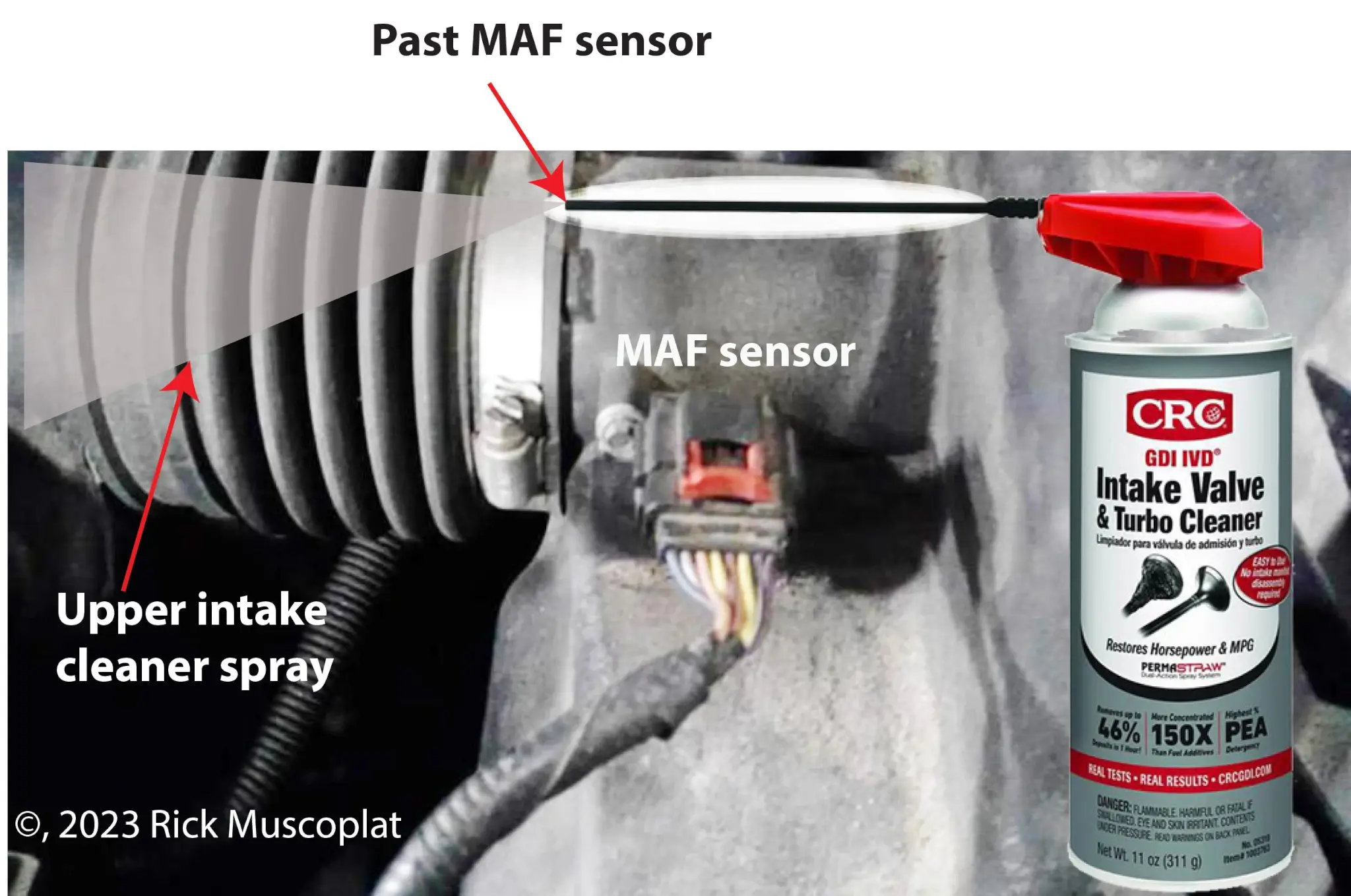
Do NOT spray anything onto the MAF sensor sensing element—The spray can damage it. Insert the straw past the sensing elements
4. Start the engine and raise the idle to the RPM listed in the directions. Spray the Cleaner in short bursts according to the direction. This is a critical step, and failure to follow these directions can cause damage to the catalytic converter.
5. Use the Whole Can— Apply the entire can evenly over several minutes to prevent staling.
6. Soak Time (If Applicable)— Some cleaners recommend shutting the engine off after spraying to let the chemical soak on the carbon deposits for 10–15 minutes.
7. Rev and Clear Out— Restart the engine after soaking.
8. Test Drive— Take the car for a spirited 10–15 minute drive to fully clear out remaining debris.
Risks of DIY Air Induction Service
If done incorrectly, liquid cleaner can damage the catalytic converter and possibly cause hydrolock (liquid entering the cylinders).
NOTE: On heavily carboned engines, this method has limited effect. It won’t clean thick carbon deposits on intake valves like walnut blasting can.
© 2024 Rick Muscoplat
Posted on by Rick Muscoplat