
Get the Facts on Serpentine Belt Replacement Cost
Understanding Serpentine Belt Replacement Costs: What You Need to Know
The serpentine belt powers engine accessories like the alternator, power steering pump, air conditioning compressor, and sometimes even the water pump. Given its importance, understanding the costs associated with serpentine belt replacement can help you budget effectively and ensure your vehicle remains in top condition. Here’s a detailed look at what you need to know about serpentine belt replacement costs.
Serpentine belt replacement cost variables
Single versus multiple belts
Some engines use a single serpentine belt to drive all the accessories, while other engines use a serpentine belt for some accessories and a second or third polygroove belt to drive other accessories. In cases where the engine has a serpentin and a polygroove belt, the polygroove belt must usually be removed before the technician can access the serpentine belt. In those cases, the labor costs are a bit higher due to the time required to remove and reinstall the second belt.
Engine size, configuration, and space variables
In some engine designs, there’s so little space available that the technician must support the engine and disconnect an engine mount to access the serpentine belt. In those applications, the serpentine belt replacement cost is considerably higher than in cases where the belt is out in the open.
Serpentine Belt Replacement Cost: Why You Can’t Trust The Internet
If you do an Internet search for serpentine belt replacement cost, you’re likely to find a J.D. Power result at the top of the list. Here’s what they say about the average cost to replace a serpentine belt:
“The average cost for serpentine belt replacement is between $109 and $134. Labor costs are estimated between $57 and $72, while parts range between $52 and $62” — jdpower.com
Let’s see how accurate that is by using actual vehicles. Let’s assume you replace a serpentine belt every 100,000 miles. At an average of 10,000 – 12,000 miles per year, we should be looking at 8-10-year-old vehicles (computed in Fall 2024). We’ll use independent shop and dealer labor rates of $140/hr and $185/hr. Respectively.
2014 Honda Accord with a 2.4 4-cylinder engine. Labor .4 hrs Belt Cost 118$62.20
Independent shop labor $56+ $62.20= $118.2 . Dealer shop labor $72 + $62.20= $134.20.
2014 Nissan Altima 3.5L 6-cylinder engine. Labor .6 hrs. Belt Cost $53.05
Independent shop labor $84+ $53.05= $137.05 . Dealer shop labor $111 + $53.05= $164.05.
2014 Toyota Yaris 4-cylinder engine. Labor .7 Belt Cost $29.35
Independent shop labor $98+ $29.35= $127.35 . Dealer shop labor $129.51 + $29.35= $158.85.
Serpentine Belt Cost Results
In the example above, the average serpentine belt replacement cost at an independent shop is $126.53, while the average cost at a dealer is $152. So the J.D. Power estimate is off by about 13% too low.
The surprise in this example is the Toyota Yaris, which is a pretty small engine, yet comes in with the highest labor cost because it doesn’t have automatic belt tensioner, requiring more labor to install and then tensioner manually.
What is a Serpentine Belt?
All about ribs and backing
Any belt with multiple ribs is called a polygroove belt, but not all polygroove belts are serpentine belts. To qualify as a serpentine belt, it must wind through multiple pulleys, driving some with the ribbed portion and other pulleys with the flat backside of the belt. To perform well on both sides, a serpentine belt has a durable fabric backing on the backside to withstand the friction and wear generated when driving pulleys from the backside.
A polygroove belt, on the other hand, is usually designed to drive one or two pulleys only from the ribbed side. To the naked eye, polygroove and serpentine belts look the same, so it’s understandable that they’re often mistaken for one another. However, if you examine the fabric backing, you’ll see that the serpentine belt is more substantial.
Serpentine Belt Construction
A serpentine belt is constructed with

Gates aramid serpentine belt
specific rubber compounds, a fiber cord, and a fabric backing. First generation serpentine belts were built with neoprene rubber that has an average life of only 30,000 miles. It was easy to judge its end of life simply by checking for cracks in the ribs.
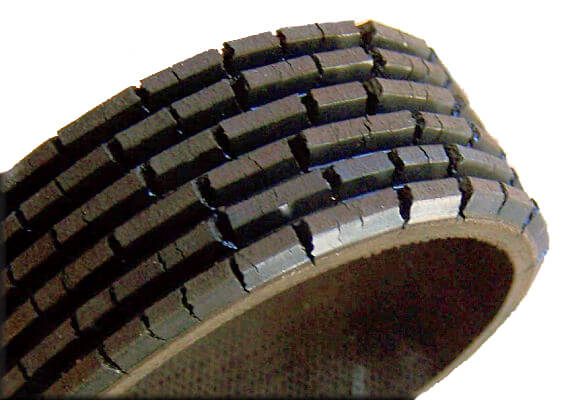
This neoprene belt is worn out. Notice the high number of cracks in the ribs
However, starting in the 2000 model year, carmakers switched to a newer style belt made with ethylene propylene diene monomer (EPDM). EPDM serpentine belts last about 100,000 miles and don’t crack like the older neoprene belts, so it’s much harder to judge their condition. You must use a wear gauge to measure the rib height or simply replace it at 100,000 miles.
Why Replace the Serpentine Belt?
Over time, serpentine belts can wear out due to friction, exposure to engine heat, and general wear and tear. A damaged or worn belt can lead to serious engine problems or leave you stranded if it breaks. Regular inspection and timely replacement are essential to avoid potential breakdowns and ensure your vehicle’s components function properly.
What else should you replace at the same time?
Most engines use a spring-loaded automatic belt tensioner, which typically lasts 100,000 miles. Therefore, it makes sense to replace the belt and tensioner at the same time.
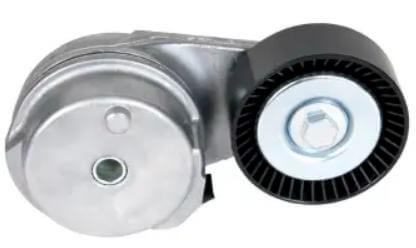
Typical spring-loaded serpentine belt tensioner
©, 2024 Rick Muscopla
t
Posted on by Rick Muscoplat