
How a turn signal flasher works
The Inner Workings of a Turn Signal Flasher
A turn signal flasher, also known simply as a flasher, is an electronic device in a vehicle’s electrical system that controls the operation of the turn signal lights. It makes the lights flash on and off at a consistent rate, signaling the driver’s intention to turn or change lanes. Here’s a breakdown of how a turn signal flasher works:
It’s easy to understand how a modern solid-state turn signal flasher words; it’s just a power transistor that opens and closes the circuit to the turn signals. However, many people wonder how the older mechanical (or thermal) turn signal flashers worked. They were mechanical switches that switched power to the turn signal bulbs using a bimetallic strip of metal and a heater. They are called thermal flashers because they rely on a heater and a bimetallic strip to operate.
How a thermal turn signal flasher works
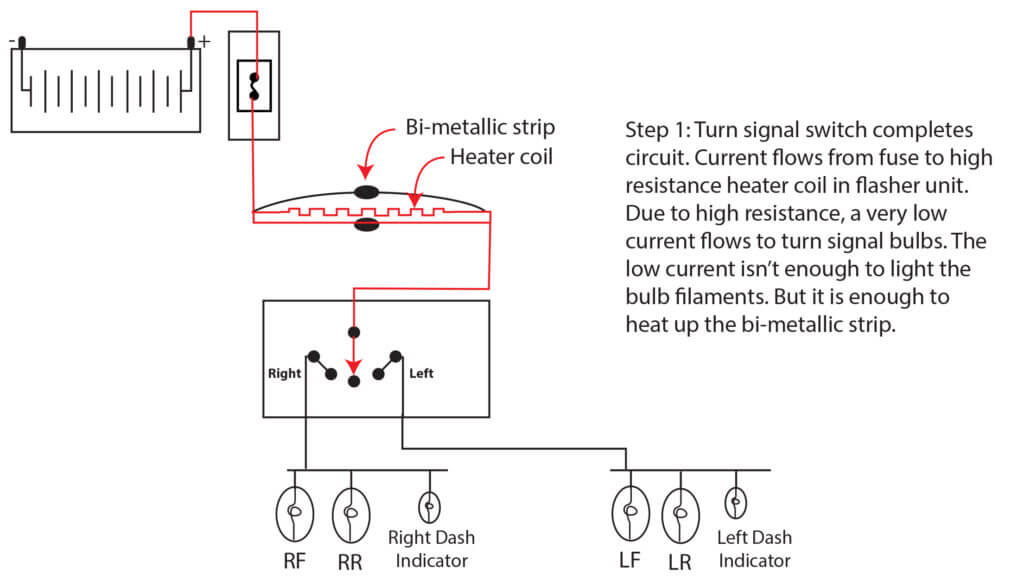
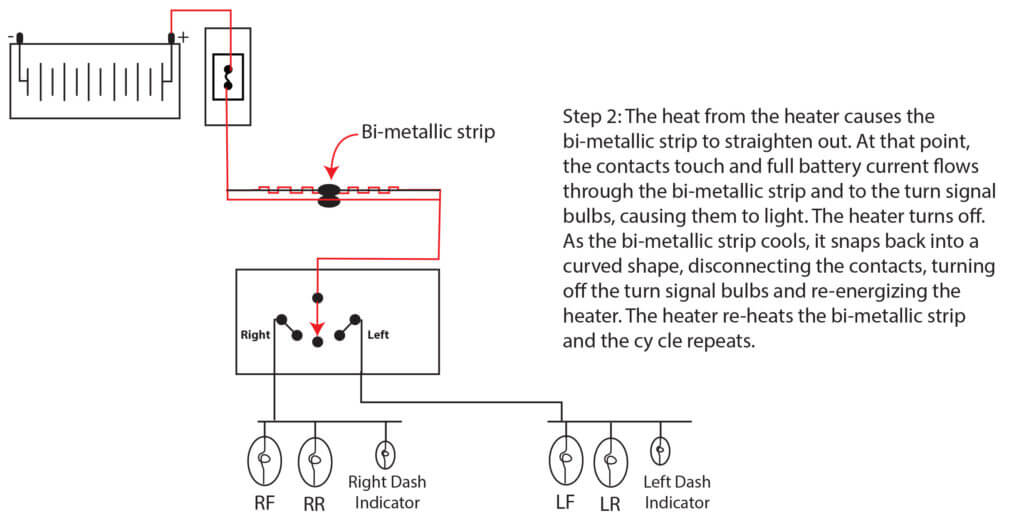
The bi-metallic strip contains electrical contact and is in a slightly curved shape when it’s not on. When you operate your turn signals, power flows through the heater in the turn signal and through the turn signal bulbs. Since the heater is a very high resistance wire, the current flow to the bulbs isn’t enough to light them. But the current flow through the heater IS enough to heat up the bi-metallic strip. Once heated, it changes shape and flattens out. That’s when the contacts touch, and full current flows to the turn signal bulbs, causing them to light up.
While they’re lit, the current bypasses the heater, and it shuts off, causing the bi-metallic strip to cool. As it cools, it “snaps” back to its curved shape. The snapping action is what causes the click.
What causes turn signals to flash fast?
When a turn signal bulb burns out, less current flows through the mechanical flasher, so the bi-metallic strip cools faster and snaps back to its original shape faster. So, the on/off cycle runs much faster when even just one bulb is burned out.
An electronic flasher mimics the operation of a mechanical flasher by flashing faster when it detects a lower current draw due to a burned-out bulb.
©, 2018 Rick Muscoplat
Posted on by Rick Muscoplat