
How ABS Brakes Work: A Detailed Explanation
The Science Behind How ABS Brakes Work
ABS brakes work by monitoring the wheel revolutions and detecting when one or more wheels are rotating slower than the others, indicating that it’s about to lock up and skid. In that case, the ABS controller module commands the valves in the hydraulic unit to release brake pressure to that wheel until it sees it rotating again at the same speed as the others. Then, it applies pressure to that wheel again. This release/apply cycle repeats multiple times per second, increasing friction with the road, while preventing skidding.
ABS braking operates on the theory that a tire provides the most friction when the brakes slow its rotation, not when the brake lock up the tire
A tire creates the most friction with the road when the brakes slow it down. The instant the wheel locks up, and the tire begins to skid across the pavement, it loses most, if not all, its traction with the road. When a wheel/tire locks up and skids, it’s effectively running on molten rubber, which provides no friction and no stopping power.
So, the goal of an ABS system is to monitor the rotational speed of all the tires and sense when one or more wheels are slowing more than the others. Because the slowing wheels will lock up if left in the current state.
Components of an ABS
• Wheel Speed Sensors— The sensors are located at each wheel and monitor the rotational speed of the wheels. They provide real-time data to the ABS control module.
• ABS Control Module— This control module processes the rotational data from the wheel speed sensors, analyzes it, and determines which wheel is about to lock up and what corrective actions are appropriate based on vehicle weight and speed.
• Hydraulic Control Unit— The hydraulic modulator consists of a series of solenoid-operated valves that control the brake fluid pressure to each wheel. It can increase, decrease, or maintain pressure based on signals from the ABS control module. The pump provides the additional pressure needed to rapidly pump the brakes
The wheel speed sensors
ABS equipped vehicles have a wheel speed
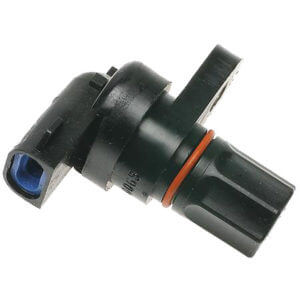
Wheel speed sensor
speed sensor at each front wheel and either a single sensor for both rear wheels (on a rear wheel drive vehicle) or an individual sensor on each rear wheel. The wheel speed sensor contains a magnet that detects the movement of teeth on a rotating “tone ring.” The sensor
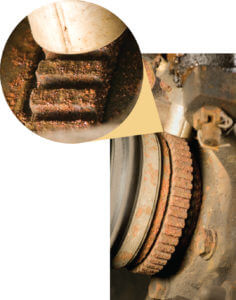
Notice the proximity of the wheel speed sensor to the tone ring
creates a voltage as the tooth approaches, and the voltage drops as the tooth passes past the sensor. The ABS brake module compares the rotation speed from each wheel speed sensor to determine which wheel is about to lock up.
The hydraulic unit is what releases and applies brake pressure to the wheels.
The hydraulic control unit sits between the master cylinder and the brake calipers and wheel cylinders. The fluid circuit to each wheel has a “dump valve” to release brake fluid pressure and an “apply valve” to re-apply brake fluid pressure. The pump supplies the additional fluid pressure needed to reapply the brakes after the dump valve releases pressure. The valves are opened and closed by an electric solenoid. The pump supplements the driver’s brake pedal pressure during periods of ABS operation.
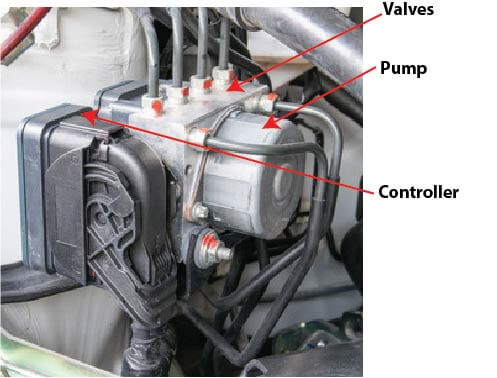
ABS Hydraulic Control Unit
What goes wrong with ABS brakes?
Since each wheel speed sensor is mounted directly to the wheel spindle, it is subject to harsh conditions like rain, snow and road debris. In addition, the sensor is connected to the control unit by a wiring harness that must flex up and down and turn left and right with the wheel movement. So, sensor and wiring harness failures cause the most frequent problems with a vehicle’s ABS system.
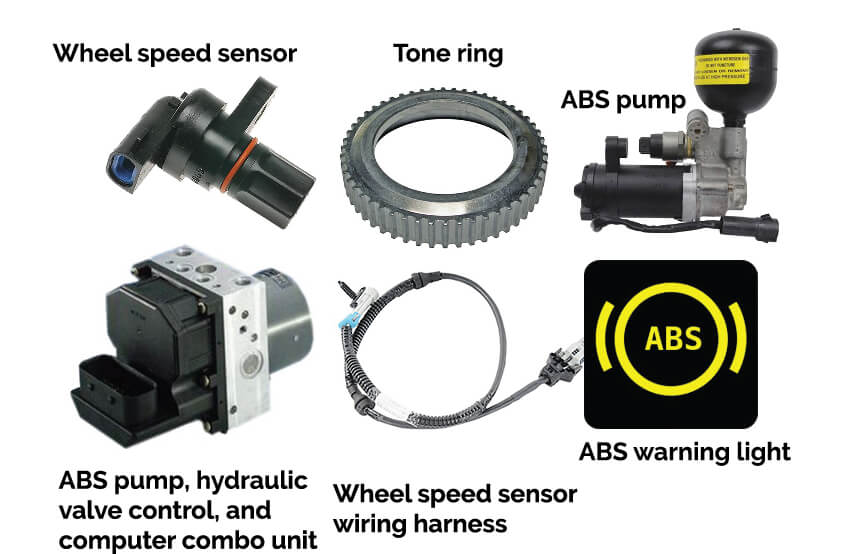
ABS components
The wheel speed sensor must also be separated from the tone ring by a specified gap. As a tone ring rusts, the gap changes, which can cause a fault code to be set in the ABS controller, which turns on the ABS warning light. The gap can also be affected by debris buildup on the magnetic wheel speed sensor.
Pump and valve failures are less common but far more costly to repair. However, these units can be rebuilt for a fraction of the price of a new part. If your HCU fails, search for an ABS rebuilder online and send yours off to be rebuilt. The difference in price between new and rebuilt is staggering: $200 versus $2,200. Modulemasters.com is one ABS HCU rebuilder.
The control module contains the solenoid coils and those too can fail, along with the power drivers mounted on the circuit board. Several companies offer ABS control module rebuilding services, and, like HCU rebuilding, control module rebuilding saves a lot of money over replacement.
What does an ABS light on mean? Read this post for more information
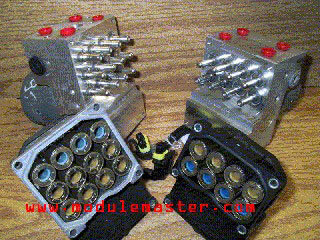
Rebuilt ABS HCU
©, 2018 Rick Muscoplat
Posted on by Rick Muscoplat