
How an Auto Immobilizer Anti-theft SystemWorks
Auto Immobilizer Explained: Modern Vehicle Theft Protection
Quick Summary
Modern vehicles use an auto immobilizer system that consists of a transponder key and an antenna coil/exciter ring mounted on the lock cylinder. Once powered by the exciter ring, the key transmits a digital code to an antenna, which is then checked by the ECM and Body Control Module. If the code is correct, the system will allow the engine start. If not, it will prevent engine cranking or will allow the engine to crank, but won’t allow the fuel injectors to fire.
Article
How Anti-Theft Car Immobilizers Work
I’ve diagnosed countless no-start conditions over the years, and one of the most misunderstood systems is the auto immobilizer. People assume it’s complicated magic. It’s not magic—but it is clever engineering.
An auto immobilizer is the electronic gatekeeper between your key and your engine. It’s a core component of the modern car anti-theft system, and without it, vehicle theft would still be as simple as twisting wires together under the dash.
Let’s break down exactly how it works.
The Role of the Transponder Key
At the center of every modern car anti-theft system is the transponder key.
Inside the plastic head of that key is a tiny RFID (radio-frequency identification) chip and a coil of wire. That chip does not use a battery in most traditional designs. Instead, it’s energized by an electromagnetic field generated by the exciter module mounted on the lock cylinder.
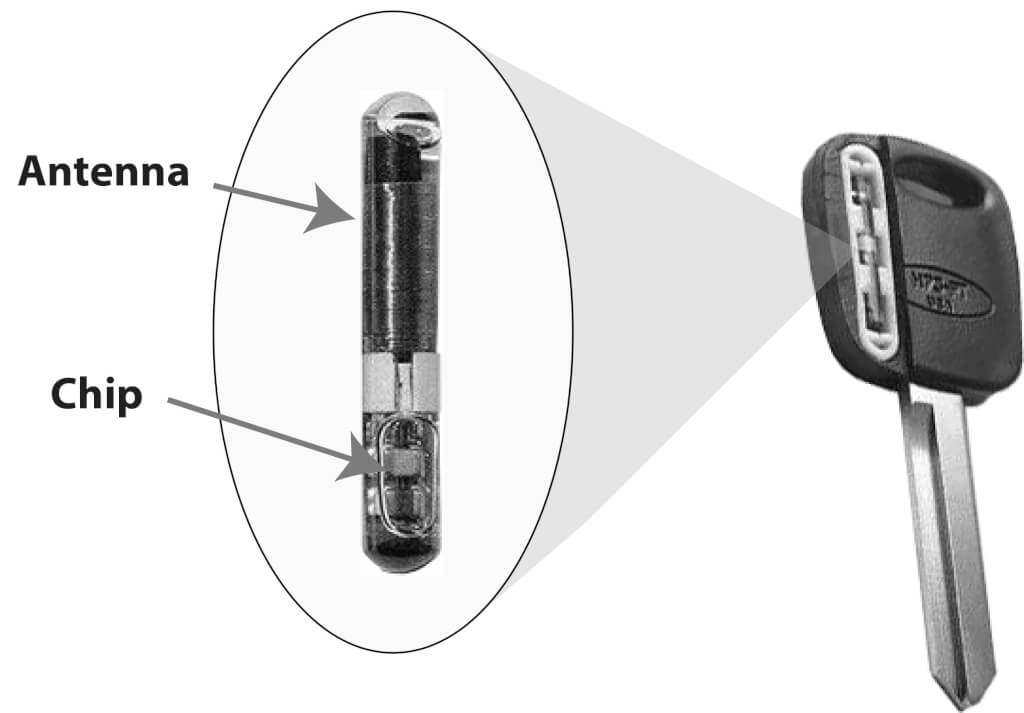
The antenna inside the key picks up the magnetic field emitted by the exciter module and uses that power to run the chip. Once powered, the chip transmits the digital signal back to the exciter module or another antenna, new to the lock cylinder.
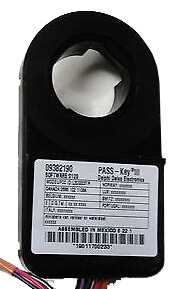
The theft deterrent exciter surrounds the lock cylinder entrance and generates an “exciter” signal and then reads the key’s response code
That’s the beginning of the handshake.
How the Auto Immobilizer Reads the Key
The antenna ring around the ignition lock cylinder (or near the push-button start module) acts as both a transmitter and receiver. It sends out a signal and then listens for a reply from the transponder key.
The returned code is sent to the auto immobilizer control module. In some vehicles, the immobilizer function is built directly into the body control module (BCM) or the engine control module (ECM). In others, it’s a standalone module.
Here’s what happens next:
The module compares the received code from the transponder key to a list of authorized codes stored in memory.
If the code matches, the car’s anti-theft system gives permission to start.
If the code does not match, or no code is received, the immobilizer blocks engine operation.
That comparison happens in milliseconds.
What the Vehicle Does With That Information
This is where the auto immobilizer earns its keep.
If the code from the transponder key is correct, the immobilizer communicates with the ECM over the vehicle’s data network, usually CAN bus.
Once validated, the system enables critical functions:
Fuel injector pulse
Ignition coil firing
Starter relay activation (in some designs)
Fuel pump operation
Without that authorization from the car anti-theft system, the ECM simply refuses to deliver fuel or spark.
In many cases, the engine will crank but not start. In other designs, the starter won’t even engage.
The system is designed so that bypassing the ignition switch alone won’t start the vehicle. That’s why old-school “hot-wiring” doesn’t work on modern cars equipped with an auto immobilizer.
Encrypted Rolling Codes and Security Layers
Early immobilizer systems used fixed codes. That made them vulnerable to duplication.
Modern car anti-theft system designs use encrypted rolling codes or challenge-response authentication.
Here’s how that works:
• The vehicle sends a random challenge signal.
• The transponder key uses an encryption algorithm to generate a response.
• The immobilizer verifies that response using the same encryption logic.
• This means even if someone intercepts the signal once, it won’t work again.
• That encryption is what makes today’s auto immobilizer systems extremely difficult to defeat without advanced equipment.
Common Failure Modes I See in the Shop
From a diagnostic standpoint, problems with a transponder key or auto immobilizer can mimic other no-start issues.
Here are common real-world failures:
• Damaged or water-soaked transponder key
• Aftermarket remote start installation errors
• Weak antenna ring around ignition cylinder
• Dead key fob battery (on proximity systems)
• Lost programming after module replacement
When the car anti-theft system fails, you’ll often see a flashing security light on the dashboard. That indicator is your first clue that the immobilizer is blocking engine operation.
I always check the scan data first. Most vehicles will store a B-code (body control fault) indicating “Key Not Recognized” or “Immobilizer Active.”
Push-Button Start and Proximity Systems
Modern vehicles without a traditional key still use a transponder key—it’s just embedded in the key fob.
In these systems, antennas located inside the cabin detect whether the fob is present. The auto immobilizer verifies its encrypted code before allowing the engine to crank.
Even if you force the steering column or access the starter circuit, the car’s anti-theft system won’t authorize fuel injection unless the validated transponder key is present.
It’s the same logic—just wireless.
Why Immobilizers Are So Effective
Vehicle theft rates dropped dramatically once the auto immobilizer became standard equipment in the late 1990s and early 2000s.
The reason is simple:
• You can physically access the ignition wiring.
• You can force the steering column.
• You can even replace the ignition switch.
But without the correct transponder key, the car’s anti-theft system won’t allow the ECM to run the engine.
It’s electronic authorization—not mechanical control—that protects the vehicle.
Final Thoughts
The modern auto immobilizer is one of the most effective security systems ever installed in production vehicles. By using encrypted communication between the vehicle and the transponder key, the car anti-theft system ensures that only an authorized key can enable fuel, spark, and starting functions.
Understanding how the vehicle reads the transponder key and what it does with that information makes diagnosing immobilizer-related no-start conditions far less intimidating.
©, 2026 Rick Muscoplat
Posted on by Rick Muscoplat