
How Auto Air Conditioning Works — A Layperson’s Guide
Auto AC System Explained for Beginners
Quick Summary
• Auto air conditioning doesn’t create cold—it removes heat from the cabin
• The system works by circulating refrigerant through a closed loop
• Key components include the compressor, condenser, evaporator, and expansion device
• Understanding how auto air conditioning works helps you diagnose problems faster
• Most AC failures are caused by leaks, airflow issues, or component failure
• How Does Auto Air Conditioning Work in a Car?
Here’s the simplest way I explain it after years of fixing these systems: Auto air conditioning works by moving heat out of your car—not by creating cold air. That’s the key concept most people miss.
Cold is just the absence of heat. Your AC system pulls heat out of the cabin and dumps it outside the vehicle. Once you understand that, everything else starts to make sense.
The Basic Principle of Air Conditioning: Heat Transfer (Not Cold Production)
When you turn on your AC, you’re not “making cold air.”
You’re:
• Absorbing heat from inside the cabin
• Moving it through the refrigerant
• Releasing it outside through the condenser
That process happens continuously in a closed loop.
When you understand how auto air conditioning works, you realize every failure comes down to one thing: heat isn’t being moved correctly.
The Main Components of an Auto AC System (And What They Do)
Compressor (The Heart of the System) — The compressor is usually driven by the engine belt, or electrically in hybrids and EVs. Its job is simple:
• Take low-pressure refrigerant vapor
• Compress it into high-pressure, high-temperature gas
If the compressor fails, the system stops moving heat entirely.

Condenser (Where Heat Gets Rejected) — Located in front of the radiator, the condenser removes heat from the refrigerant.

The Auto AC condenser sits in front of the engine’s radiator
Here’s what happens:
• Hot refrigerant enters
• Airflow cools it
• It condenses into a high-pressure liquid
If airflow is blocked, the system can’t dump heat, and cooling suffers.
Receiver-Drier or Accumulator (Protection and Storage) — Depending on system design:

• TXV systems use a receiver-drier
• Orifice tube systems use an accumulator
These components:
• Remove moisture
• Filter debris
• Store refrigerant
If they fail, contamination and moisture damage the system.
Expansion Valve or Orifice Tube (The Metering Device) — This component controls refrigerant flow into the evaporator.

It:
• Drops pressure suddenly
• Allows refrigerant to expand
• Enables heat absorption
If it’s restricted or stuck, cooling drops dramatically.
Evaporator (Where Cooling Happens) — This is where the actual cooling takes place.
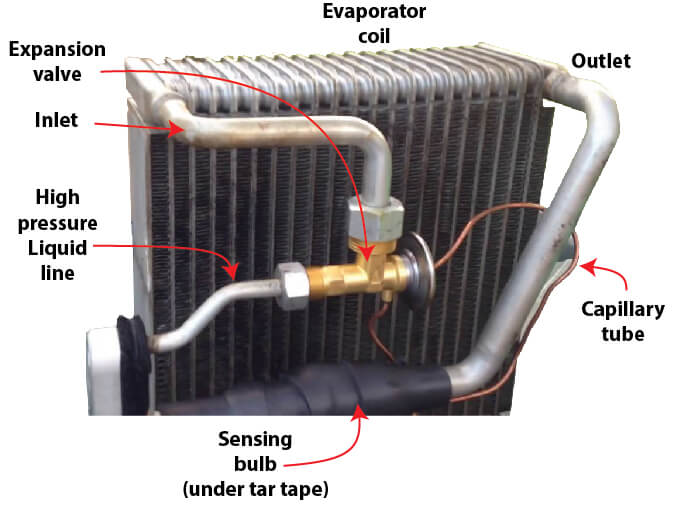
Evaporator core
Located inside the dash, the evaporator:
• Absorbs heat from cabin air
• Causes refrigerant to boil into vapor
• Produces cold air through heat removal
When airflow passes across it, that’s when you feel cold air.
How Auto Air Conditioning Works (Step-by-Step Cycle)
Let’s walk through the cycles like this:
1) The compressor compresses refrigerant into hot, high-pressure vapor
2) Refrigerant flows to the condenser and releases heat
3) It condenses into a high-pressure liquid
4) It passes through the receiver-drier or accumulator
5) The expansion device drops pressure
6) Refrigerant enters the evaporator and absorbs cabin heat
7) Vapor returns to the compressor and repeats
That’s the entire system—and once you understand it, diagnosing problems becomes much easier.
Why Understanding How Auto Air Conditioning Works Helps You Diagnose Problems
This is where knowledge pays off.
When I diagnose AC systems, I don’t just look at symptoms—I think about where the heat transfer process is failing.
If cooling isn’t happening, one of these is the issue:
• Heat isn’t being absorbed
• Heat isn’t being rejected
• Refrigerant isn’t flowing properly
That’s it.
The Most Common Reasons Car AC Systems Stop Working
After decades of repairs, I see the same failures over and over.
• Low Refrigerant (Most Common Problem)
All AC systems are sealed—but they leak over time.
When the refrigerant leaks out of the system:
• Cooling decreases
• Compressor cycles rapidly
• The system may shut down
And here’s the critical part most people miss:
If refrigerant leaks out, oil leaks out too.
That’s how compressors fail.
Compressor Failure
If the compressor stops working:
• No pressure difference
• No refrigerant movement
• No cooling
Common signs:
• Noise
• No engagement or output
• Intermittent cooling
• Restricted Expansion Device
Debris or contamination can block refrigerant flow.
When that happens:
• High pressure builds on one side
• Low pressure drops on the other
• Cooling stops
This often happens after compressor failure.
Condenser Airflow Problems
This one gets overlooked all the time.
If airflow is restricted by:
• Dirt
• Bugs
• Debris
• Fan failure
The system can’t remove heat, and cooling suffers.
I’ve fixed plenty of “no AC” complaints just by cleaning the condenser.
The Bottom Line on How Auto Air Conditioning Works
If you understand how auto air conditioning works, you can diagnose most problems logically instead of guessing.
Every failure comes down to:
• Heat not being removed
• Refrigerant not flowing
• Or components not doing their job
Once you see it that way, the system becomes simple.
©, 2025 Rick Muscoplat
Posted on by Rick Muscoplat