
How Much Oil to Add to AC System:
How Much Oil to Add to the AC System During Compressor or Component Replacement
If you’re tackling an AC compressor replacement or swapping out any major part of your car’s AC system, knowing how much oil to add to the AC system is critical. Over the years, I’ve seen countless systems fail early simply because someone guessed wrong on the oil level.
Here’s my step-by-step guide, based on proven best practices, for choosing the right oil for the AC compressor and getting the charge just right.
Why Adding Oil is Mandatory
Every time I replace or flush a system, or even open a major connection, I make it a rule to replenish the oil. That’s because the refrigerant isn’t the only thing that escapes when you open the system—oil goes with it. Without the correct amount of oil for the AC compressor, you risk premature wear, poor cooling performance, or a complete system failure.
Here’s How Much Oil to add if you replace the condenser, accumulator, receiver, or evaporator
Add the correct oil to the component before installing it into the system.
| Component | Amount of oil to add |
|---|---|
| Condenser | 1 Oz. |
| Evaporator | 1.5-2 Oz. |
| Accumulator | 2 Oz. |
| Receiver/Dryer | 1 Oz. |
| Hose | 1 Oz. |
How Much Oil to Add When Replacing an AC Compressor
During an AC compressor replacement, the oil situation is a bit more involved. Most new compressors come pre-filled with enough oil for the entire AC system. The full oil charge is based on the assumption that if you’re replacing the compressor, you’re likely replacing all the other components at the same time.
That’s fine if that’s what you’re actually doing. But if you’re only swapping the compressor, adding all that oil would overcharge the system and cause major problems.
Here’s what I do every single time:
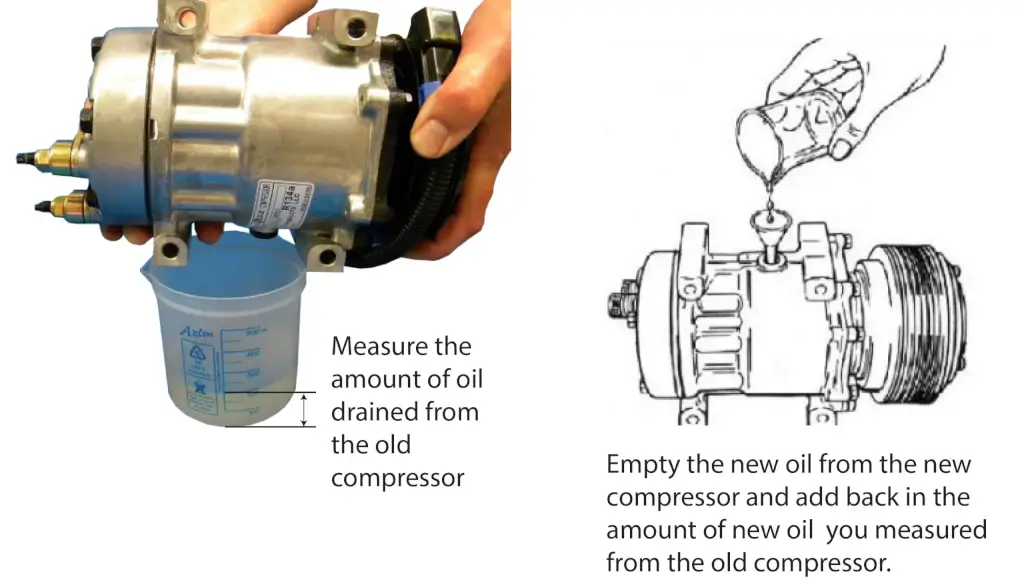
• Drain the old compressor – Pull the drain plug and pour all the oil into a clean, graduated cup.
• Measure what came out – Write that number down.
• Drain the new compressor – Remove its oil into another clean container.
• Refill precisely – Put back into the new compressor only the same amount that came from the old one.
For example, if the old compressor had 3.5 ounces and the new one came with 6 ounces, I would refill the new compressor with 3.5 ounces. That keeps the oil for the AC compressor at the factory-specified level.
Choosing the Right Oil for the AC Compressor
Not all oil for AC compressors is the same. Different vehicles and compressors call for different viscosities and formulations. For example:
Many R-134a systems use PAG 46, PAG 100, or PAG 150.
Sanden SD7H15 compressors require SP-15 PAG oil.
Sanden SD5H compressors use SP-20 PAG oil.
Certain GM, Honda, and VW models specify SP-10 PAG oil.
If you’re unsure, I always recommend checking the factory service manual or compressor label before adding any oil. Using the wrong viscosity is one of the fastest ways to shorten compressor life
Don’t add too much AC oil
Every time you lose refrigerant, you also lose some AC oil. So, it’s common for DIYers to go overboard and add more oil every time they add refrigerant. But that can be self-defeating. Too much oil decreases cooling because it coats the interior fins and blocks heat transfer.
When a shop evacuates an AC system, they measure the amount of oil that comes out, and they replace it with the same amount. But how are you supposed to know? Yeah, it’s a crap shoot if you’ve lost refrigerant due to a leak. The general rule is to add 1-Oz. if the system has lost just a few ounces of refrigerant. However, if you’ve lost more than that, the best approach is to evacuate the system, flush it, empty the compressor and then add full charge of oil
What happens if there’s too little oil in the system?
AC compressors must be lubricated from the crankcase and the top of the piston. The refrigerant carries oil through the system to ensure there’s always oil mist entering the compressor along with the refrigerant vapor.
If there’s a leak, you’ve lost oil, and that lack of oil will wear out the compressor. That’s why it’s always best to evacuate the system, flush it drain the compressor, and add back in the full oil charge instead of guessing
©, 2015 Rick Muscoplat
Posted on by Rick Muscoplat