
How Often to Change Oil in Modern Turbo Engines
How Often to Change Oil: Severe Service vs Normal Service Explained
Quick Summary
The right interval depends on your driving style, engine design (especially turbocharged direct injection engines), and real data—not just mileage. The owner’s manual is your starting point, but it’s not the final word. When it comes to oil changes, science and trend analysis beat tradition and marketing every time.
Article
Oil Changes: How Often to Change Oil and Should You Follow the Carmaker’s Recommendations?
When someone asks me how often to change oil, my answer is always the same: it depends, but it should be based on data, not myths.
Let me walk you through how I approach oil changes, especially on a brand-new engine.
The Most Engine Wear Happens Early
One of the most misunderstood topics in maintenance is break-in. The first few thousand miles of a new engine are critical. Contrary to what many people believe, engines are not fully broken in at the factory.
During break-in, piston rings seat against the cylinder walls, bearings establish wear patterns, and microscopic high spots are smoothed down. That process generates debris—metal particles, silicon from sealants, and assembly residue. An oil filter removes a lot, but not all of it.
This is why, when someone asks me how often to change oil on a brand-new vehicle, I often recommend an early oil change—sometimes around 500 to 1,000 miles. That’s not speculation. Oil analysis consistently shows elevated silicon, copper, and other wear metals early on. Those numbers trend downward over time, but they don’t magically disappear at 1,000 miles.
If you care about long engine life, those early oil changes matter.
Should You Follow the Owner’s Manual?
Here’s where things get interesting.
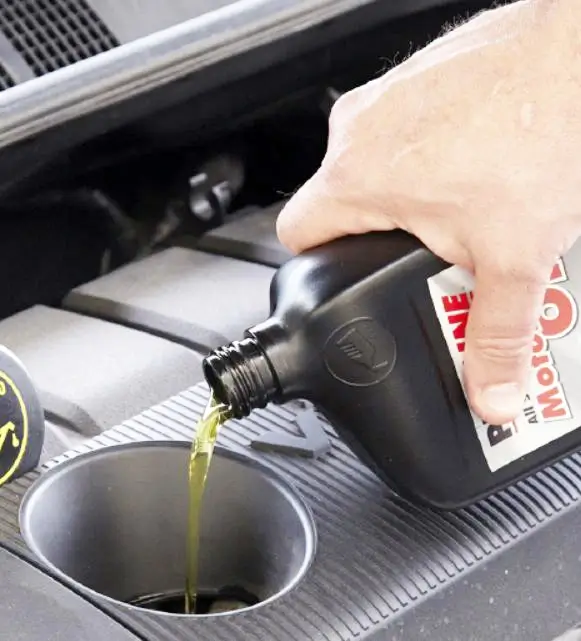
Pour motor oil the right way, with the angled spout up. That allows air into the bottle so it self burbs and eliminates glugging and oil spills.
The owner’s manual is absolutely the right place to start. Carmakers specify oil viscosity, performance standards (like API or ILSAC), and maintenance intervals. Those recommendations are engineered to meet emissions requirements, fuel economy targets, warranty obligations, and average consumer usage.
But here’s the key: they are not necessarily optimized for maximum engine longevity under all conditions.
I say: follow the manual unless you have better data. If you drive short trips in cold weather, tow heavy loads, idle extensively, or run a turbocharged engine, you may need shorter intervals than the “normal service” schedule suggests.
Modern oil life monitors are good—but they primarily calculate based on engine temperature, load, and runtime. They don’t directly measure contamination levels, fuel dilution, or microscopic particle counts.
Temperature and Contamination: The Two Enemies of Oil
In turbocharged engines, oil doesn’t just lubricate bearings. It also cools the turbocharger, which can reach temperatures exceeding 1,500°F on the turbine side. That heat accelerates oxidation. Oxidized oil thickens, forms deposits, and loses protective properties.
Direct-injection engines introduce another complication: fuel dilution. Raw fuel can wash past piston rings and enter the oil, thinning it and reducing film strength. This is especially common in short-trip driving.
Short trips = Severe service: So follow the Severe Service recommendations for oil changes listed in the owner’s manual
Towing = Severe service.
Cold climate starts with short trips = Severe service.
That means shorter intervals between oil changes.
Why “One-Size-Fits-All” Intervals Don’t Work
Older engines running conventional oil often benefited from shorter intervals. Modern synthetic oils are dramatically more stable. But extended intervals only make sense if operating conditions support them.
If you really want to know how often to change your vehicle’s oil based on your driving patterns, the ONLY way to get concrete data is to have your oil tested. That gives you hard data, not speculation. When the results come back, look at wear metals per million miles, particle counts, fuel dilution percentages, viscosity retention, and oxidation levels. That data tells you whether the oil is still protecting the engine—or overstaying its welcome.
In other words, your driving habits matter more than the number printed on a maintenance schedule.
For more information on oil testing, visit Blackstone Labs and order a test kit
Oil Viscosity: Don’t Freelance This Part
Another question tied to how often to change oil is what viscosity to use.
Use the manufacturer-specified viscosity unless you have a compelling, data-backed reason not to. Modern engines are engineered with tight bearing clearances, variable valve timing systems, and hydraulic tensioners that depend on precise oil flow characteristics.
Using the wrong viscosity can create startup wear or reduce fuel efficiency. Stick with the spec—especially during break-in and warranty periods.
Driving Style Matters More Than You Think
Long highway drives at a steady temperature mean the oil and its additives last longer. However, if you drive short trips where the engine never warms fully, your oil and its additives degrade faster. In addition, moisture, fuel dilution, and sludge are far more common in short-trip vehicles.
Oil Filters: Replace Every Time
I recommend replacing the oil filter with every oil change. Filters become slightly more efficient as they load, but they also have capacity limits. For most owners, replacing the filter at each regular oil change is the safest and simplest approach.
So… How Often Should You Change Oil?
If you want a simple answer to how often to change oil, here’s my practical guidance:
Normal driving with synthetic oil: 5,000–7,500 miles is a safe, conservative range.
Severe service (short trips, towing, turbocharged DI engines): lean toward 5,000 miles.
Final Word: Follow Data, Not Dogma
Owner’s manuals are excellent starting points. But if you truly care about longevity, the best answer to how often to change oil comes from understanding how your engine is used.
©, 2026 Rick Muscoplat
Posted on by Rick Muscoplat