
Why worn spark plugs cause no-start problems in cold weather
How worn spark plugs affect cold weather starting
As a car enthusiast and retired ASE Master Technician, I’ve always enjoyed diagnosing and solving automotive issues. But few things have taught me as much about the importance of maintenance as a series of frosty mornings spent struggling to start customers’ cars—all because of worn spark plugs. I’ll never forget those frustrating mornings when an otherwise reliable vehicle refused to fire up properly, teaching me the hard way how crucial spark plugs are for cold-weather starting.
In a Nutshell: Why Worn Spark Plugs Cause No Starts In Cold Weather
Read this summary if you’re not interested in the science behind spark plugs and ignition.
Spark plugs might seem like small, unassuming components, but their job is monumental. They ignite the air-fuel mixture in the engine’s cylinders, creating the combustion that powers your car. In cold weather, this process becomes even more demanding because colder temperatures make the fuel less likely to vaporize and mix with air properly. This results in a harder-to-ignite air-fuel mixture, requiring the spark plug to perform at its absolute best.
When spark plugs are worn, their ability to produce a strong, consistent spark is compromised. The electrodes may be eroded, increasing the gap that the spark needs to jump. In cold weather, this problem is magnified because the battery’s cranking power is reduced, and the engine requires more effort to turn over. Add worn spark plugs to the equation, and you’ve got a recipe for those dreaded morning no-starts.
Spark ignition is a three-part process; ionization, plasma creation, and flame creation
On a modern engine, the ignition coil develops 40,000 volts and sends it to the spark plug where it’s supposed to jump the gap between the center and side electrodes. Forcing voltage to jump a gap is hard enough in air, but it’s even harder when the gap is filled with a compressed non-conductive air/fuel mixture. In order to get voltage to flow across the gap, the air/fuel mixture must become conductive in a process called ionization.
The 40,000 volts waiting the center electrode causes the ions in the air/fuel mixture to “line up” and become conductive. Once the line-up is complete, the voltage travels across the ion gap “bridge” creating plasma that’s up to 60,000 °K. That’s the heat that ignites the fuel.
Worn spark plugs don’t create enough heat
Sparks always jump from the sharpest edge of the center
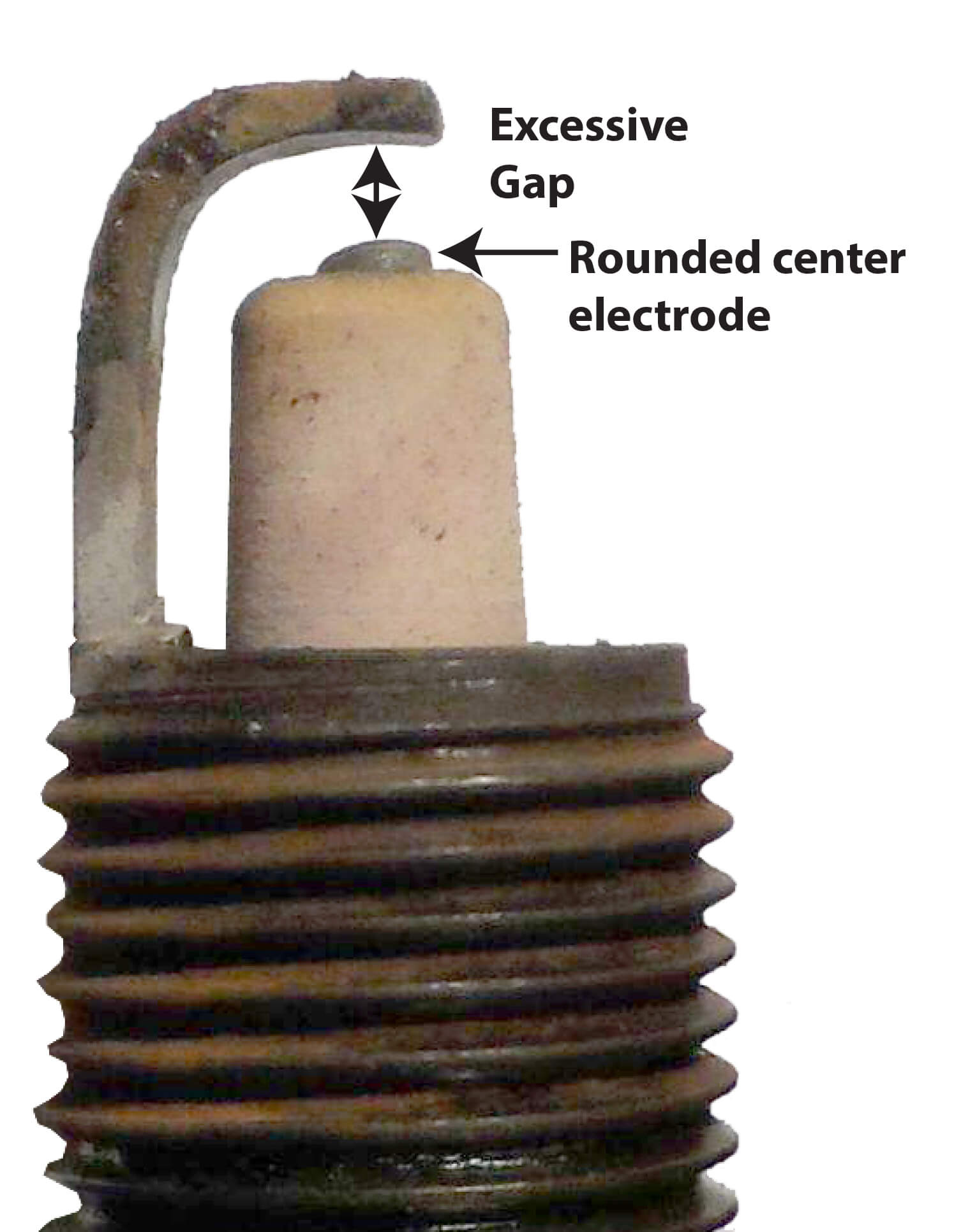
The spark jumps from a sharp edge on the center electrode to the side electrode. As the center electrode wears, it rounds off, resulting in shorter spark duration and misfires.
electrode to the sharpest edge of the side electrode. Unfortunately, the electrodes on the worn spark are rounded over, and the gap erodes and becomes larger. So, more of the high voltage energy is wasted overcoming the wider gap and rounded electrodes. The result? A shorter spark that’s not as hot.
Now, here’s where the cold weather comes into play
• A cold air/fuel mixture has a much higher electrical resistance than warm air and fuel. So it takes even more energy to ignite the fuel in cold weather than in warm weather. That’s the energy you don’t have with worn spark plugs. A good portion of the available energy has already been wasted trying to jump the larger gap.
• The cold metal engine tends to quench any flame that’s created.
That’s why so many car owners are shocked that an engine that started fine on November 15th, doesn’t start on December 15 when only thing that’s changed is the outside temperature.
©, 2022 Rick Muscoplat
Posted on by Rick Muscoplat