
How to Fix Active Grille Shutter Problems
Diagnosing Active Grille Shutter Trouble Codes
Quick Summary
The active grille shutter improves fuel economy by reducing aerodynamic drag and also helps the engine warm up faster. When it works correctly, you never notice it. When it fails, it can trigger check-engine lights, reduce MPG, and even affect cabin heat or AC performance. Most active grille shutter problems stem from actuator failures, broken louvers, wiring issues, or communication faults—and proper diagnosis is critical before replacing parts.
Why Automakers Started Using Active Grille Shutters
If you work on modern vehicles long enough, you start noticing how aggressively manufacturers chase efficiency. One of the quiet heroes in that effort is the active grille shutter. I’ve diagnosed plenty of vehicles where owners had no idea their car even had one—until a warning light came on.
At its core, the active grille shutter system manages airflow through the front of the vehicle. When engine cooling demand is low, the shutters close. That reduces aerodynamic drag, improves fuel economy, and helps the engine reach and maintain operating temperature faster. When cooling demand increases, the shutters open to maximize airflow across the condenser and radiator.
It’s a simple concept, but the execution is more complex than it looks.
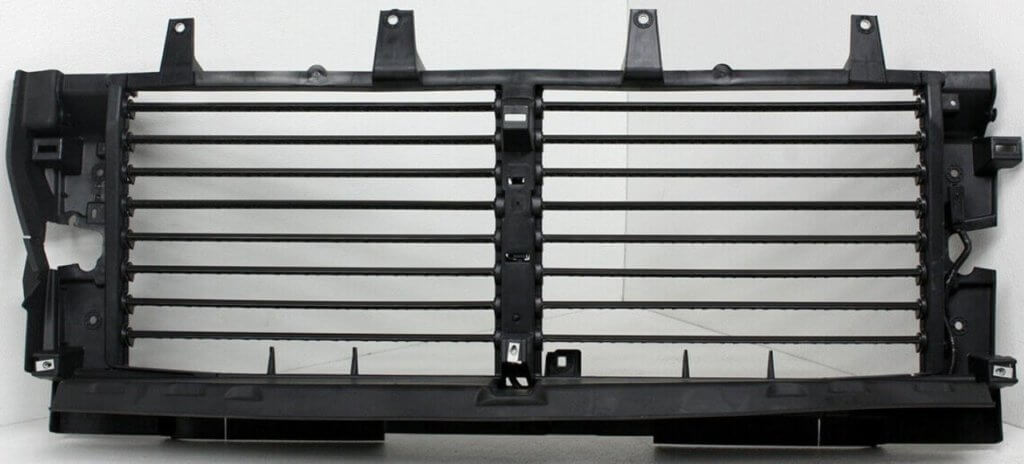
Active grille shutters can have single or multiple sections
If the ambient temperature is low, the ECM will keep the shutters closed until needed.
What the Active Grille Shutter Actually Does
The active grille shutter has three primary jobs, and it’s constantly balancing them. First, it reduces drag by smoothing airflow around 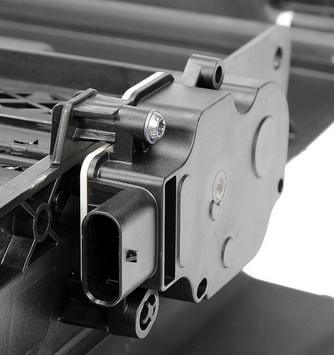 the front of the vehicle. That may sound minor, but at highway speeds, drag reduction translates directly into measurable MPG gains.
Second, the active grille shutter improves fuel economy by staying closed during light-load driving, cold ambient temperatures, or steady cruising. During these conditions, the radiator and condenser don’t need full airflow, so closing the shutters improves efficiency.
Third—and this one surprises many drivers—the active grille shutter helps with thermal management. By limiting cold air rushing through the radiator during warm-up, the engine reaches operating temperature faster. That improves emissions, fuel economy, and cabin heat performance in cold weather.
The engine control module decides when to open or close the shutters based on vehicle speed, coolant temperature, fan operation, AC system pressures, compressor demand, and ambient air temperature. When cooling demand spikes, the shutters open automatically—often in stages if the system has multiple shutter sections.
How the Active Grille Shutter System Is Built
Most vehicles use one or more shutter assemblies mounted directly behind the grille. Some designs use a single wide shutter assembly, while others split the active grille shutter into upper and lower sections that can operate independently.
The system is driven by an active grille shutter actuator, which is an electric motor with an internal position sensor. The actuator moves the louvers through a linkage and reports the actual shutter position back to the ECM. The computer constantly compares the commanded position to the actual position. If those two don’t agree after multiple attempts, a fault code is set.
This constant feedback loop is why calibration and electrical integrity matter so much.
The Most Common Active Grille Shutter Failures I See
In the real world, active grille shutter problems usually fall into a few predictable categories. Mechanical failures are at the top of the list. The shutters are made of lightweight plastic and operate in a harsh environment. Road debris, ice buildup, snowbanks, and even minor front-end impacts can break or jam the louvers.
Actuator failures are also common. The electric motor can fail internally, or the position sensor can stop reporting accurate data. When that happens, the ECM sees a mismatch between commanded and actual shutter position and flags a fault.
Electrical issues are another frequent culprit. Corroded connectors, damaged wiring near the front bumper, or poor ground connections can all prevent the active grille shutter actuator from responding correctly. On vehicles that use LIN bus communication, even a slight voltage or communication drop can trigger faults.
Trouble Codes That Point Straight to the Active Grille Shutter
When diagnosing active grille shutter problems, fault codes provide valuable direction. A P059F code indicates the ECM commanded a shutter position but couldn’t achieve it after multiple attempts. That usually indicates a stuck shutter, a broken linkage, or a weak actuator.
A P151E code indicates a LIN bus communication malfunction. In those cases, the actuator may be physically fine, but the ECM can’t communicate with it reliably. Wiring damage, connector corrosion, or module communication faults are common causes.
The key is understanding that these codes don’t automatically mean “replace the shutter.” They tell the system didn’t behave as expected—and you need to find out why.
How I Diagnose Active Grille Shutter Problems
I always start with a visual inspection. Before touching a scan tool, I check for broken louvers, ice damage, or debris lodged in the shutter assembly. If the shutters are physically jammed, no amount of electrical testing will fix the problem.
Next, I inspect the active grille shutter actuator connector. Most actuators use three wires: power, ground, and a communication or control circuit. Using a wiring diagram, I verify proper power and ground integrity. Ground resistance should be very low—ideally under two ohms from the connector to the body ground point. Anything higher indicates corrosion or a wiring issue that needs repair.
I then check the connector for a proper power supply and verify the fuse and relay feeding the circuit. If power and ground are solid, I proceed to scan-tool testing, commanding the shutters to open and close while monitoring position feedback. If commanded and actual positions don’t match, the actuator or linkage is usually at fault.
Fixing Active Grille Shutter Problems the Right Way
Repairing active grille shutter issues depends entirely on the root cause. Broken or jammed shutter assemblies usually require replacement of the entire shutter unit. In many designs, the actuator is serviced separately, but in others, it’s integrated into the assembly.
Actuator replacement is typically straightforward, but calibration may be required afterward. Some vehicles automatically relearn shutter positions after key cycles, while others require a scan tool calibration procedure. Skipping that step can lead to repeated faults and customer comebacks.
Wiring repairs should never be rushed. Because the active grille shutter sits at the front of the vehicle, repairs must be weatherproof and properly routed to prevent future damage.
Final Thoughts From the Diagnostic Bay
The active grille shutter is a perfect example of modern automotive engineering doing a lot of work quietly in the background. When it fails, symptoms can include cooling problems, electrical issues, or even fuel-economy complaints. Proper diagnosis—mechanical first, electrical second, software last—is the difference between a clean fix and repeated failures.
Fix it right once, and the system will return to the background where it belongs.
© 2022 Rick Muscoplat
Posted on by Rick Muscoplat