
Hyundai P2187 Code Fix: Step-by-Step Diagnosis Guide
Common Causes of a Hyundai P2187 Code
Quick Summary
The Hyundai P2187 code is defined as: System Too Lean at Idle (Bank 1). That means the engine is running too lean at idle (Bank 1). In other words, there’s too much air or not enough fuel when the engine is idling. In my experience, this code is almost always caused by a vacuum leak, unmetered air, or a fuel delivery issue, not a failed sensor.
Most common causes:
• Vacuum leaks (top cause)
• Cracked hoses
• Leaking intake manifold gasket
• PCV hose failures
• Dirty or faulty Mass Airflow (MAF) sensor
• Under-reporting airflow
• Skewing fuel calculations
• Intake air leaks after the MAF
• Loose air ducts
• Cracked intake boots
• Low fuel pressure
• Weak fuel pump
• Restricted fuel filter
• Faulty fuel pressure regulator
• Exhaust leaks near the upstream O2 sensor — Pulls in outside air, tricking the sensor
• Faulty PCV valve — Acts like a vacuum leak at idle
The engine computer (ECM) monitors the air-fuel mixture using oxygen sensors. When it detects excessive oxygen in the exhaust at idle, it knows the engine is running lean. To compensate, the ECM increases fuel delivery. But if it has to add too much fuel (high positive fuel trim), it sets the Hyundai P2187 code. This is not a sensor code—it’s a mixture imbalance code.
Common Symptoms of a Hyundai P2187 Code
When diagnosing a Hyundai P2187 code, I look for symptoms indicating a lean condition, particularly at idle.
Most common symptoms include:
• Rough or unstable idle
• Engine stalling at stops
• Hesitation on takeoff
• Check engine light illuminated
• Higher-than-normal idle speed
• Possible misfires at idle
How a bad purge valve causes Hyundai P2187 and P2189 codes
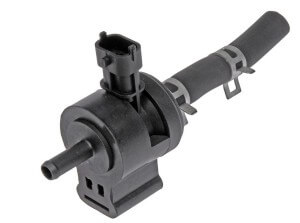 This purge valve on Hyundai vehicles is a common failure point. When the valve sticks open, the intake continues to suck fuel vapors from the charcoal canister.
The oxygen sensor sees a rich mixture and commands a leaner mixture to compensate. These valves can also develop cracks in the vacuum hose from the charcoal canister to the valve and from the valve to the intake.
If you have a scan tool with live data, see if the fuel trims are too high. If so, pinch off the vacuum line to the canister purge valve to see if they change. If so, you’ve found your problem. If the fuel trims are low or negative, try the same trick. That’ll block off extra fuel from the canister. If that works, replace the valve.
For more information on how the EVAP system works, read this post
Why the Hyundai P2187 Code Happens at Idle
This is something a lot of DIYers miss.
At idle:
• The throttle plate is mostly closed
• Engine vacuum is at its highest
That means even a small vacuum leak has a big impact.
At higher RPM:
• Airflow increases
• The effect of the leak is diluted
That’s why the Hyundai P2187 code specifically points to an issue at idle—it’s where leaks show up the most.
How I Diagnose a Hyundai P2187 Code (Step-by-Step)
When I diagnose a Hyundai P2187 code, I follow a structured approach. This avoids replacing good parts.
Step 1: Check fuel trim data — Look at Short-Term Fuel Trim (STFT) and Long-Term Fuel Trim (LTFT)
At idle, trims above +10% to +25% confirm a lean condition
Step 2: Perform a smoke test — This is my go-to test.
• Introduce smoke into the intake system
• Watch for leaks at hoses, gaskets, or fittings
If there’s a leak, you’ll find it quickly.
Step 3: Inspect intake system — Check air duct from MAF to throttle body. Look for cracks or loose clamps
Step 4: Clean and test the MAF sensor — Use proper MAF cleaner. Never use brake cleaner or carb cleaner
Step 5: Check fuel pressure — Verify pressure meets specs. Low pressure = lean condition
Step 6: Inspect PCV system — Remove and shake PCV valve. Check hoses for leaks or collapse
Step 7: Check for exhaust leaks — Especially before the upstream O2 sensor
How to Fix a Hyundai P2187 Code
Once you identify the root cause, the fix is usually straightforward.
Common repairs include:
Replacing cracked vacuum hoses
Repairing intake leaks
Cleaning or replacing the MAF sensor
Replacing the faulty PCV valve
Fixing fuel pressure issues
Repairing exhaust leaks
In most cases, I fix a Hyundai P2187 code without replacing expensive components.
Pro Tips From the Shop
Here are a few things I’ve learned over the years:
Always check fuel trims first—they tell the story
A smoke test beats guessing every time
Don’t replace the O2 sensor unless testing proves it’s bad
Look for recent repairs—many lean codes show up after work has been done
Final Thoughts
The Hyundai P2187 code isn’t complicated once you understand what it’s telling you: the engine is getting too much air or not enough fuel at idle.
If you follow a logical diagnostic path—starting with vacuum leaks and fuel trims—you’ll fix it quickly and avoid unnecessary parts replacement.
©, 2015 Rick Muscoplat
Posted on by Rick Muscoplat