
Ignition coil failure symptoms and common causes
Learn the most common ignition coil failure symptoms and how to diagnose the causes
The ignition coi’s primary role is to transform the battery’s low voltage into the high voltage needed to create an electric spark in the spark plugs, which ignites the air-fuel mixture in the engine cylinders. When an ignition coil starts to fail, it can lead to a variety of symptoms that affect the vehicle’s performance, fuel efficiency, and overall drivability. Understanding these symptoms can help diagnose issues early and avoid more severe engine damage. Here are some of the most common symptoms of ignition coil failure:
The top 8 most common ignition coil failure symptoms
1) Misfires— One of the most apparent symptoms of a failing ignition coil is engine misfires. When the ignition coil fails to deliver the necessary voltage to the spark plugs, the air-fuel mixture in the cylinder does not ignite properly. This can result in incomplete combustion, leading to a noticeable misfire. Misfires often manifest as a rough idle, hesitation during acceleration, and a general lack of power. The vehicle may also shake or jerk, especially when accelerating or driving uphill.
2) Check Engine Light or flashing check engine light— A malfunctioning ignition coil can trigger the vehicle’s onboard diagnostic system to illuminate the Check Engine Light (CEL). Modern vehicles are equipped with sensors that monitor various engine parameters, including the ignition system. When the engine control unit (ECU) detects a problem with the ignition coil or misfires, it logs a diagnostic trouble code (DTC) and illuminates the CEL. While the CEL can indicate many potential issues, it is advisable to use an OBD-II scanner to read the specific trouble codes and determine if the ignition coil is the culprit.
If the Check Engine light flashes, that means the misfire is serious enough to damage your catalytic converter. Try driving with less acceleration and see if the flashing stops. If it does, drive to a shop and get it checked out. If the flashing doesn’t stop, call a tow truck. The tow will be cheaper than a catalytic converter replacement.
3) Poor Fuel Economy— Faulty ignition coils can lead to inefficient combustion, which directly impacts fuel economy. When the air-fuel mixture is not ignited properly, the engine has to work harder to produce the same amount of power, resulting in increased fuel consumption. Drivers may notice that they need to fill up their gas tank more frequently than usual. If there is a sudden drop in fuel efficiency, it could be a sign that one or more ignition coils are failing.
4) Difficulty Starting the Engine— Ignition coils play a crucial role in starting the engine. If an ignition coil is failing, the engine may crank but have difficulty starting, or it may not start at all. This is because the spark plugs are not receiving the high voltage needed to ignite the air-fuel mixture in the cylinders. In some cases, the engine may start but stall shortly after. Persistent starting issues should be addressed promptly to avoid being stranded or causing further damage to the engine.
5) Loss of Power— A noticeable loss of engine power is another common symptom of ignition coil failure. The vehicle may struggle to accelerate, feel sluggish, and have reduced overall performance. This occurs because the engine is not receiving the proper spark to ignite the air-fuel mixture efficiently. The loss of power can be particularly evident during high-demand situations, such as climbing steep inclines, towing, or rapid acceleration.
6) Backfiring and Black Smoke— A failing ignition coil can cause the engine to backfire, producing a loud popping noise from the exhaust. This happens when unburned fuel ignites in the exhaust system. Backfiring can be damaging to the exhaust components and is a clear indication that the ignition system is not functioning correctly. Additionally, black smoke from the exhaust is a sign of incomplete combustion and excessive fuel in the exhaust, often related to ignition coil issues.
7) Stalling— Engine stalling is a severe symptom of ignition coil failure. If the ignition coil intermittently fails to deliver the spark, the engine can stall unexpectedly while driving or idling. This is not only inconvenient but also dangerous, especially if it occurs at high speeds or in heavy traffic. Stalling can be sporadic or occur regularly, depending on the extent of the ignition coil failure.
8) Vibration and Shaking— A failing ignition coil can cause the engine to vibrate or shake excessively. This is due to the uneven firing of the cylinders when the spark plugs do not receive the proper voltage. The vibrations can be felt throughout the vehicle, particularly at idle or low speeds. If the ignition coil failure is isolated to one cylinder, the vibration may be less noticeable but still present.
What causes COP ignition coil failures?
The most common cause of COP ignition coil failure is worn spark plugs! Yup, car owners are ignoring normal maintenance and driving too long on factory spark plugs. As the spark plug gap erodes, 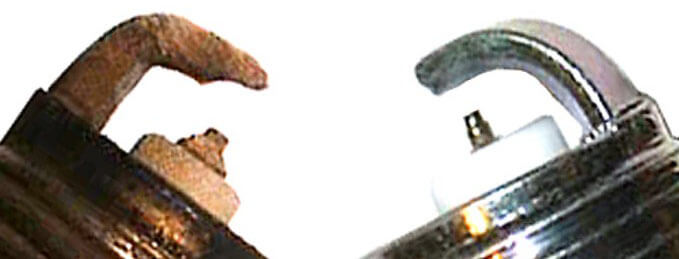 it take more voltage to jump the larger gap. In fact, a worn spark plug can require almost 80,000 volts to fire. A COP ignition coil can deliver that kind of voltage, but not for extended periods. Repeated 80,000 volt firings overheats the secondary windings and degrades the insulating materials inside the ignition coil. Then, the COP ignition coil begins to misfire.
Extra lean air/fuel mixtures can also cause ignition coil failures. A vacuum or air duct leak can cause a lean mixture that can’t be corrected by the PCM. Continued operation causes the ignition coil to overheat and fail.
Water or oil in the spark plug tubes can also cause ignition coil failures. A failed valve cover gasket, for example, can allow engine oil to seep into the spark plug tube and cause a short to ground. Or, faulty sealing gaskets at the top of a COP coil can allow water to enter the spark plug tube, especially during a pressure wash engine cleaning operation.
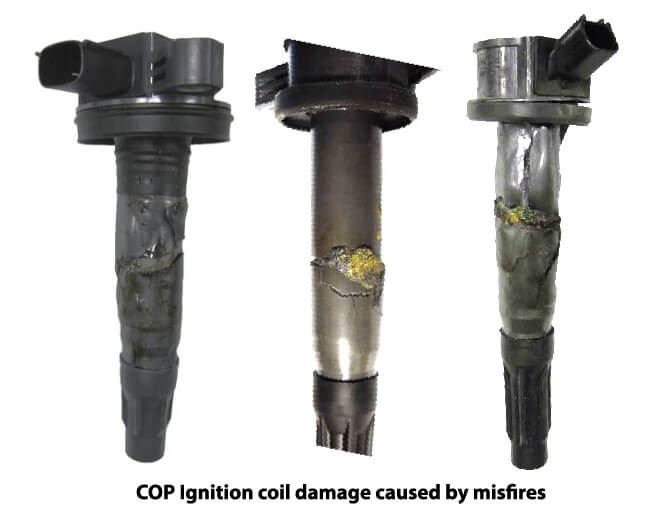
When the spark plug can’t fire, the high voltage shoots through the side of a COP boot, melting it
What happens when ignition coils misfire?
Once you create 80,000 volts, it has to seek ground somewhere. If it can’t jump the spark plug gap, it will find ground through degraded coil insulation. The high voltage can shoot through the plastic case or through the spark plug boot. In the most severe instances, the high voltage can seek ground through the ignition controller—either a free-standing ignition module, or the ignition “driver” inside the PCM.
Once the ignition module or the driver is destroyed, replacing the module or PCM without fixing the underlying cause of the failure will just damage the replacement components.
When does an ignition coil misfire?
Ignition coil misfire occurs when the engine is under heavy load, if the air/fuel mixture is consistently too lean, when spark plugs are worn, or when engine temperatures are too high.
Diagnose the root cause of the ignition coil failure before replacing
Always check the condition of the spark plugs before replacing an ignition coil. If the plug gap is too wide, the new coil will prematurely fail. Also, check fuel trim readings to see if the PCM is attempting to compensate for a vacuum or air duct leak.
Read this post to learn how to diagnose a misfire
Most late model engines use coil-on-plug (COP) ignition coils. COP ignition coil provide higher voltage than coil packs because they operate with longer dwell time. In other words, they have more time to build a magnetic field before the power shuts off and the field collapse. So a COP produces a higher voltage spark when it collapses. Car makers need that hotter/longer spark to ignite leaner fuel mixtures in modern engines.
What a COP ignition coil schematic looks like
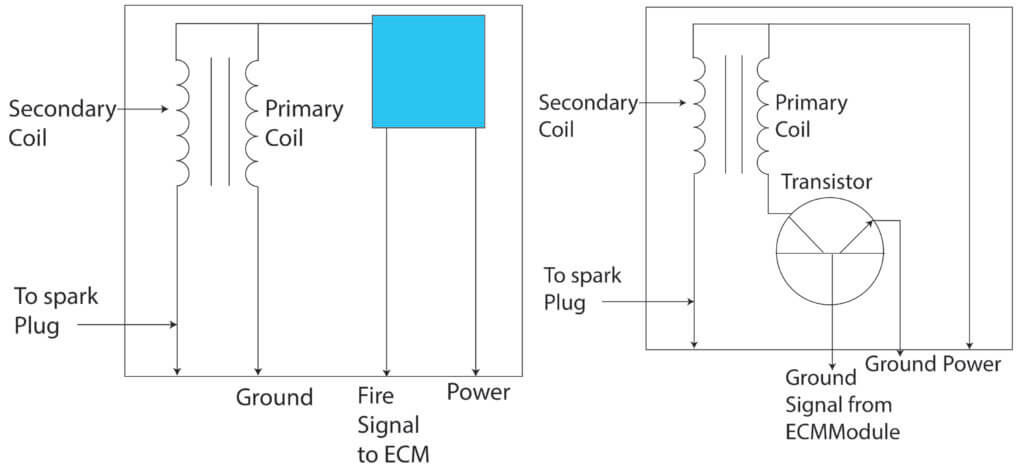
COP ignition coils can have 3 or more wires in addition to the secondary. There’s always a power and a ground. First generation COP coils work just like traditional ignition coils where the ECM or ignition modules toggles ground through a driver (transistor) located in the ignition module or ECM.
Any time you control the ground circuit with a transistor, you run the risk of a bad coil damaging the transistor. In those older vehicles, a bad coil could wipe out the driver, requiring the replacement of the entire ignition module or even the ECM.
In modern COP ignition coils, the driver transistor or triggering device is located in the COP coil. The ECM either grounds the transistor or sends a digital or analog signal to the triggering mechanism located in the COP coil.
In another advancement, some carmakers include a sensing device in the COP coil to confirm that the coil actually fired.
How NOT to diagnose a COP ignition coil
1) Disconnecting the electrical connector from a COP coil with the key in RUN or engine running
Warning: NEVER disconnect the electrical connector to the COP coil while the ignition is in the RUN position, especially on European vehicles. THIS IS AN OBSOLETE method of checking for coil failure. Doing this on a modern vehicle can cause a primary field collapse and spark that can damage the ECM.
2) Swapping COP coils to another cylinder
You’ll never see this technique in any carmaker’s service manual. If the primary circuit is shorted and has not yet damaged an ECM driver, swapping the coil can damage the driver on the new cylinder. (Hint: always check resistance and test continuity on the primary as one of your first checks. Doing this can avoid ECM damage).
3) Yanking the coil off the plug while the engine is running
If you think yanking the entire COP coil while the engine is running can tell you the condition of the coil, think again. A bad coil can produce a perfectly good spark in atmospheric pressure of 14-psi but fail to produce a spark in the combustion chamber at 150-psi+.
The correct COP ignition coil tests
1) Check for power and ground using a multimeter
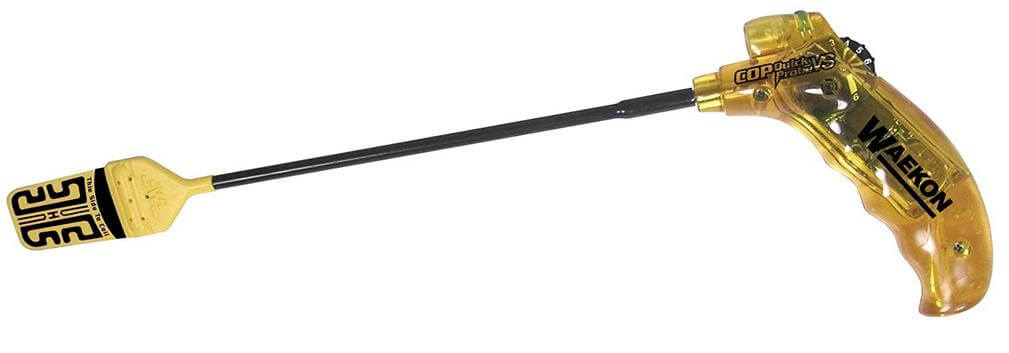
Waekon 76562 COP coil tester
2) Check primary resistance and check for short-to-ground or short-to-secondary using your multimeter
3) Use a capacitive probe to check for coil firing
4) Check for driver signal from the ECM
©, 2017 Rick Muscopalt
Posted on by Rick Muscoplat