
Most Common Causes of Catalytic Converter Failure
Top Reasons Catalytic Converters Go Bad
Quick Summary
The most common causes of catalytic converter failure are
• Engine misfires — Misfires cause incomplete combustion that dumps unburned fuel into the exhaust, causing the catalytic converter to foul, overheat, and melt.
• Rich fuel mixtures — Leaking fuel injectors or rich fuel mixtures cause extra fuel to enter the exhaust and damage the catalytic converter.
• Oil or coolant contamination — Oil burning, internal oil, or coolant leaks can coat the precious metals inside the catalytic converter, rendering them inoperative.
A P0420 or P0430 code means the converter is no longer storing oxygen and cleaning the exhaust efficiently. In my experience, replacing oxygen sensors rarely fixes a P0420 code or P0430 code.
The root cause is almost always upstream—fuel, ignition, or mechanical engine problems.
Proper diagnosis is critical before replacing an expensive catalytic converter.
What Causes Catalytic Converter Failure? (From Real-World Diagnostics)
After decades of diagnosing emissions issues, I can tell you this: catalytic converters don’t just “go bad” on their own. When I see a catalytic converter failure, I immediately start looking for what killed it.
The converter is the victim—not the cause.
Your catalytic converter is designed to last the life of the vehicle. It works by storing oxygen and using it to burn off excess fuel in the exhaust stream. When that process is disrupted, efficiency drops, and the computer sets a P0420 code (Bank 1) or P0430 code (Bank 2).
What a P0420 or P0430 Code Actually Means
A P0420 code or P0430 code indicates:
• Catalyst system efficiency is below the minimum threshold
To determine catalytic converter efficiency, the ECM compares signals from:
• Upstream oxygen sensor (before the converter)
• Downstream oxygen sensor (after the converter)
If both sensors show similar switching patterns, the converter isn’t doing its job—so the ECM triggers the code.
The Most Common Causes of Catalytic Converter Failure
1. Engine Misfires (The #1 Cause) — A misfire sends raw, unburned fuel into the exhaust. That fuel ignites inside the converter, causing extreme heat. Internal heat can reach nearly 2,100°F, melting or shattering the ceramic substrate, permanently damaging the converter, and triggering a P0420 or P0430 code.
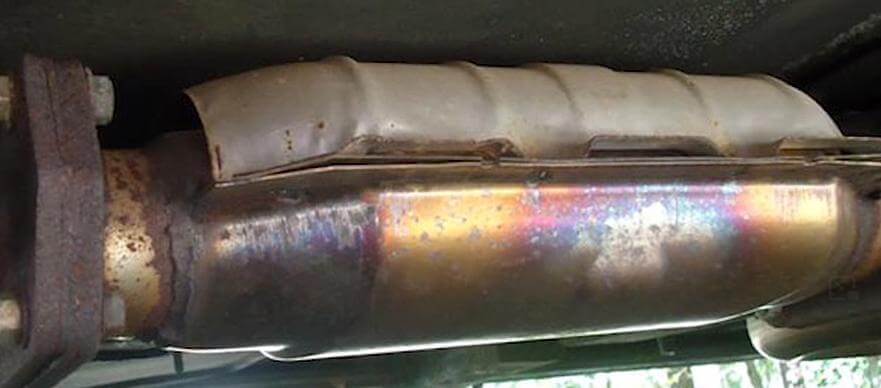
Overheated catalytic converter viewed from the outside
2. Rich Air/Fuel Mixture — Running rich is almost as damaging as a misfire.
Common causes include:
• Leaking fuel injectors
• Faulty mass airflow (MAF) sensor
• Incorrect fuel trim data
Excess fuel continuously enters the converter, overheating it and reducing efficiency.
If you’re diagnosing a P0420 code, always check fuel trims first.
3. Oil or Coolant Contamination — This is one of the most overlooked causes of catalytic converter failure symptoms.
If an engine burns:
• Oil (worn rings or valve seals)
• Coolant (blown head gasket)
• Those contaminants coat the catalyst material and prevent it from functioning.
• Once the converter is contaminated, it can’t recover—even if you fix the engine.
4. Exhaust Leaks (False P0420 or P0430 Codes) — An exhaust leak upstream of the converter can draw in outside air, skewing oxygen sensor readings. This can mimic a failed converter and trigger a P0420 code or P0430 code even when the converter is still good.
5. Physical Damage or Restriction — Impact damage or internal breakup can:
• Crack the ceramic core
• Restrict exhaust flow
• Reduce efficiency
A restricted converter often causes power loss and overheating along with the code.
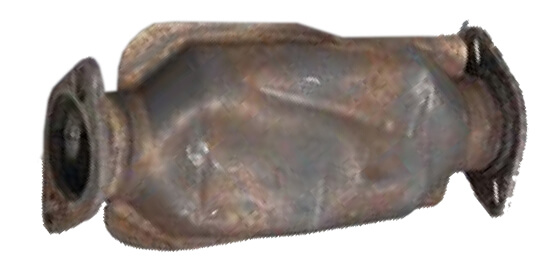
Impact damage that shatters the ceramic honeycomb and causes the converter to clog
Why a Bad Oxygen Sensor Rarely Causes P0420 or P0430
Let’s clear up one of the biggest myths in automotive repair. A lot of people assume a bad O2 sensor causes a P0420 code. In reality, that’s rarely the case.
Here’s why:
1. O2 Sensors Monitor The Combustion Process and Catalytic Converter Efficiency, but they don’t control the converter — The oxygen sensors are reporting devices. They measure oxygen content—they don’t affect how the converter works. If the converter is inefficient, the sensors are simply reporting what they see.
2. Modern Diagnostics Are Redundant — Today’s systems cross-check data from multiple inputs:
• Fuel trims
• Upstream vs downstream sensor activity
• Catalyst efficiency models
• If an O2 sensor fails, it usually sets its own code—not a P0420 or P0430 code.
3. When O2 Sensors Can Be the Cause (Rare Cases) — There are a few exceptions:
• Older narrowband sensors contaminated by oil or debris
• Wiring or connector issues affecting sensor accuracy
• But these are the minority of cases. In real-world diagnostics, replacing an oxygen sensor to fix a P0420 code is usually guesswork.
How I Diagnose a P0420 or P0430 Code (Professional Strategy)
Here’s the exact approach I use:
Step 1: Check for Engine Problems
• Misfire codes — Don’t ignore misfire codes; they cause catalytic converter failure
• Fuel trim data — Long-term fuel trim that exceeds 10% is an indication of an air/fuel problem
• Oil or coolant consumption
If you skip this step, you’ll ruin the new converter.
Step 2: Inspect for Exhaust Leaks — Even a small leak can trigger false readings.
Here’s how to conduct an exhaust leak test.
Step 3: Test for Exhaust Restriction — I use a vacuum gauge or backpressure test:
• Stable vacuum = good flow
• Dropping vacuum at steady RPM = restriction
Step 4: Evaluate Converter Performance — Using scan data:
• Upstream sensor should switch rapidly
• Downstream sensor should be stable
• If both mirror each other → confirmed catalytic converter failure
Final Thoughts: Don’t Replace Parts—Fix the Cause
If there’s one takeaway I want you to remember, it’s this:
A P0420 or P0430 code is usually the result of another problem—not the starting point. If you replace the catalytic converter without fixing the root cause, you’ll be replacing the new catalytic converter soon.
Tips to avoid catalytic converter contamination:
1) NEVER use any type of RTV on exhaust flanges. If a gasket won’t seal it, don’t reach for any type of sealer. You’ll just kill the cat converter. Have an exhaust shop weld on a new flange so it will seal with a gasket.
2) NEVER use Teflon tape on an O2 sensor. High-temperature 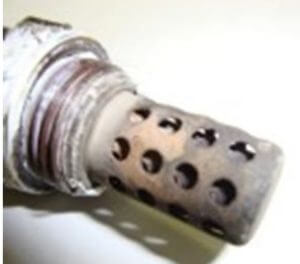 anti-seize is the ONLY sealant that’s approved for O2 sensors.
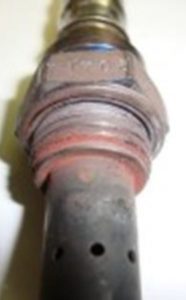
3) NEVER add high-temperature silicone RTV to O2 sensor threads. High-temperature anti-seize is the ONLY sealant approved for O2 sensors.
©. 2019 Rick Muscoplat
Posted on by Rick Muscoplat