
Why Oxygen Sensors Rarely Cause P0420 or P0430 Codes
Understanding the Relationship Between the O2 Sensors and a P0420 or P0430 Code
Quick summary
An oxygen sensor rarely causes a P0420 or P0430. That’s because the engine computer needs a working oxygen sensor to even test catalytic converter efficiency. A P0420 or P0430 means the converter is no longer storing oxygen properly, or there are underlying issues like exhaust leaks, fuel trim problems, or engine conditions that slowly killed the converter. Understanding how the computer uses the oxygen sensor data makes diagnosing P0420 and P0430 far more accurate and far less expensive.
Article
Understanding the Relationship Between Oxygen Sensors and P0420 / P0430 Codes
Over the years, I’ve lost count of how many vehicles I’ve seen where the owner replaced one or more oxygen sensors because a P0420 or P0430 code popped up—only to have the light come right back on. That mistake is incredibly common and stems from a misunderstanding of how the system actually works.
Let’s clear that up.
A P0420 means “Catalyst System Efficiency Below Threshold (Bank 1).” A P0430 means the same thing, but for Bank 2. In both cases, the computer is telling you the catalytic converter isn’t doing its job well enough anymore. The key phrase there is “efficiency,” not “sensor failure.”
Why an Oxygen Sensor Usually Does Not Cause P0420 or P0430
Here’s the logic problem I see all the time: people assume that because the oxygen sensor is involved in the test, it must be the cause of the P0420 or P0430. In reality, that’s backwards.
On most vehicles, if an oxygen sensor is bad, slow, or electrically dead, the engine control module will set a specific oxygen sensor code. It won’t jump straight to a P0420 or P0430. In fact, the computer usually cannot run the catalyst efficiency test unless the upstream oxygen sensor is working correctly.
In other words, a functioning oxygen sensor is required to set a P0420 or P0430 in the first place.
How the Computer Actually Tests the Catalytic Converter
This is the part most DIY explanations gloss over, but it’s critical.
Upstream of the catalytic converter, the exhaust stream is chaotic. Oxygen content and unburned fuel are constantly changing as the engine runs rich, then lean, then rich again. The upstream oxygen sensor reflects this by rapidly switching voltage.
The catalytic converter’s job is to store oxygen and use heat to burn off excess fuel, oil vapors, or trace contaminants. By the time exhaust leaves the converter, it should be relatively stable—neither rich nor lean.
That’s where the downstream oxygen sensor comes in.
During the catalyst test, the ECM intentionally commands rapid rich-and-lean air/fuel changes. It watches the upstream oxygen sensor to confirm that those changes are happening. Then it watches the downstream oxygen sensor.
If the converter is healthy, the downstream sensor signal stays relatively flat. If the downstream signal starts mirroring the upstream signal, the computer knows the converter isn’t storing oxygen anymore—and that’s when it sets a P0420 or P0430.
This is why blaming the oxygen sensor usually misses the mark.
The Rare Exception Where an Oxygen Sensor Can Cause P0420
There is an exception, and it’s worth mentioning because it gets repeated online without context.
Some older Subaru models didn’t have a rigorous test for upstream oxygen sensor response. In those vehicles, a “lazy” upstream oxygen sensor could still pass basic checks but respond too slowly during the catalyst test. That could falsely trigger a P0420.
However, that loophole was closed years ago. On late-model Subarus—and virtually every other modern vehicle—a failing oxygen sensor will set its own code long before it causes a P0420 or P0430. Outside of that narrow scenario, I rarely see an oxygen sensor as the root cause.
Exhaust Leaks: The Most Overlooked Cause of P0420 and P0430
If there’s one thing I always check before condemning a converter, it’s the exhaust system.
An exhaust leak upstream of the downstream oxygen sensor can pull fresh air into the exhaust stream. That extra oxygen fools the sensor into reporting lean conditions that mimic a failed converter. The result? A P0420 or P0430 that has nothing to do with the converter itself.
Soot around exhaust flanges, cracked flex pipes, or leaking gaskets are all prime suspects. I’ve fixed plenty of P0420 complaints with nothing more than an exhaust repair.
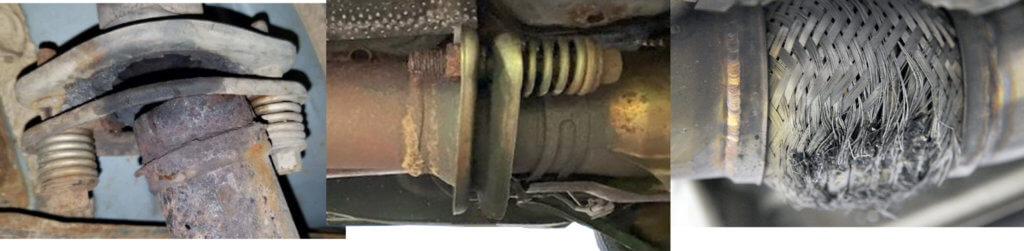
Check for exhaust leaks
Fuel Trim Problems That Slowly Kill Catalytic Converters
Fuel trim numbers tell a story, and ignoring them is a mistake.
When short-term or long-term fuel trims consistently exceed normal ranges, the engine is running rich or lean. That excess fuel ends up in the exhaust, where the converter has to burn it off. Over time, that overheats and degrades the catalyst.
Vacuum leaks, unmetered air, dirty mass airflow sensors, or clogged injectors can all push fuel trims out of range. The converter becomes the victim, and eventually the computer reports a P0420 or P0430—even though the real problem started upstream.
Coolant and Oil Contamination: Silent Converter Killers
Another angle I always consider is engine health.
A failing head gasket can cause coolant to leak into the combustion chamber. Even small amounts contaminate the exhaust, coat the catalyst, and damage the oxygen sensor. The converter struggles to function, and the ECM eventually flags a P0420 or P0430.
Perform a cooling system pressure test
A failing head gasket can force coolant into the combustion chamber, creating a rich mixture in the exhaust and contaminating the O2 sensors. If the cooling system pressure indicates it is fine, proceed with other tests.
The Bottom Line on P0420, P0430, and Oxygen Sensors
Here’s the takeaway I give every customer and DIYer: a P0420 or P0430 is a result, not a diagnosis.
The oxygen sensor is a witness, not the culprit. In most cases, it’s simply reporting what it sees. Before replacing sensors or converters, I always look for exhaust leaks, fuel trim issues, and engine problems that caused the converter to fail in the first place.
Understand that relationship, and diagnosing P0420 and P0430 becomes logical instead of frustrating.
©, 2019 Rick Muscoplat
Posted on by Rick Muscoplat