
How OBD IM Monitors Actually Test Your Emissions System
How OBDII IM Readiness Really Works
Quick Summary
OBDII IM (Inspection and Maintenance) monitors are diagnostic systems in modern vehicles that continuously check whether emissions-related components are functioning properly. They run automated tests on systems such as the catalytic converter, oxygen sensors, evaporative emissions system, and EGR valve by measuring sensor data during normal driving conditions. When a monitor completes its diagnostic test successfully, it sets a “ready” status; if it detects a malfunction, it triggers a check engine light and stores a diagnostic trouble code. Vehicles typically need most monitors showing “ready” status to pass emissions inspections, though some regulations allow one or two monitors to be “not ready,” depending on the jurisdiction—this ensures that temporary issues or recent battery disconnections don’t prevent a vehicle from being tested while still catching genuine emissions problems.
Article
What Are OBDII Readiness Monitors and How Do They Work?
OBD IM Monitors aren’t special sensors, and they’re not parts you can replace. They’re software routines inside the engine computer that verify emissions performance under real-world driving conditions.
OBDII IM Readiness exists for one reason—proof. The computer doesn’t just want to know whether a sensor is plugged in or whether a fault code is present. It wants to know whether each emissions system has proven it can do its job. That’s why clearing codes right before an emissions test will cause an immediate fail. The moment power is lost, or codes are erased, all OBD IM Monitors reset to NOT READY status.
How OBD IM Monitors Actually Test a System
To understand OBDII IM Readiness, you have to think like the computer. It doesn’t guess—it commands conditions and watches responses.
Take the catalytic converter monitor, for example. A catalytic converter can’t be evaluated cold, and it can’t be tested at idle alone. The computer waits until coolant temperature, engine runtime, and load fall into a narrow window. On newer vehicles, it may also reference exhaust gas temperature data.
Once conditions are right, the computer intentionally alters the air-fuel mixture. It monitors the upstream oxygen sensor to confirm the commanded change, then checks the downstream sensor to see whether the catalytic converter has absorbed it. If the rear sensor mirrors the front sensor too closely, the converter either isn’t hot enough or isn’t functioning properly.
If the test passes, the computer flags the OBD IM Monitor as READY. If it fails, the system doesn’t immediately cry wolf. It repeats the test during a defined drive cycle. Only after repeated failures does the computer set a fault code. Until then, OBDII IM Readiness may stay in a NOT READY or INCOMPLETE state.
Why Drive Cycles Matter More Than Miles
One of the biggest misconceptions I see is the idea that driving “a certain number of miles” will reset OBD IM Monitors. That’s not how it works.
OBDII IM Readiness depends on conditions, not distance. A hundred miles of city driving may never run the EVAP monitor, while a single cold start followed by steady highway cruising might complete several monitors at once.
Drive cycles are manufacturer-specific recipes. They define speed, throttle position, engine temperature, idle time, and even how long the vehicle sits overnight. If a monitor never sees its required conditions, it never runs—and it never sets to READY.
If the readings fail the test, the computer will repeat the test under a set driving condition, called a Drive Cycle, until it passes the test or determines that there’s a true failure. If it passes the test, the computer will turn the catalytic converter readiness monitor to READY/PASS. If it fails, it will read NOT READY/FAIL.
Continuous vs Non-Continuous OBD IM Monitors
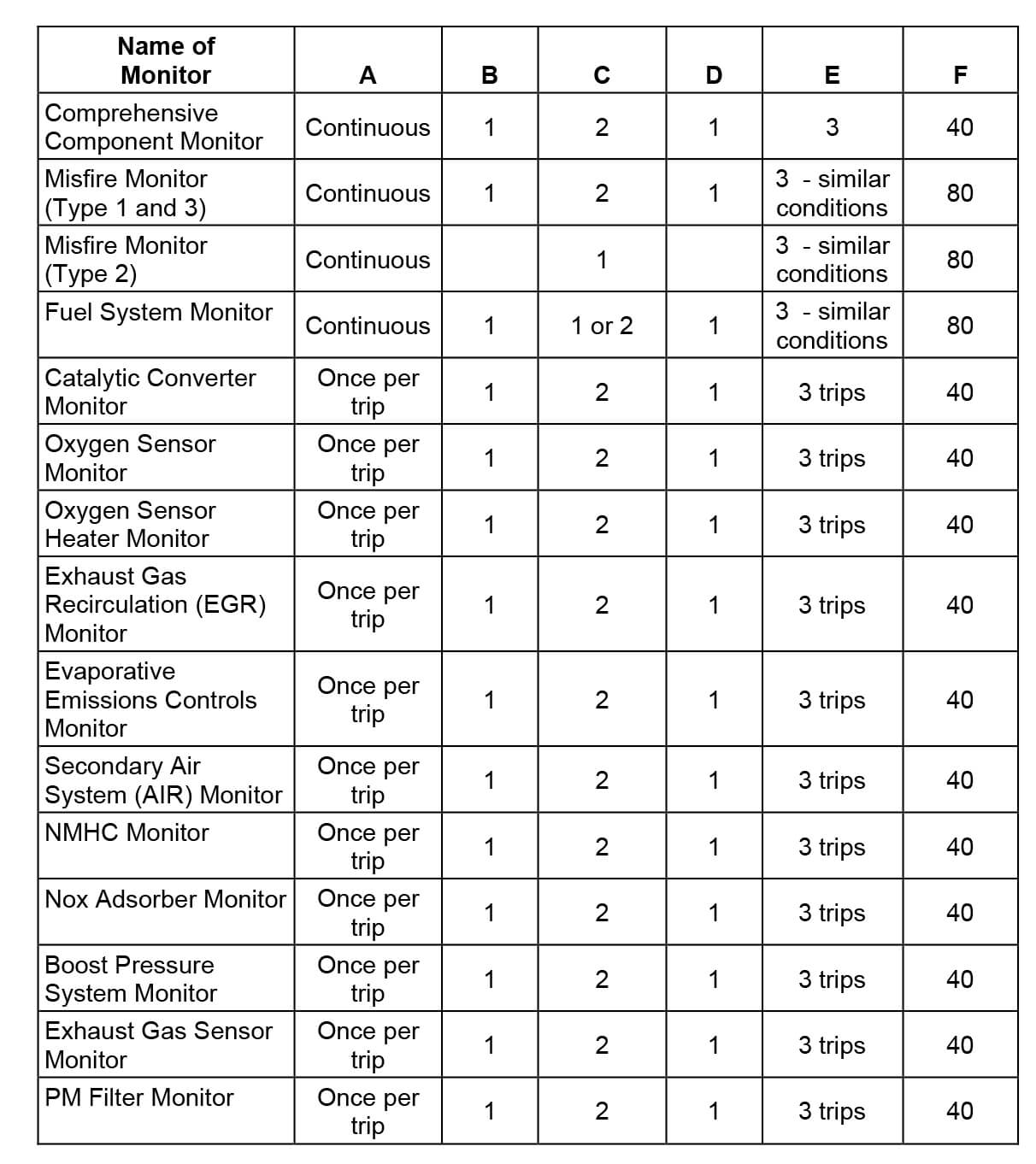
OBDII rules divide OBD IM Monitors into two categories: continuous and non-continuous. Understanding the difference explains why some monitors reset instantly while others take days.
Continuous OBD IM Monitors: Always Watching
Continuous monitors remain active whenever the engine is running. They don’t wait for special conditions because the systems they monitor are critical to engine protection and emissions control.
The misfire monitor is a perfect example. The computer constantly analyzes changes in crankshaft speed to detect combustion problems. If misfires exceed a calculated threshold, a trouble code is set immediately. Fuel system monitoring works the same way, tracking whether commanded air-fuel ratios match the actual ratios.
These continuous OBD IM Monitors are usually set to READY almost immediately after a reset, because the computer can evaluate them during normal driving.
Non-Continuous OBD IM Monitors: Very Picky Test Conditions
Non-continuous monitors are the reason most vehicles fail OBDII IM Readiness checks. These monitors only run when specific criteria are met—and some of those criteria are surprisingly strict.
Oxygen sensor monitors, catalyst monitors, EGR monitors, EVAP monitors, and secondary air system monitors all fall into this category. The EVAP monitor, in particular, is notorious. It may require a fuel level between 15% and 85%, a cold soak, steady speeds, and zero throttle movement for extended periods.
If even one condition is missed, the test doesn’t run, and the OBD IM Monitor remains NOT READY.
Some examples of NON-continuous OBDII readiness monitors:
Comprehensive Component Monitor (CCM) See this article for more information
Misfires — See this article for more information on the misfire monitor
Fuel system mixtures — See this article for more information on Fuel Trim and how it works
Some examples on NON-continuous OBDII readiness monitors:
Oxygen Sensor Monitor — See this article for more information on the oxygen sensor monitor
Oxygen Sensor Heater Monitor — See this article for more information on the oxygen sensor heater monitor
Catalyst Monitor — See this article for more information on the Catalyst Monitor
Heated Catalyst Monitor — See this article for more information on the Heated Catalyst Monitor
EGR System Monitor — See this article for more information on the EGR monitor
EVAP System Monitor — See this article for more information on the EVAP Monitor
Secondary Air System Monitor — See this article for more information on Secondary Air Monitor
The following Monitors became standard beginning in 2010. The majority of vehicles produced before this time will not support these Readiness Monitors
NMHC Monitor — See this article for more information on NMHC Monitor
NOx Adsorber Monitor — See this article for more information on NOx Adsorber monitor
Boost Pressure System Monitor — See this article for more information on the Boost Pressure System Monitor
Exhaust Gas Sensor Monitor — See this article for more information on the Exhaust GAs Sensor Monitor
PM Filter Monitor — See this article for more information on the PM filter monitor
The Real Reason OBDII IM Readiness Fails
When someone tells me their car “won’t set monitors,” I look for patterns. In most cases, the issue isn’t a bad sensor—it’s interrupted drive cycles, marginal battery voltage, or a system that barely passes but never quite meets test thresholds.
Weak batteries are a silent killer of OBD IM Monitors. Low voltage can prevent monitors from completing without ever setting a code. So can aftermarket calibrations, short trips, and clearing codes too frequently.
Understanding OBDII IM Readiness means understanding patience. The system doesn’t rush—and neither should diagnostics.
The Bottom Line on OBD IM Monitors
OBD IM Monitors aren’t out to punish drivers—they’re designed to ensure emissions systems work under real conditions, not just in theory. If a monitor shows NOT READY, the computer is telling you it hasn’t seen enough proof yet.
Once you understand how OBDII IM Readiness works, emissions testing stops feeling like a guessing game. You stop throwing parts at the car and start giving the computer what it needs: the right conditions, the right drive cycle, and enough time to do its job.
©, 2019 Rick Muscoplat
Posted on by Rick Muscoplat