
Oil Temperature: Key to Engine Performance
How Oil Temperature Affects Turbocharger Life
Turbocharged engines dominate today’s automotive landscape. Automakers rely on forced induction to balance power, fuel efficiency, and emissions compliance. But with turbocharging comes one unavoidable consequence: higher heat loads. Among the most important, yet often overlooked, factors in preserving engine life is maintaining a proper oil temperature. When oil gets too hot, it loses its ability to lubricate, protect, and cool critical components—especially the turbocharger itself.
What Engine Oil Really Does
Most drivers know that engine oil lubricates moving parts, but in a turbocharged engine, its job is far more complex. Oil provides:
• Lubrication for the crankshaft, camshafts, and turbo bearings.
• Sealing inside gaskets and around seals, minimizing leaks.
• Cleaning by trapping contaminants and suspending them until they can be filtered out.
• Corrosion protection against rust and harmful deposits.
• Cooling by drawing heat away from pistons, valvetrain components, and turbo bearings.
• Hydraulic control for timing chain tensioners and variable valve timing systems.
Each of these functions depends heavily on stable oil temperature. Too cold, and the oil is too thick to flow. Too hot, and the additives break down, leaving metal parts vulnerable to wear.
How Oil Temperature Affects Turbochargers
Turbochargers spin at more than 100,000 RPM, supported only by a thin film of pressurized oil. The center housing rotating assembly (CHRA) contains the turbine shaft, compressor wheel, and bearing system. This “heart” of the turbo depends on oil both for lubrication and for cooling.

As exhaust gases heat the turbine side, the oil absorbs that heat. Without adequate cooling, the oil can reach extremely high temperatures, leading to “coking”—where the oil carbonizes inside the turbo’s narrow passages. Once coked deposits form, they restrict flow, starve the bearings, and often lead to catastrophic turbo failure.
Controlling oil temperature isn’t optional in turbocharged engines—it’s essential for turbo longevity.
The Optimal Oil Temperature Range
Engines and oil are designed to operate within a target temperature window. For most turbocharged vehicles, the ideal oil temperature lies between 190°F and 220°F. Within this range, oil flows freely, retains its viscosity, and allows additives to function properly.
If oil consistently climbs beyond 240°F, oxidation accelerates. Additives like antioxidants, anti-wear compounds, and detergents degrade rapidly, reducing the oil’s protective qualities. At temperatures above 260°F, viscosity modifiers begin to fail, thinning the oil film and increasing metal-to-metal contact within the turbo and engine.
In short, excessive oil temperature undermines every protective property oil provides.
Additives That Depend on Proper Oil Temperature
Modern oils are blended with chemical additives designed to withstand stress, but they are still temperature-sensitive:
• Antioxidants slow oxidation but are consumed more rapidly at high temperatures.
• ZDDP anti-wear agents form a sacrificial film but lose effectiveness above 250–300°F.
• Detergents prevent sludge but break down under prolonged thermal stress.
• Dispersants suspend contaminants but degrade when overheated.
• Viscosity index improvers allow multi-grade protection but shear down when oil is too hot.
Keeping oil temperature in check preserves these additives, extending both oil and engine life.
Other Auto Engine Systems That Depend on Cool Oil
Today’s vehicles incorporate multiple systems that rely directly on oil performance:
• Turbochargers require cool oil for high-speed bearings.
• Variable valve timing uses oil pressure to control cam phasing.
• Timing chain tensioners depend on oil hydraulics.
• The camshaft lobes that drive the direct injection fuel pump demand clean, cool oil to prevent excessive lobe and plunger.
If oil runs hot and loses its properties, each of these systems suffers. The result is rough performance, higher emissions, and potentially severe mechanical failure.
Methods to Control Oil Temperature
Oil Coolers— Factory and aftermarket oil coolers regulate oil temperature by transferring heat either to the engine coolant or ambient air. Performance engines often use larger or external coolers to handle higher loads.
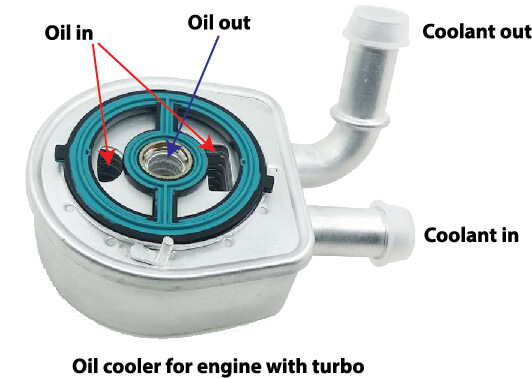
Typical turbo oil cooler
Synthetic Oils — Synthetic motor oils are engineered for stability at both hot and cold extremes. They resist thermal breakdown better than conventional oils, making them the smart choice for turbocharged applications.
Routine Oil Changes— Following correct oil change intervals is critical. Turbo engines contaminate oil more quickly, and dirty oil runs hotter, which further accelerates breakdown.
Warm-Up and Cool-Down— Allowing the engine to reach operating temperature before hard acceleration ensures proper oil flow. Likewise, idling for a short period after spirited driving allows the turbo to cool, preventing oil coking in the CHRA.
The Consequences of Ignoring Oil Temperature
Failure to manage oil temperature leads to a cascade of problems:
• Turbocharger bearing failure from oil starvation.
• Accelerated wear of crankshaft and camshaft components.
• Sludge and varnish restricting oil passages.
• Reduced performance and efficiency.
• Complete engine failure in severe cases.
Once overheated oil causes internal damage, repairs often run into the thousands of dollars.
©, 2025 Rick Muscoplat
Posted on by Rick Muscoplat