
P0015 Code Fix Guide from an Expert Technician
Professional Diagnostic Steps for a P0015 Trouble Code
Quick Summary
The P0015 code indicates that the engine’s computer has detected camshaft timing that is over-retarded on Bank 1, Exhaust Camshaft (Camshaft B). The P0015 code is most commonly caused by:
• dirty or low engine oil,
• failing VVT (Variable Valve Timing) solenoid
• sticking cam phaser
• worn timing components
• wiring faults
Diagnosing a P0015 code requires checking oil condition, testing the VVT solenoid, using scan-tool data to compare commanded vs. actual cam timing, and inspecting mechanical timing if all else checks out. Below, I’ll walk you through precisely what the P0015 code means, why it occurs, and how to diagnose it like a professional.
What is a P0015 Code
When the engine computer sets a P0015 code, it’s telling you that the exhaust camshaft on Bank 1 is staying too far behind its commanded position. Bank 1 refers to the side of the engine with cylinder #1, and Camshaft B denotes the exhaust cam on that bank.
Modern engines use Variable Valve Timing (VVT) to adjust camshaft position on the fly. This improves power, fuel economy, and emissions. But for the system to work properly, the cam phaser, VVT solenoid, oil flow passages, and timing chain must all be functioning correctly.
If the camshaft does not advance or retard as commanded—specifically if it remains in a retarded position—your ECM will trigger a P0015 code.
Symptoms can include:
• Rough idle
• Poor fuel economy
• Hard starting
• Loss of power
• Check Engine Light (CEL)
• Rattling noise from the timing chain area
Most Common Causes of a P0015 Code
In my experience, these are the issues I see most often when diagnosing a P0015 code:
1. Dirty or Low Engine Oil — VVT systems rely entirely on clean, correct-viscosity oil. If the oil is dirty, sludged, or low, the VVT solenoid cannot supply proper hydraulic pressure. When the phaser cannot move as commanded, the ECM sets a P0015 code.
2. A Sticking or Failed VVT Solenoid (Oil Control Valve) — The VVT solenoid meters oil pressure to the cam phaser. When the internal screen gets clogged or the solenoid fails electrically, timing adjustment becomes slow or impossible. A stuck solenoid is one of the most common causes of a P0015 code.
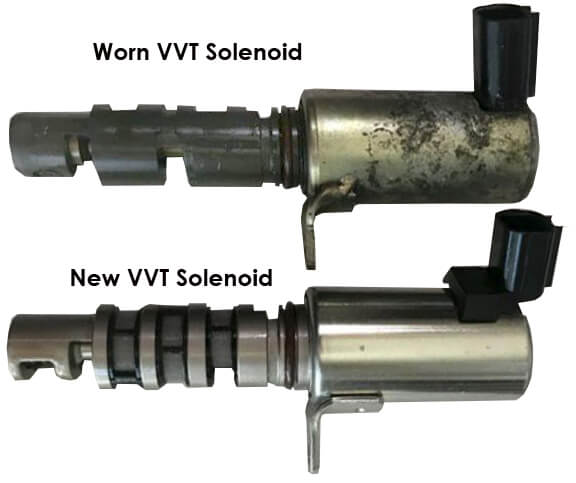
VVT solenoid oil control valve
3. Worn or Sludged Cam Phaser — Cam phasers wear with age, especially on engines that haven’t received regular oil changes. A sticking or internally damaged phaser can leave the exhaust cam permanently retarded, triggering the P0015 code.

4. Timing Chain Stretch or Incorrect Mechanical Timing — Timing chains wear and stretch over time. A stretched chain can allow cam timing to drift enough for the ECM to recognize the misalignment and set a P0015 code. Incorrect timing after engine work can cause the same issue.
5. Faulty Cam Position Sensor or Crank Position Sensor — If either position sensor provides erratic or inaccurate readings, the ECM may interpret the difference as over-retarded timing.
6. Wiring Problems or Poor Electrical Connections — Damaged wiring, corroded connectors, oil contamination inside connectors, or poor grounds can disrupt the VVT system’s electrical control circuitry.
How to Diagnose a P0015 Code Like a Professional
Here’s the step-by-step method I use in my shop to accurately diagnose a P0015 code and avoid unnecessary part replacement.
Step 1: Start with Engine Oil Inspection
Before touching anything else, I confirm:
• Oil level
• Oil condition
• Oil viscosity
If the oil is low, contaminated, or the wrong weight, I change it immediately. A surprising number of P0015 code issues disappear after correcting the oil.
Step 2: Check for Additional Timing Codes
Codes such as P0011, P0012, or P0024 can help determine whether the issue is isolated or part of a systemwide timing problem. Multiple timing codes almost always point to oil- or mechanical-timing issues.
Step 3: Scan Tool Live Data
This is where the real diagnosis begins. I compare:
• Commanded camshaft angle
• Actual camshaft angle
If the actual angle lags behind commanded values, the cause is either hydraulic (oil/VVT) or mechanical (phaser/timing chain).
Step 4: Test the VVT Solenoid
I test the solenoid using:
• Coil resistance measurement
• Power/ground verification
• Actuation testing using a scan tool or bench test
If the solenoid doesn’t click or responds slowly, it’s at least partly to blame for the P0015 code.
Step 5: Inspect Wiring and Connectors
I examine:
• Harness routing
• Broken insulation
• Melted wires
• Oil-filled connectors
• Loose terminals
• Any intermittent connection can cause erratic VVT operation.
Step 6: Mechanical Timing Verification
If everything above checks out, I remove the valve cover and verify alignment marks. A stretched timing chain, broken guide, or weak tensioner can delay cam response and cause a P0015 code.
If mechanical timing is off, no amount of sensor or solenoid replacement will fix it.
Step 7: Inspect and Test the Cam Phaser
If I still suspect the phaser, I check for:
• Sticking vanes
• Worn internal bearings
• Oil flow restrictions
• Cam phasers often fail on engines with extended oil-change intervals.
How to Fix a P0015 Code
Repairing a P0015 code depends on the root cause:
• Change engine oil and filter
• Replace VVT solenoid
• Clean or replace clogged VVT oil passages
• Repair damaged wiring or connectors
• Replace cam position sensor
• Replace timing chain, tensioner, or guides
• Replace cam phaser if worn or sticking
Once repairs are made, I clear the code, warm up the engine, and verify cam timing with a scan tool at idle and under acceleration.
©, 2025 Rick Muscoplat
Posted on by Rick Muscoplat