
P0597 Code: What it means and how to fix it
Solving the P0597 Code Problem on GM vehicles
The P0597 code is a diagnostic trouble code is defined as: “Thermostat Heater Control Circuit/Open.” This code is often triggered when the engine control module (ECM) detects an issue with the thermostat heater control circuit. Modern vehicles use an electronically controlled thermostat to manage the engine’s operating temperature, ensuring optimal performance and efficiency. When the ECM identifies a malfunction in this system, it activates the check engine light (CEL) and stores the P0597 code.
What is an electric thermostat heater?
The thermostat in modern GM vehicles is electronically controlled to maintain optimal engine operating temperatures. The heater causes the thermostat to open more quickly than normal on cold days, which allows hot engine coolant to circulate faster into the heater core and provide heat to the driver and passengers. Unfortunately, many GM cars with these engines suffer a P0597 code due to heater failure.
GM has had many issues with this component, from failed heaters to cracked plastic housings that dump all the engine coolant. However, in the case of a P0597 code, the problem is limited to the thermostat heater.
Causes of the P0597 Code
Several factors can contribute to the P0597 code being triggered:
• Faulty Thermostat— The thermostat itself may be defective, preventing it from regulating the engine’s temperature correctly.
• Damaged Wiring or Connectors— Wiring issues, such as broken wires or corroded connectors, can disrupt the thermostat heater control circuit.
• Failed ECM— Although less common, a malfunctioning engine control module can also lead to the P0597 code.
• Electrical Problems— Issues with the vehicle’s electrical system, such as blown fuses or relays, can affect the thermostat’s operation.
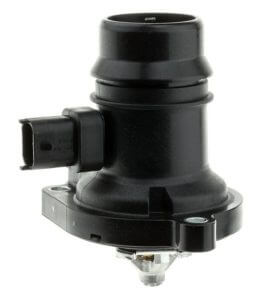 How to test the thermostat heater
Power is provided to the heater on the violet/blue wire from fuse 23 in the underhood fuse box. Backprobe this wire with the key in the RUN position to check for battery voltage.
To complete the circuit, the PCM provides a pulse width modulated (PWM) ground. Check for ground on the dark blue wire using a scope or averaging digital meter. The PCM regulates how much power the heater receives by altering the pulse time for the ground.
If you see battery voltage and ground, perform the following tests:
Disconnect the connector to the thermostat and check for resistance across the heater power and ground terminals. You should see around 3Ω. If the reading is higher, replace the thermostat. If it’s lower, the heater has an open, and the thermostat should be replaced.
Next, check for continuity between the heater pin one and the thermostat housing. The reading should be open or an infinity symbol. If you see any other reading, you’ve got a heater short-to-ground.
©, 2019 Rick Muscoplat
Posted on by Rick Muscoplat