
What is secondary air injection?
Learn what secondary air is and how it works
Secondary Air Injection (SAI) systems play a crucial role in reducing emissions in internal combustion engines. Introduced to meet stringent environmental regulations, these systems help minimize harmful pollutants, particularly during a vehicle’s cold start phase when emissions are typically highest. Secondary air is known as an air injection reaction system (AIR).
What secondary air does
The AIR system injects fresh air into the exhaust stream to facilitate the oxidation of unburned hydrocarbons (HC) and carbon monoxide (CO) into less harmful substances like carbon dioxide (CO2) and water (H2O). By promoting more complete combustion of exhaust gases, the SAI system helps the catalytic converter operate more efficiently, particularly when the engine is cold and not yet running at optimal temperature.
The components of an AIR system
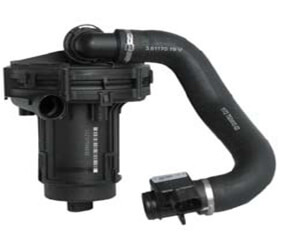
Modern secondary air systems use an electric air pump
• Air pump— A small, usually electric, air pump (like a small compressor) • One-way solenoid valves— Allows air to enter the exhaust but prevents exhaust from backflowing into the pump.
• Relay— power the pump on command from the ECM.
How secondary air systems work
At cold startup, the computer commands a rich mixture. The extra air from the AIR pump helps oxidize the extra hydrocarbons and carbon monoxide in the exhaust during this rich mixture period.
The AIR pump is usually active only during the first 20-120 seconds of engine operation or until the catalytic converter heats up. If the AIR system doesn’t work properly, all that extra fuel from a rich startup could cause the catalytic converter to overheat once it reaches operating temperature.
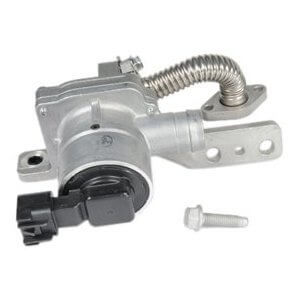
Secondary air one way valve and solenoid
The ECM monitors the effectiveness of the AIR pump by watching the O2 sensor. So you start the cold engine. The PCM sees it’s cold by checking the engine coolant temp sensor. If it’s below 195°, it’s “cold.”
The ECM commands a rich mixture. The ECM powers the AIR pump relay to switch power to the pump (the electric pump draws a high current, so it needs a relay to switch the power). Extra air blows into the exhaust, and ECM starts a timer.
If the O2 sensor doesn’t show a lean condition within the time limit, it figures the pump isn’t working and sets a P0411 secondary air injection system flow (low flow or no flow) malfunction. The PCM activates the AIR relay by providing ground to the control coil. The PCM checks for faults on the control coil side of the AIR relay and sets a P0412 secondary AIR circuit malfunction if it finds one. The problem can be an open in the wire from the relay to the PCM, no power into the control coil from fuse 128, or an internal “driver” fault within the PCM that won’t provide ground to the relay control coil.
Once the AIR relay is activated, the PCM checks voltage on the power feed to the AIR pump. If it detects a problem on the secondary side of the relay, it sets one of two codes; a P1413 secondary air injection system monitor circuit low, or P1414 secondary air injection system monitor circuit high.
©, 2015 Rick Muscoplat
Posted on by Rick Muscoplat