
Spark Plug Lifespan Explained: How Long They Really Last
Spark Plug Lifespan: Why Some Last 120K and Others Don’t
Quick Summary
Spark plug lifespan is determined by engine design, ignition system demands, combustion pressures, and fuel strategy. While some spark plugs can last well over 100,000 miles, others wear out far sooner in modern turbocharged and direct-injection engines. Knowing when to change spark plugs means understanding what your engine asks of them, not just what the box claims. Change them too late, and you risk misfires, poor fuel economy, and expensive secondary damage.
Article
Factors Affecting Spark Plug Life: What Every Car Owner Should Know
After decades of diagnosing misfires, rough idle complaints, and “mystery” check engine lights, I can tell you this with confidence: spark plug lifespan is one of the most misunderstood maintenance topics in automotive service. I’ve seen brand-new plugs pulled early due to poor engine condition, and I’ve pulled factory plugs at 120,000 miles that still looked surprisingly decent. The difference wasn’t the plug—it was the engine.
Let’s talk about what really determines spark plug lifespan, how long spark plugs last in real engines, and exactly when to change spark plugs if you want peak performance and reliability.
What Actually Determines Spark Plug Lifespan?
A spark plug must survive in a hostile environment. Each time it ignites the air-fuel mixture, it’s exposed to extreme heat, pressure, and chemical oxidation. How long it lasts depends on far more than the material stamped on the box.
The most obvious factor affecting spark plug lifespan is electrode material. Every spark jumps from the sharpest edge of the center electrode to the sharpest edge of the side electrode. Over time, those sharp edges erode and round off. As the edges dull, the ignition system must work harder to fire the plug, increasing voltage demand and accelerating wear.
Harder metals with higher melting points erode more slowly, which is why copper plugs wear quickly and iridium plugs last longer—at least under ideal conditions.
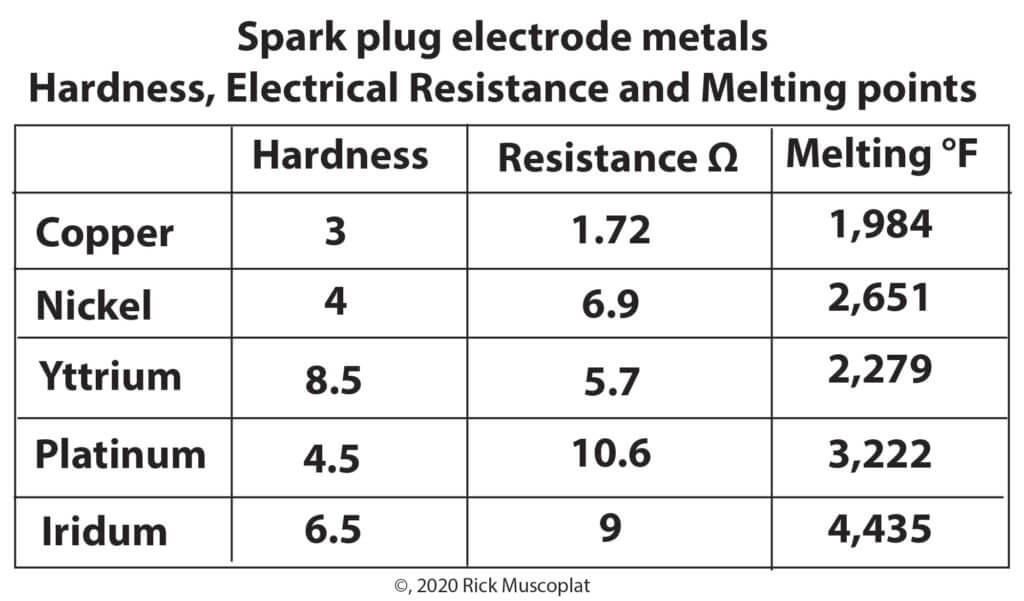
2) Spark plug electrode size and shape affect spark plug life
The voltage required to fire a spark plug depends on several factors, including gap size, electrode shape and size, gas density, gas and electrode temperatures, and gas type.
Smaller electrodes reduce the firing voltage requirements
Many newer iridium spark plugs use a “thin wire” design. Studies show that the thinner the center electrode, the lower the voltage needed to initiate the spark. A lower firing voltage reduces stress on the ignition coil and allows for a longer spark duration, which is critical in lean-burn engine designs. The lower firing voltage also increases spark plug life by reducing electrode erosion.
Smaller electrodes reduce heat absorption and reduce spark plug quenching
Since a thinner electrode has less surface area, it absorbs less heat from the flame kernel, thereby prolonging electrode life. The lower heat absorption also reduces the quenching action created by the center and side electrode metals. In summary; smaller electrodes absorb less heat from the flame kernel and reduce quenching which increases the ignitability of the air/fuel mixture. The smaller footprint also increases flame propagation.
Spark plug life is affected by temperature and oxidation
Platinum-tipped spark plugs exhibit high resistance to temperature and oxidation-erosion. As engineers evaluated pure Iridium, they found that, even though it has a much higher melting point than platinum, Iridium is more susceptible to oxidation-erosion during heavy engine operation.
To combat oxidation-erosion, engineers developed an iridium alloy by adding 10% Rhodium to the mix.
Iridium spark plug benefits
Laboratory testing proves that iridium spark plugs afford the following benefits
• Lower firing voltage
• 3% improvement in fuel economy during idling and 1.3% improvement during highway operation
• improved acceleration
• Faster starting in cold temperatures
(Development of New Iridium Alloy for Spark Plug Electrodes Hironori Osamuraand Nobuo Abe— DENSO CORP)
Why do some carmakers recommend more frequent spark plug changes
As mentioned earlier, some iridium spark plugs can last up to 120K miles. Yet some carmakers recommend changing iridium spark plugs at 30,000, 45,000, or 60,000 miles. If iridium spark plugs are so good, why don’t they all last 120K miles?
Engine design affects spark plug life
Even though iridium spark plugs offer increased resistance to erosion and oxidation, their service life is affected by firing voltage, spark duration, combustion pressure, and air/fuel mixture.
Lean burn, direct injection, and turbocharging reduce spark plug life
Lean air/fuel mixtures are much harder to ignite, so they require a longer spark duration. At the same time, direct injection and turbocharging increase cylinder pressures, making ignition even harder to accomplish. When you combine longer spark duration, leaner mixtures, and higher pressures, you get reduced spark plug life.
Copper spark plugs have a much shorter life compared to platinum or iridium
A traditional copper spark plug contains a 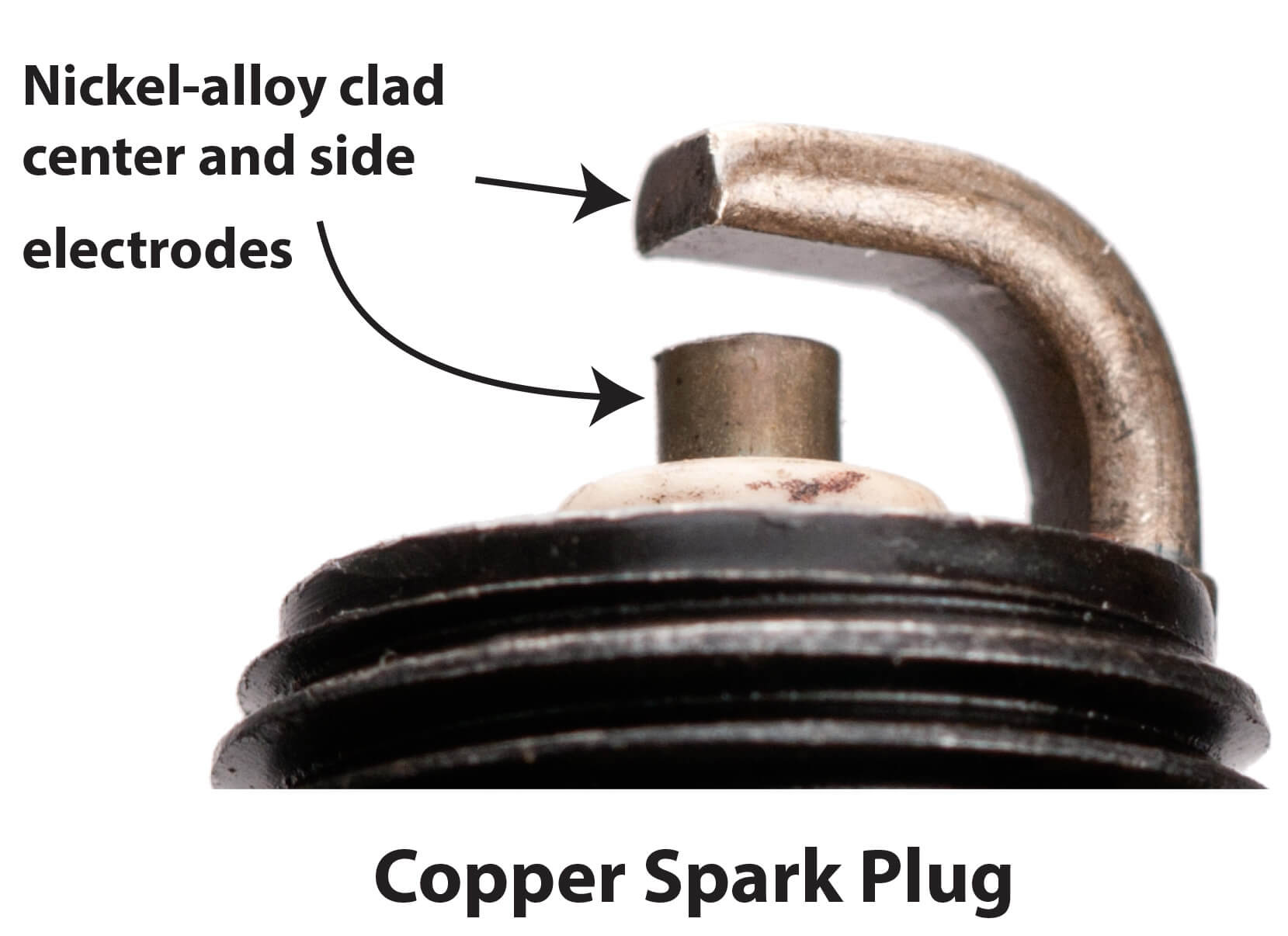 copper-core center electrode with a fused nickel alloy tip. That design offers lower electrical resistance than that of precious-metal plugs, so you lose less ignition coil energy. Lower electrical resistance yields a hotter spark, resulting in more power. That’s a huge advantage in performance applications where spark plug life isn’t an issue. In addition, traditional copper spark plugs run cooler, further increasing performance.
Unfortunately, the nickel-alloy isn’t as hard as other metals and has a lower melting point. So it erodes faster, resulting in a rounded edge and a faster-wearing gap. As the spark plug gap increases, misfires and fouling become more common. This is why copper spark plugs must be replaced every 20,000 miles.
Platinum spark plugs
A platinum tip welded to a copper core provides a longer spark plug life simply because platinum is harder than copper (4.5 versus 3) and has a higher melting point (4,435°F versus 1,984°F). Car makers switched to platinum spark plugs to increase spark plug life in distributorless ignition systems (DIS). DIS ignition systems generate higher spark voltages and temperatures that are needed to ignite leaner fuel mixtures.
Single-tipped platinum spark plugs use a copper-core center electrode with a platinum tip on the center electrode only. Car makers switched to platinum spark plugs in DIS systems due to the higher voltage and higher temperatures needed to ignite leaner fuel mixtures.
Double platinum-tipped spark plugs contain a small piece of platinum 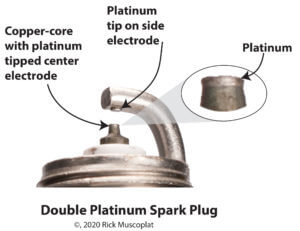 on the side electrode to reduce gap erosion in DIS systems where the waste spark jumps from the side electrode to the center electrode.
Yttrium spark plugs
Bosch offered yttrium spark plugs in their earlier +4 spark plugs. Those plugs have four side electrodes. Four electrodes reduce the risk of misfire caused by gap erosion. Yttirum is much cheaper than platinum but also has a lower melting point.
©, 2020 Rick Muscoplat
Posted on by Rick Muscoplat