
Bad MAP Sensor Symptoms Every Driver Should Know
How to Test a MAP Sensor the Right Way
Quick Summary
A bad MAP sensor can cause rough idle, poor fuel economy, hesitation, misfires, black smoke, and even a limp mode on turbo engines. In this article, I’ll explain the symptoms of a bad MAP sensor, how a MAP sensor works, why failures occur, and how I professionally test and diagnose a bad MAP sensor using scan data, voltage checks, and vacuum testing.
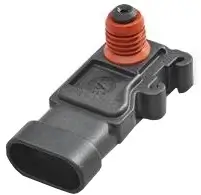
MAP sensor
Article
Bad MAP Sensor Symptoms Explained
Over the years, I’ve diagnosed countless driveability complaints that traced back to a single overlooked component: the Manifold Absolute Pressure (MAP) sensor. A bad MAP sensor doesn’t just turn on the check engine light—it quietly corrupts fuel calculations, ignition timing, and boost control. When that happens, engines run poorly, fuel economy drops, and owners chase the wrong repairs.
Let me walk you through how I identify bad MAP symptoms, how the sensor actually works, and how you can test it correctly instead of guessing.
Signs of a Bad MAP Sensor
When a MAP sensor fails, your engine’s performance takes a hit. Watch for these warning signs:
1. Check Engine Light Codes Linked to a Bad MAP Sensor
One of the first clues I look for is stored diagnostic trouble codes. A bad MAP sensor commonly sets correlation, range, or circuit faults, especially when its signal no longer matches engine load.
The most frequent MAP-related codes I encounter include P0105 through P0109, which indicate circuit or performance problems, and P0069, which flags a disagreement between manifold pressure and barometric pressure. On some vehicles, P0068 appears when the ECM detects that throttle position, airflow, and MAP readings don’t agree.
These codes don’t always mean the sensor itself is dead—but they absolutely point toward bad MAP symptoms that deserve proper testing
• P0068: MAP/MAF – Throttle Position Correlation
• P0069: Manifold Absolute Pressure – Barometric Pressure Correlation
• P0105: MAP Circuit Malfunction
• P0106: MAP/Barometric Pressure Circuit Range/Performance Problem
• P0107: Manifold Absolute Pressure/Barometric Pressure Circuit Low Input
• P0108: MAP Pressure Circuit High Input
• P0109: MAP / Baro Pressure Circuit Intermittent
• P1106: MAP/BARO Pressure Circuit Range/Performance Problem
• P1107: Barometric Pressure Sensor Circuit Low Voltage
• Turbocharger-related Boost Trouble Codes— On forced induction engines, a faulty MAP sensor can trick the ECM into thinking the turbo isn’t producing the correct boost, triggering performance problems and potentially limp mode.
These are the most common MAP Sensor Trouble Codes:
P0068: MAP/MAF – Throttle Position Correlation
P0105 to P0109: MAP circuit issues
P0069: MAP/Barometric Pressure Correlation
2. Engine Performance Problems— Because a bad MAP sensor distorts the air-fuel ratio, you may encounter any of the following symptoms:
• Rough idle
• Stalling
• Misfires
• Poor acceleration
• Reduced fuel economy
• Knocking or pinging
• Hesitation or surging
• Gas smells and black smoke.
• Overheating and backfiring
How I Diagnose a Bad MAP Sensor Step by Step
Before replacing anything, I always start with the basics. Many MAP sensors are mounted directly to the intake manifold, but some manufacturers use a remote-mounted sensor connected by a vacuum hose.
1. Check MAP Sensor Electrical Connections and Vacuum Hose Connections: Locate the MAP sensor (usually on or near the intake manifold). Inspect the electrical connector for corrosion or damage.
Some carmakers mount the MAP sensor in a remote location and connect it to the intake manifold using a vacuum hose. In those applications, I always check the vacuum hose for a disconnected end and cracks or splits.
2. Test the Sensor: Use a scan tool or multimeter with backprobes and this wiring diagram:
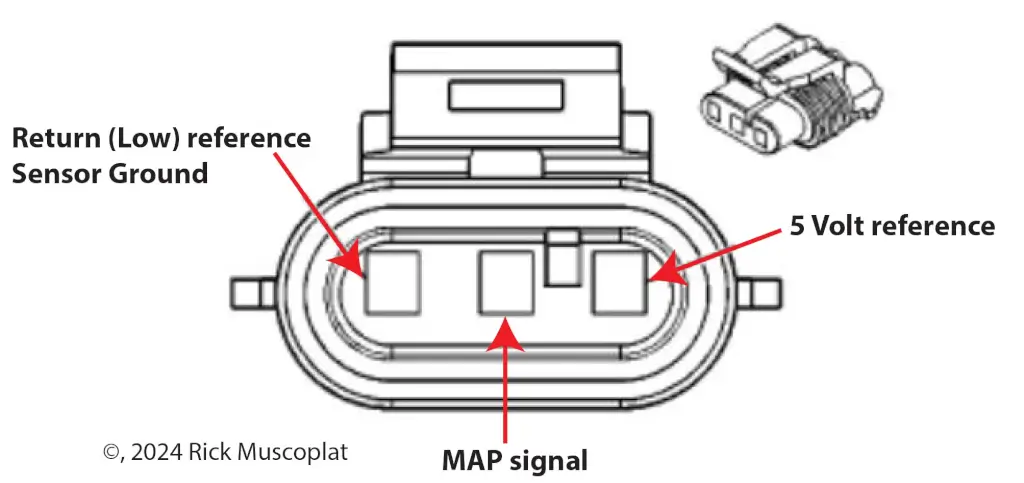
This is a typical MAP sensor wiring diagram. However, refer to a shop manual to confirm the exact wiring diagram for your MAP sensor.
1) With the engine off, read the reference voltage. It should be 4.5–5 volts.
2) The return reference (sensor ground) should read 0 or near 0.
3) The MAP signal wire should read 0.5–1.5 volts for naturally aspirated engines and 2.0–3.0 volts for turbocharged models.
4) Start the engine and check the signal voltage again. It should vary with throttle position. In other words, the voltage should drop as you increase engine RPM. Or, remove the sensor and test it with a handheld vacuum pump. As the vacuum increases, the voltage should drop.
Solutions:
If the 5-volt reference voltage isn’t present, there’s an open between the ECM and the sensor connector. Locate the open/bad connection and repair.
If the reference return (sensor ground) reads above zero, there’s an open in the ground circuit between the MAP connector and the ECM. Locate and fix the open.
If the MAP sensor signal voltage doesn’t change with engine RPM, clean the MAP Sensor:
• Carefully remove the sensor and spray the vacuum port with MAP or MAF sensor cleaner.
• Dry the port thoroughly with compressed air before reinstalling.
If the MAP sensor still doesn’t respond properly, replace the sensor.
Cleaning vs. Replacing a Bad MAP Sensor
Sometimes contamination is the culprit. Oil vapor, carbon, or dirt can clog the MAP sensor’s pressure port, causing slow or inaccurate readings. In those cases, I remove the sensor and clean it with the appropriate MAP or MAF sensor cleaner—never brake cleaner or compressed shop air — directly into the electronics.
If cleaning restores a normal signal response, great. If not, replacement is the only real fix. Once internal electronics fail, a bad MAP sensor can’t be repaired.
What a MAP Sensor Does—and Why It’s So Important
With the key on and the engine off, the MAP sensor acts as a barometric pressure sensor. The ECM uses that reading to adjust fueling for the car’s altitude. That’s why a bad MAP sensor can cause rich or lean conditions immediately after startup.
On startup, the MAP sensor measures the pressure inside the intake manifold (barometric pressure minus manifold vacuum). That pressure tells the engine computer how much air the engine can draw in, which directly reflects throttle position, engine speed, and load.
When the throttle is mostly closed at idle, manifold vacuum is high, and pressure is low. The sensor reports low pressure, and the computer knows the engine needs very little fuel. When you step on the gas, the throttle opens, vacuum drops, manifold pressure rises, and the sensor signals that the engine load has increased—so the computer adds fuel and adjusts ignition timing.
In short, the MAP is answering three critical questions for the ECM:
How much load is on the engine right now?
Higher manifold pressure means higher load; lower pressure means lighter load.
How much fuel should be injected?
The ECM uses MAP data, along with RPM and intake air temperature, to calculate airflow using a speed-density formula.
How should ignition timing be adjusted?
Light load allows more spark advance; heavy load requires less to prevent knock.
On turbocharged engines, the sensor goes even further. It’s trying to figure out actual boost pressure, not just engine load. That information is used to control wastegates, variable-geometry turbos, and electronic boost-control solenoids. If the MAP sensor lies, boost control goes off the rails, and limp mode isn’t far behind.
In simple terms:
The sensor tells the engine computer how much air the engine is under pressure to intake so that the computer can deliver the right amount of fuel and spark at exactly the right time.
Why MAP Sensors Fail Over Time
Most bad MAP sensor failures fall into a few predictable categories.
1) Contamination is common, especially on engines with high oil vapor levels. Electrical problems, such as corroded connectors or heat-damaged wiring, are another common cause.
2) On remote-mounted sensors, cracked vacuum hoses are a common cause of false diagnoses.
3) Long-term engine vibration can also damage internal electronics, leading to intermittent failures that are difficult to trace without proper testing.
Final Takeaway on Bad MAP Symptoms
A bad sensor can masquerade as an ignition problem, fuel system failures, or even transmission issues. That’s why I never blindly replace parts. When you understand the symptoms of a bad sensor, test the sensor correctly, and verify wiring and vacuum integrity, the diagnosis becomes straightforward.
If your engine is running poorly and the data doesn’t make sense, the sensor should be at the top of your checklist. Fixing it restores fuel control, drivability, and engine performance exactly the way the manufacturer intended.
A faulty sensor isn’t something to ignore. If you’re noticing performance issues or the check engine light is on, start by inspecting and testing the sssensor. With the right tools and a systematic approach, you can diagnose and resolve the problem, restoring your engine’s performance to peak condition.
For additional information, see this article from Delphi
©, 2024 Rick Muscoplat
Posted on by Rick Muscoplat