
How to Set Water Heater Expansion Tank Pressure Correctly
The Right Way to Adjust Expansion Tank Pressure
Quick Summary
Setting the proper water heater expansion tank pressure is critical for protecting your plumbing system from thermal expansion damage. The expansion tank pressure should match the home’s static water pressure, measured when no plumbing fixtures are in use. If the pressure is set too low, the tank can become waterlogged and lose expansion capacity, rendering it useless. If the pressure is too high, the tank can’t handle pressure spikes, leading to a dripping T&P valve, pipe stress, and early plumbing and appliance failures. Periodic testing helps confirm the expansion tank is still functioning correctly.
See this article explaining why you need a water heater expansion tank.
What Is the Correct Water Heater Expansion Tank Pressure?
The correct water heater expansion tank pressure should match the home’s static water pressure.
For example:
• If your home water pressure measures 60 PSI, the expansion tank should also be precharged to 60 PSI. The precharge pressure is set with the unit disconnected or the water supply shut off, and the water pressure released throughout the house.
• If your incoming pressure is 70 PSI, the tank should be set to 70 PSI.
I always recommend checking pressure before installing the tank because the factory precharge settings are often inaccurate for the home’s actual plumbing pressure.
Many tanks arrive precharged to 40 PSI, or sometimes 50 PSI. But that may not be compatible with your plumbing system.
The Best Time of Day To Check Your Home’s Water Pressure
1) Early in the morning, before you or neighboring homes have begun their morning routines — At this time, municipal water pressure will be at its highest, so you’ll get the most accurate reading.no fixtures are open, no appliances are running, and demand on the municipal supply line is at or near its lowest — conditions that allow the pressure in your pipes to stabilize and reflect a true resting state rather than a fluctuating reading influenced by active draw.
2) Midday on a weekday can also be a reasonable window — Water demand across the local distribution system tends to dip during these hours, which can produce a comparably stable reading. However, morning remains the more reliable choice because it eliminates variables introduced by irrigation systems, businesses drawing from the same supply main, and the general unpredictability of daytime usage patterns.
3) Avoid early evening and weekend mornings, when household and neighborhood demand peaks sharply — Showers, laundry, dishwashers, and outdoor irrigation all run simultaneously during these windows, pulling pressure down across the distribution system and giving you an artificially low reading that doesn’t represent what your plumbing actually experiences throughout the day. A pressure reading taken during peak demand may lead you to incorrectly conclude that your pressure is within a safe range, even though it may actually be running too high during off-peak hours.
How to Measure Water Pressure
To properly set the water heater expansion tank pressure, you first need to measure the home’s water pressure.
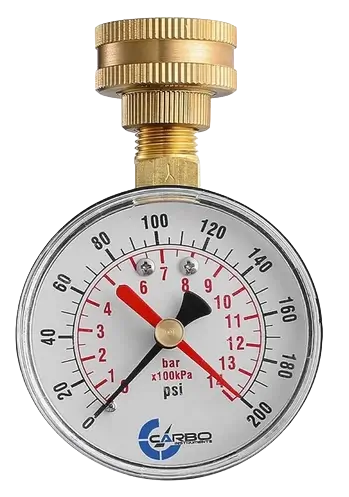
Purchase a water pressure gauge at any hardware or home center store
I typically use a simple hose-thread pressure gauge attached to:
• a laundry faucet,
• hose bib,
To get an accurate reading, conduct the test when:
• No water has been used recently
• Toilets aren’t refilling
• The shower isn’t in use, and
• No water-using appliances are running
Note the reading on the gauge
Normal residential pressure usually falls between:
• 50 PSI and 70 PSI.
If pressure exceeds 80 PSI, most plumbing codes require a pressure-reducing valve.
How to Adjust Expansion Tank Pressure
You’ll need a tire pressure gauge and an air pump.
Before adjusting pressure on an expansion tank:
1. Shut off the water at the main shut-off valve.
2. Relieve water pressure from the plumbing system by opening the hot and cold on any faucet. Leave the faucet open during the procedure.
3. The expansion tank should be empty for the most accurate setting.
Then:
4. Use an air gauge to check bladder pressure.
5. Add air if the pressure is low to bring it to the static pressure you measured with the gauge.
6. Release air if pressure is too high.
The final pressure should match the home’s static water pressure exactly.
I’ve seen many failed installations simply because the installer never checked the factory precharge.
How often should you check the air pressure in the expansion tank?
In real-world plumbing systems, expansion tanks slowly lose air over time through:
• Normal permeation through the rubber bladder
• Schrader valve seepage
• Tiny bladder leaks
• Repeated thermal cycling
You should check the air pressure in a water heater expansion tank about once a year. That’s the same interval I recommend for:
• Testing the water heater T&P valve
• Flushing the water heater
• Inspecting for leaks or corrosion around the tank
What Happens if the Water Heater Expansion Tank Pressure Is Wrong?
The air pressure (precharge) in a water heater expansion tank is critical because it determines when water starts entering the tank and how much expansion volume the tank can absorb. If the air pressure is too low or too high, the tank still “works” to some degree, but not correctly.
What Happens if the Expansion Tank Pressure Is Too Low
Example:
• House static pressure = 60 PSI
• Expansion tank precharge = 30 PSI
That causes several problems:
• The tank partially fills too early
• Instead of starting mostly empty, the tank already contains water before thermal expansion even begins.
That means:
• Less air cushion remains
• Less expansion volume is available
• The tank effectively behaves like a much smaller tank
• System pressure rises faster during heating
As water heats and expands, there’s less compressible air space available. Pressure climbs rapidly.
This often causes:
• dripping T&P valves
• pressure spikes
• faucet drips
• stress on washing machine hoses and fixtures
• The bladder stretches farther than intended
Low precharge can force the diaphragm deeper into the tank, increasing wear over time.
• The tank can become waterlogged sooner
• When most of the air cushion is lost, the tank may fill almost completely with water. Water doesn’t compress appreciably, so pressure spikes become severe.
What Happens if the Expansion Tank Pressure Is Too High
Example:
• House pressure = 60 PSI
• Expansion tank precharge = 80 PSI
Now the opposite problem occurs. The incoming water pressure is not high enough to push water into the tank initially. So when the water heater begins heating:
• Pressure rises immediately
• Little or no expansion enters the tank at first
The tank becomes “inactive” until system pressure exceeds the precharge pressure. In this example, the tank does almost nothing until pressure exceeds 80 PSI
That can create:
• rapid pressure spikes
• nuisance T&P dripping
• fixture stress
An overcharged tank acts undersized. Even though the physical tank is large enough, excessive precharge prevents it from accepting water soon enough.
©, 2026 Rick Muscoplat
Posted on by Rick Muscoplat