
The Pros and Cons of Auto Performance Air Filters
How to choose an auto air filter
Performance air filters are a popular aftermarket modification for car enthusiasts and everyday drivers alike. These filters are designed to replace the standard air filters in vehicles, promising improved engine performance, better fuel efficiency, and increased longevity. However, like any modification, performance air filters come with their own set of advantages and disadvantages. In this article, we will explore the pros and cons of installing a performance air filter in your car.
Understanding The Supposed Promise Of Performance Air Filters
Before diving into the pros and cons, it’s important to understand what a performance air filter is and how it differs from a standard air filter. A standard air filter is typically made from paper or a similar material and is designed to trap dust, dirt, and debris from the air before it enters the engine. This keeps the engine clean and running smoothly.
On the other hand, performance air filters are usually made from cotton gauze or foam, which allow more air to flow into the engine while still filtering out some contaminants. The filter manufactures claim their performance air filters increase airflow better engine performance, but labs results don’t always bear out their performance claims. Worse yet, the lab results show that while performance filters do let in more air, they also let in more dirt.
First, a bit of info about carbureted versus fuel-injected air induction systems
Carbureted Engines Need Warm Air To Help With Vaporization
A carburetor is designed to atomize liquid fuel into droplets and dump them into a central point on the intake manifold. To help vaporize the fuel, the air filter assembly contains a snorkel fitted with a thermal valve. When it starts cold, the thermal valve closes off airflow from the underhood area, forcing it to suck in heated air from a “stove” assembly surrounding the exhaust manifold. When the engine is started cold, the heated air from the exhaust manifold helps vaporize the cold fuel being sprayed into the cold intake manifold. However, as the engine warms up, the thermal valve opens, and the engine sucks in warm air from the engine compartment.
The entire “hot air” system is designed to bring in warm air to help with fuel vaporization in cold weather. Retrofitting the system with a cold air intake shows performance gains when run in warm weather when vaporization isn’t such a problem.
Fuel-injected Rngines Come From the Factory With a Tuned Cold Air Intake
Fuel injectors do a much better job of vaporizing the fuel than older carburetors. So carmakers moved the air filter away from the intake manifold and arranged the air duct to draw in outside “cold” air, due to its higher mass. By drawing in high-mass cold air and measuring its mass with a mass airflow sensor (MAF) located directly after the air filter, the engine computer more accurately meters fuel to obtain the most power and efficiency. But the filter box move wasn’t just for drawing in cold air.
AN OEM filter box on a fuel-injected vehicle is purposely designed to accomplish four things:
1) Create a swirl/vortex airflow pattern inside the filter box that causes particulate matter to drop out of suspension and fall to the bottom of the box, thereby extending the life of the air filter.
2) Reduce inrush air noise by creating a noise-canceling airflow path.
3) Create laminar airflow across the sensing elements in the MAF sensor to ensure accurate mass readings
4) Filter out harmful particulate matter while also providing maximum airflow and the lowest pressure drop across the filter.
To accomplish these goals, carmakers have designed pleated/fluted high-filtration filters that occupy less underhood space than previous designs. The filters provide low flow restriction and high dust-holding capacity.
Aftermarket cold air intakes eliminate all the benefits of the factory cold air intakes
Based on a bogus theory that a larger filter with more surface area creates more airflow, many aftermarket cold air intake manufacturers and DIYers remove the factory air filter box and replace it with an aftermarket system.
The promised benefits of an aftermarket cold intake are:
More horsepower due to greater airflow
Better gas mileage due to increased airflow efficiency
Lower cost due to a reusable design.
Let’s look at each of those claims.
Do aftermarket performance air filters and a retrofit intake provide more horsepower?
No. Aftermarket cold air intake systems and performance air filters do provide vastly more surface area and can, in theory, provide more airflow to the engine. But does that translate into more power? Not necessarily. First, a normal air filter can provide all the airflow an engine needs. Second, adding the capacity for more airflow that the engine will never use may sound good in the seller’s marketing materials, but it doesn’t actually provide more power. In other words, more airflow doesn’t mean more power. Here’s why.
Aftermarket filters can provide more HP, but only at or near redline
The greatest restriction in an air intake system is NOT the air filter; it’s the throttle plate. Even with increased airflow, aftermarket performance air filters don’t provide any noticeable increase in HP until the throttle plate is fully open when the engine is at or near redline. So, the increased HP claims are due to the wide-open throttle plate. Unless you’re racing the vehicle at wide-open throttle, you will never see a performance gain by using a performance air filter.
Performance air filters don’t increase fuel mileage
Again, the greatest restriction in an air intake system is NOT the filter, it’s the throttle plate. According to the Automotive Aftermarket Suppliers Association (AASA), “modern air filters have more than enough surface area to support airflow during normal driving conditions. Even if airflow through the air filter becomes slightly restricted, the powertrain control module (PCM) will use the mass airflow (MAF) sensor input to match the volume of incoming fuel with the volume of incoming air. So, even while horsepower might be slightly reduced due to restricted airflow, fuel economy, and power won’t suffer during normal driving conditions.”
…the popular perception is that increasing air filter capacity will increase an engine’s horsepower and fuel economy. The reality is that increasing the airflow beyond the capacity of the engine’s peak demand will do nothing to enhance performance. In practically all cases, the OE air filtration system is, by far, the most efficient and the least maintenance-intensive system on the market simply because its design matches the engine’s original intake airflow requirements. — Air and Fuel Filter Service Tips knowyourparts.com/technical-articles/air-and-fuel-filter-service-tips/
Aftermarket cone filters clog faster than factory air filters
First, recall that factory air filter boxes are purposely designed to create a vortex that drops particulate matter out of suspension. Aftermarket cold air filters lack the vortex design, so they actually need the extra surface area because more particulate matter hits the filter surface. So, in dirty environments, they can actually clog faster than a smaller surface area factory filter.
Performance air filters lose their filtration efficiency after repeat washings and re-oiling cycles
In SAE J1858 filter capacity tests done by Hastings Filter Company, aftermarket oiled filters lost their dirt-holding capacity over repeat washings and re-oiling cycles.
“We recently tested one of the latest market offerings for a reusable engine oil filter. During the first test cycle, the filter demonstrated nearly the same efficiency and capacity of a standard replaceable filter. However, the performance of the filter element during subsequent use cycles fell off dramatically. By the 10th use cycle (as recommended by the manufacturer), the contaminant holding capacity had decreased by 67%. The chart below illustrates the decrease in capacity with the successive uses of the reusable filter compared to the performance offered by a conventional Hastings filter.” — Hastings Engineering Bulletin 98-3
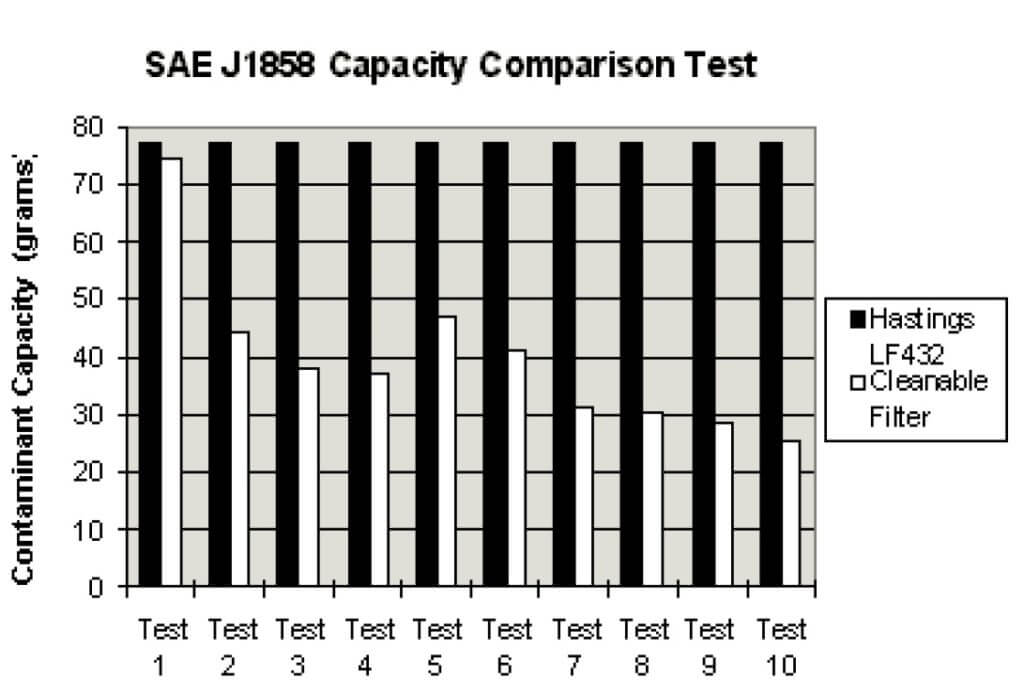
Hastings dirty holding capacity test
Why performance air filters lose their filtration ability with successive cleaning and oiling
Because they shed cotton fibers during use and during each wash/oil cycle.
Where do the fibers go?
Many winds up being baked onto the hot wire in the MAF sensor, which throws off your MAF sensor readings. Others get sucked into the engine, where they’re burned. The remainder gets dislodged into the soapy water and is lost permanently when the filter is rined off.
Performance air filters provide more airflow but let in more dirt
Many performance air filters are constructed from cotton and synthetic fibers that are sprayed with oil to capture and hold particulate matter. Due to their larger pore size, they do provide more airflow, but they also let in more dirt—the opposite of what you want in an engine air filter. See the PDF below to view Arlen Spicer’s actual test results using ISO 5011 air filter testing protocols.
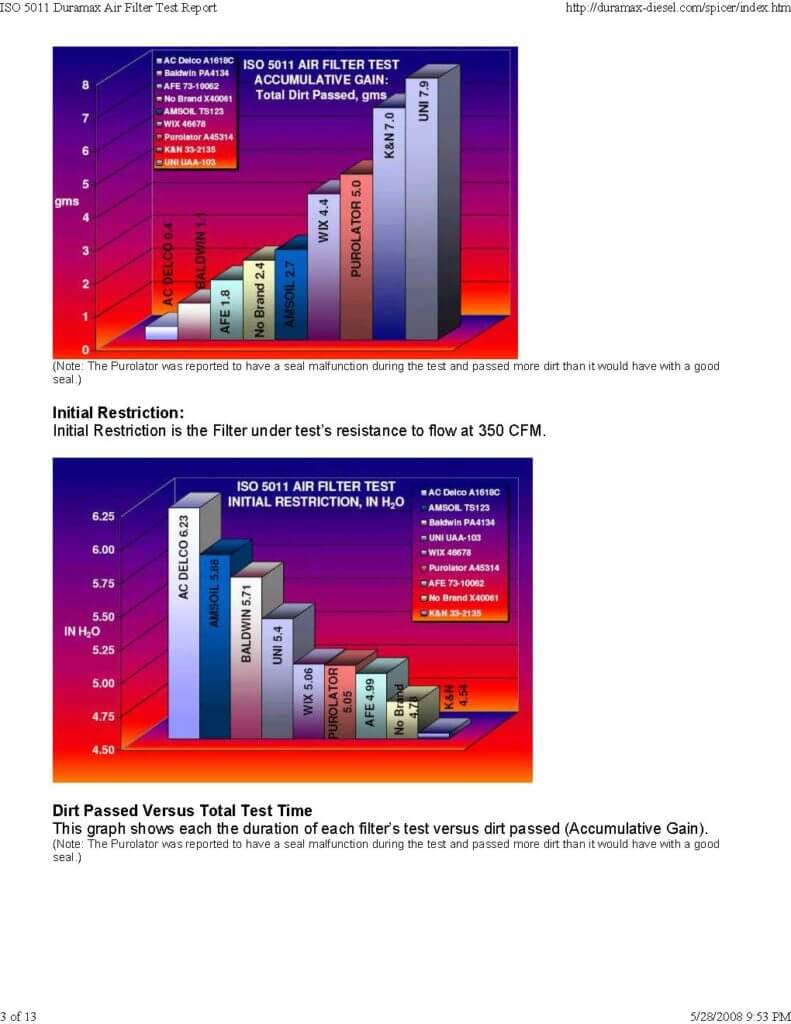
Click on the image to download a PDF of Spicer’s test
Reusable performance cone filters don’t really reduce the cost of ownership
When you consider the initial cost of an aftermarket cold air intake assembly compared to the cost of regular air filter replacements, they don’t reduce the cost of ownership. That’s especially true when you consider that Hasting’s tests show that a reusable filter’s dirt-holding capacity drops by 67% after the 10th washing. Even though performance filter manufacturers claim their filters are “lifetime,” it’s obvious from the testing that you should replace them rather than suffer decreased filtering capacity.
Typical cost of aftermarket cold air intake system. $291.99 (69-1507TS K&N Performance Air Intake System)
1 replacement filter (after the 10th washing) Approximately $52
Total cost $343
10 cellulose air filters @ $15-ea. $150.
The best air filters are OE or OE-compatible filters from major filter manufacturers
Bosch, Denso, Hastings, Mahle, Fram, ACDelco, Mann, Wix, Purolator
Pros of Performance Air Filters
• Slightly Improved Horsepower At Wide-Open Throttle— A slight increase in horsepower at or near redline, when you operate the engine at wide-open throttle.
• Longer Lifespan— Because they’re washable, they can be reused. However, with each washing, the filter loses filtration efficiency
• Better Sound— By replacing the factory-tuned air filter box with an aftermarket cold air intake, you get a more throaty sound preferred by car enthusiasts. Unfortunately, that comes with the loss of laminar airflow across the MAF, which can set a check engine light.
• Environmental Benefits— A reusable performance air filter reduces the number of disposable filters that end up in landfills. They’re designed to last the lifetime of the vehicle and they do, but with successive losses in filtration efficiency, which allows more dirt into the engine.
Cons of Performance Air Filters
• Increased Engine Wear— While performance air filters are designed to allow more air into the engine, this comes at the cost of more dirt infiltration which could lead to increased engine wear over time. This is particularly a concern in dusty or dirty driving conditions, where more contaminants are present in the air.
• Higher Overall Cost— Performance air filters are more expensive than standard filters. Although they may save money in the long run due to their reusability, the upfront cost can be a deterrent for some drivers. Additionally, the cost of cleaning kits and maintenance products should be factored into the overall expense.
• They Provide Minimal Performance Gains— The performance gains from a performance air filter are minimal and only available at or near wide-open throttle. In most cases, the increase in horsepower is so small that it doesn’t justify the cost and effort involved in installing and maintaining the filter.
• Possible Warranty Issues— Modifying your vehicle with performance air filters, can sometimes lead to warranty concerns. Some manufacturers may void the warranty on the MAF sensor if your vehicle is fitted with a cotton-oiled air filter.
©, 2020 Rick Muscoplat
Posted on by Rick Muscoplat