
Troubleshooting Heated Seat Problems on a Chevrolet
Fix Heated Seat Problems on a Chevrolet — Step-by-Step Guide
Like any electrical component, heated seats can develop issues over time. These problems can range from seats not heating up at all to uneven heating or intermittent operation. This article will guide you through common heated seat problems on a Chevrolet and provide step-by-step instructions on how to fix them. The system I’ll describe here is for many Chevrolet and other GM vehicles like Buick, Cadillac, GMC, and Pontiac.
How Chevrolet heated seats work
GM designed the system to have two heat zones with three heat levels. The buttons refer to the heaters in the seat cushion or the seat back. If the driver presses the seat cushion button, it activates the heaters in both the seat cushion and seat back. However, if the driver presses the seat back button, only the seat back heater will activate.
Three heated seat heating levels
The heat level is determined by the number of times the seat cushion and back or back buttons are pressed. Pressing the seat cushion 1 time activates both the seat back and cushion heater elements to run in the high heat mode. Subsequent button presses of the same button reduce the heat level from high to medium, medium to low, and low to off. The same routine applies to the seat back button; the first press is high, while subsequent presses reduce the heat level.
How buttons control heated seats
The door modules receive battery power from a door circuit breaker (25A) and a driver/passenger door module fuse (15A) located in the left instrument panel fuse box. The door modules then provide power to each heated seat switch and each button press produces a momentary contact closure. The door module sees the contact closure requesting heat and heat level and communicates the request to the seat module via a digital bus.
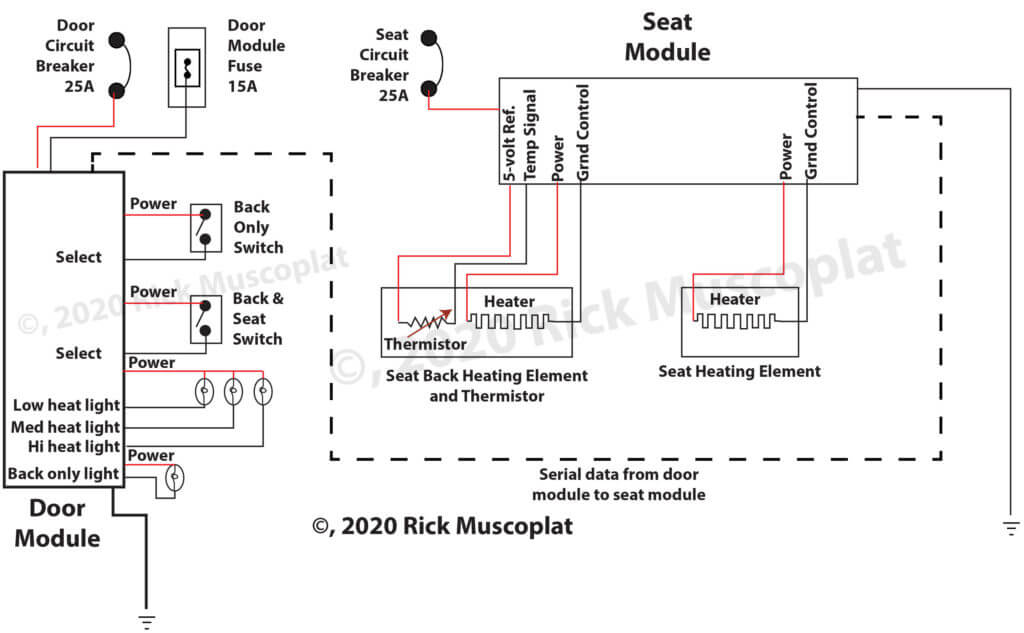
The heated seat wiring diagram shows the schematic for one seat. The wiring diagram for the other seat is the same
The seat module receives battery power from the seat circuit breaker (30A); one for each seat located in the instrument panel relay block. The seat module provides power and ground to the seat and back heating elements. The seat module controls which heating element is activated by switch the appropriate heating element ground on or off. In addition to controlling which heating element is activated, the seat module controls the heat level by switching the ground on or off. It determines when to perform the switching based on temperature feedback from the 2-wire thermistor located near the seat back element. The thermistor receives a 5-volt reference from the seat module and the module notes the varying voltage drop from each thermistor based on the temperature it senses.
Heated seat problems — Step-by-step guide
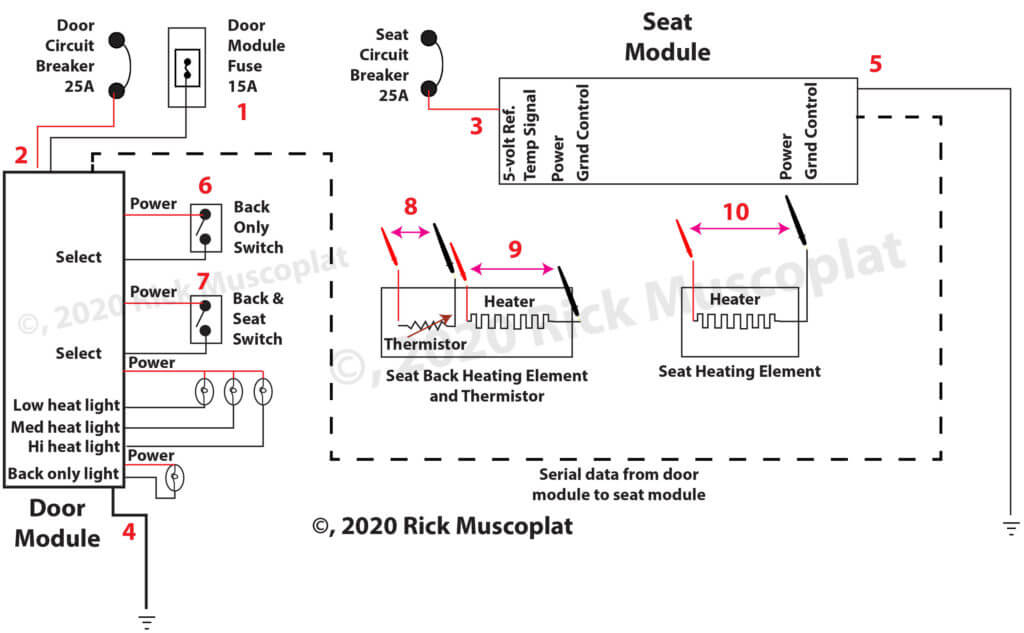
1) Check the fuses
2) Check for battery power at the door module
3) Check for battery power at seat module
4) Check for good ground at the door module
5) Check for good ground at seat module
6) Check for power at the back switch
7) Check for power at back and seat switch
8) Seat thermistor continuity (set meter to ohms scale). Resistance should be 10KΩ ± 2KΩ at room temperature. If the meter reads OL or ∞ the seat thermistor is open, it must be replaced.
9) Next, check heater element resistance. Set meter to ohms. Resistance should be 1.5-5.5Ω. If the meter reads, OL or ∞ the element is open and must be replaced. Double check the heater element by jumpering a light bulb (#3056 or 194) in place of the seat or back heating element. Activate the seat heater and see if the light comes on with the bulb in place. If the light comes on now but doesn’t when the actual heating element is connected, this test confirms the element is bad and must be replaced.
©, 2020 Rick Muscoplat
Posted on by Rick Muscoplat