
Understanding A 2 Cycle Oil Calculator Chart
How to Mix 2-Cycle Oil Like a Pro
Quick Summary
• Use high-quality 2-stroke oil; never regular motor oil
• Measure your oil carefully, referring to the 2 Cycle Oil Calculator Chart below.
• Add the oil to an empty gas can and then add the gas for the best mix.
• If you add the oil to the gas, you must mix it manually.
Article
When people ask me how to mix 2-cycle oil, I always start by stressing one point: a 2-stroke engine will destroy itself without the correct oil-and-gas blend. I’ve rebuilt many ruined engines simply because the owner guessed at the ratio or skipped oil entirely. That’s why I rely heavily on a 2 Cycle Oil Calculator Chart.
2 cycle oil calculator chart
This 2-cycle oil calculator chart shows how much 2-cycle oil to use per gallon using traditional 2-cycle oil or Opti-2 oil.
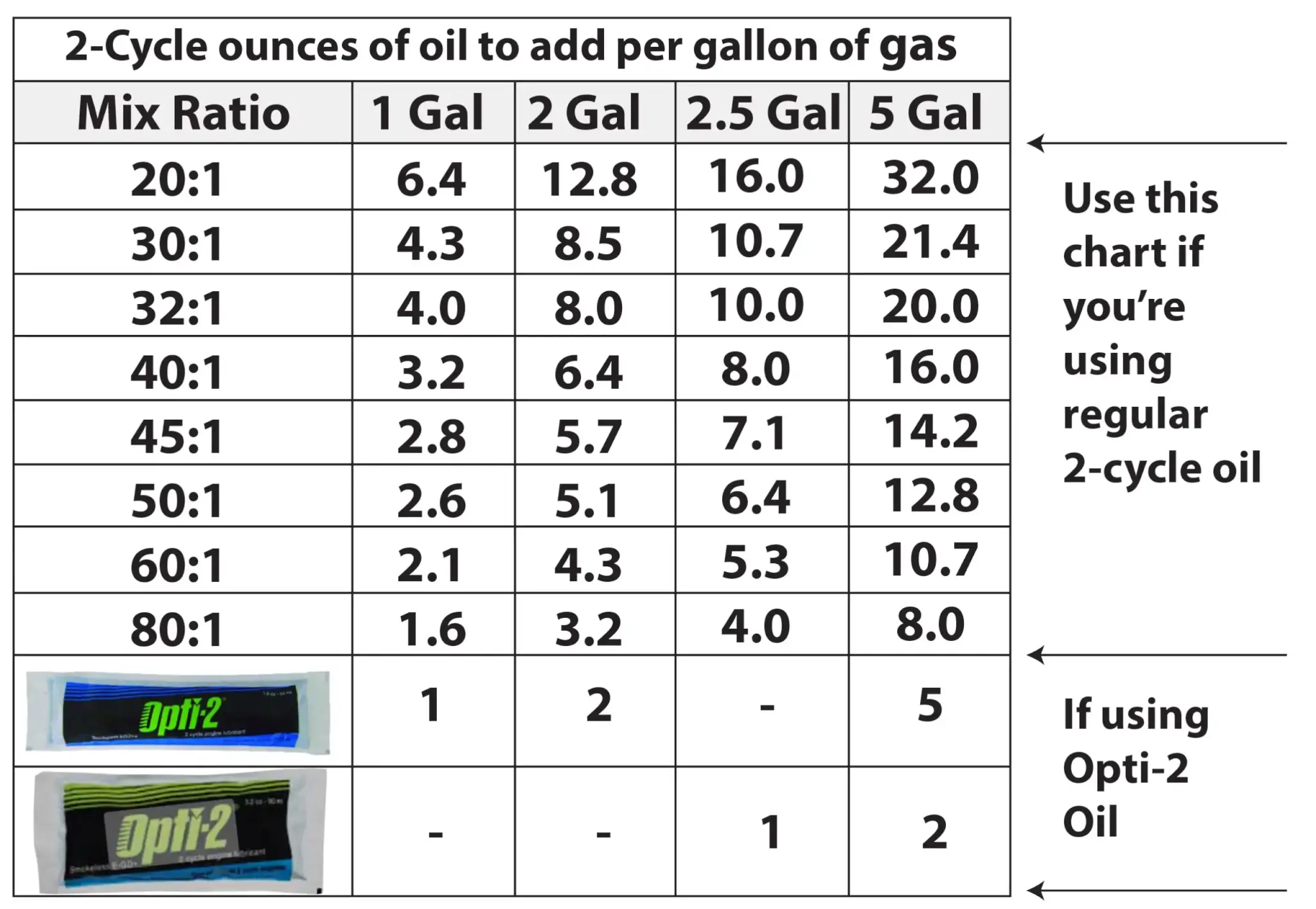
How to Mix 2-Cycle Oil
I’ve mixed thousands of gallons of 2-stroke fuel in my career, and this is the method I teach:
1. Start with fresh gasoline — Never use fuel older than 30 days unless treated. Ethanol fuels attract moisture, so freshness matters.
2. Use a clean, dedicated gas can for your 2-stroke equipment — Label it “2-Cycle Mix Only.”
3. Measure the oil accurately — Use a real measurement, not “eyeballing it.” Following the ratios shown in the chart above, measure out the correct amount of 2-cycle oil.
4. Add the oil to the empty gas can — You’ll get the best mixing if you add the gas to the oil versus adding oil to the gas.
5. Add the gasoline at the pump — The swirl created by the gas nozzle will help mix the oil and gas.
6. Mix only what you’ll use in 30 days — Even stabilized fuel degrades.
Following these steps ensures you understand how to mix 2-cycle oil correctly every time.
Typical 2-Stroke Mix Ratios (Use Your 2 Cycle Oil Calculator Chart)
Different engines require different ratios. Always confirm your model’s requirement, then check the 2 Cycle Oil Calculator Chart above. If you don’t know the recommended ratio for your engine, here’s a reference chart:
Common ratios include:
50:1 – Most modern trimmers, chainsaws, blowers
40:1 – Many mid-size older 2-stroke tools
32:1 – High-performance engines and older designs
If you’re unsure, your manual or a 2 Cycle Oil Calculator Chart eliminates guesswork.
What is Opti-2 oil?
Opti-2 is a specialized two-cycle engine oil designed to be mixed at a single ratio for almost all 2-stroke small engines, regardless of the original manufacturer’s recommendation. Unlike traditional 2-cycle oils that require different ratios like 50:1, 40:1, or 32:1, Opti-2 lets you run a single universal mix in all engines after the break-in has been completed.
Opti-2 Oil Isn’t Magic: Here’s How It Works
Opti-2 is a high-performance, air-cooled two-stroke oil formulated with a patented “eutectic” additive package. This additive bonds microscopic lubricants to the tiny pores of the cylinder walls, providing exceptional protection even at very lean mixtures.
It’s most commonly used for:
• Chainsaws
• Leaf blowers
• Snowthrowers
• String trimmers
• Hedge trimmers
• Any air-cooled 2-stroke for small engine
One mix for all engines — After break-in, you can use one unified gas/oil mix (based on Opti-2’s instructions) instead of keeping separate cans for 50:1, 40:1, and 32:1 equipment.
Virtually smokeless — The formula produces very low smoke, carbon, and deposits.
Contains a 24-month fuel stabilizer — This is a major advantage over standard 2-stroke oils—your fuel stays fresh far longer.
Ethanol-compatible — Helps reduce the corrosive and drying effects of E10 gasoline.
Highest-rated 2-cycle oil in the industry – It’s designed for maximum lubrication, minimal carbon buildup, and extended engine life.
When NOT to Use Opti-2
Opti-2 is not recommended during the break-in period of a brand-new engine. A break-in requires a higher oil ratio (often 40:1 or 32:1) that Opti-2 intentionally avoids.
After three to five tanks of traditional mix, you can switch to Opti-2.
For more information on how Opti-2 works, see their educational link
- Highest rated 2-cycle oil in industry
- Smoke-free operation
- Ethanol compatible
- Contains 24 month fuel stabilizer.
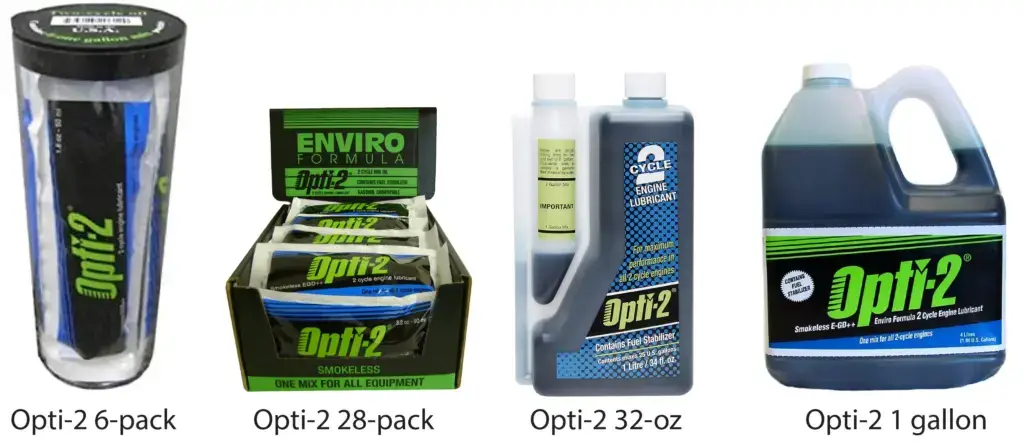
What Makes 2-Stroke Engine Oil Different
2-stroke engines don’t have a separate crankcase full of oil like a 4-stroke engine. Instead, the oil must mix with the gasoline, travel through the crankcase, and burn during combustion.
Because of that, 2-stroke oil is engineered very differently:
It burns cleanly — Since the oil goes through the combustion chamber, 2-stroke oil is formulated to burn with minimal smoke and carbon.
It must lubricate AND clean — The oil has to protect the piston, rings, rod bearings, crank bearings, and cylinder walls—while also preventing carbon deposits on ports and exhaust components.
It resists fuel dilution and ethanol effects — 2-stroke oil must stay stable when mixed with gasoline, including E10 ethanol blends.
It has special detergents and dispersants — These additives keep varnish and carbon from clogging ports, rings, and muffler spark arrestors.
It’s designed to atomize and mix evenly with fuel — Unlike motor oil, 2-stroke oil is engineered to stay suspended in gasoline without separating.
In other words:
Regular motor oil will destroy a 2-stroke engine—use only oil specifically labeled “2-cycle” or “2-stroke.”
The Two Types of 2-Stroke Oil
1. Air-Cooled 2-Stroke Oil (Most common in small engines) — Air-cooled oil runs hotter and must withstand higher combustion temps. Look for: JASO FD or ISO-L-EGD on the bottle.
Used in:
Chainsaws
Trimmers
Leaf blowers
Snowthrowers
Mopeds
2. Water-Cooled 2-Stroke Oil (Marine oil, TC-W3) — Used in:
Outboard boat engines
Jet skis
What Specs & Features You Should Look For
When choosing a 2-stroke oil, here are the specs that matter most:
1. JASO Rating (Most Important Spec) — A JASO Rating is an industry-standard quality classification for 2-stroke engine oils, created by the Japanese Automotive Standards Organization (JASO). It tells you how clean the oil burns, how well it lubricates, and how much carbon and smoke it produces. This is the industry standard for 2-stroke small-engine oil quality.
JASO FB – Basic
JASO FC – Medium detergency
JASO FD – Highest detergency, cleanest burning oil
Always choose JASO FD if available.
2. ISO Global Specification — ISO ratings parallel JASO and indicate cleanliness and lubrication quality.
ISO-L-EGB – Basic
ISO-L-EGC – Midgrade
ISO-L-EGD – Highest performance
ISO-L-EGD = top-tier.
3. Compatibility With Ethanol Fuels — E10 fuel attracts water and causes corrosion.
Choose an oil labeled:
Ethanol compatible
Full synthetic or synthetic blend (synthetics handle ethanol better)
4. Smoke Level / Emissions — Because the oil is burning with the fuel, you want a 2-cycle oil that produces:
Low smoke
Less odor
Fewer carbon deposits in the exhaust port
5. Fuel Stabilizer Included — Some premium oils include a built-in stabilizer (like Opti-2).
This helps significantly if you store equipment or leave fuel in the tank.
6. Synthetic vs. Conventional — Full Synthetic offers the best protection, but costs more. Best for chainsaws, pro equipment, hard use
7. Brand Reputation — Reliable small-engine oils include:
Stihl HP Ultra
Husqvarna XP+
Echo PowerBlend
Opti-2
Amsoil Saber
Lucas Semi-Synthetic
High-quality brands produce cleaner engines with fewer carburetor and exhaust issues.
JASO FD (best available)
The JASO FD is the current rating and the one you want.
Maximum detergency
Very clean burning
Minimal carbon buildup
Low smoke
Excellent piston cleanliness
Best for high-RPM tools like chainsaws, trimmers, and blowers.
©, 2023 Rick Muscoplat
Posted on by Rick Muscoplat