
Understanding Long Term Fuel Trim and how to fix it
How to use long term fuel trim values to diagnose engine and fuel problems
Understanding how a vehicle’s engine management system regulates fuel and air mixture is crucial. One key component in this system is the concept of fuel trim, which helps maintain optimal engine performance and efficiency. Specifically, long-term fuel trim (LTFT) plays a significant role in diagnosing issues that may arise in the fuel delivery system. This article explores what long-term fuel trim is, how it functions, and how it can be used to diagnose problems in a car’s engine. If you’d like to learn more about fuel trim in general, read this post
The basic definition of Short-term versus long-term fuel trim
The factory software in ECMs includes a look-up table providing specific fuel delivery values based on the position of the throttle position sensor while maintaining emissions goals. However, the ECM is also self-learning and can make short-term and long-term adjustments to the factory look-up table to add or subtract fuel based on the engine’s actual performance at the time. This learning feature is referred to as fuel trim.
• Short-term fuel trim STFT)— The ECM adjusts short-term fuel trim to change fuel delivery based on the immediate engine performance needs. STFT is constantly changing and is not nearly as useful as LTFT for diagnosing engine problems unless those problems occur at a certain throttle position
• Long-term fuel trim (LTFT)—Unlike STFT, Long-term fuel trim is learned over time. The adjustment is then stored in the ECM’s keep-alive or adaptive memory.
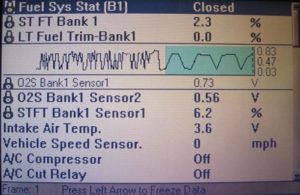
Scan tool fuel trim data
Let’s take a deeper dive into long-term fuel trim works
Let’s say that the ECM has found that over time, a worn engine needs 5% more fuel when the engine is running at 1,000 RPM, and the driver is requesting 30% throttle. Once the ECM detects those conditions, it refers to its internal lookup table to see if it has stored an LTFT adjustment for that condition. If so, it automatically provides 5% more fuel (or whatever LTFT adjustment is stored).
The long-term fuel trim adjustments are stored in the ECM’s adaptive memory. For more information on how adaptive memory works, read this post
How much LTFT is too much?
Each car maker is different, but the general rule is that an LTFT of +25% or -25% indicates a serious problem with the engine or fuel system. In other words, the ECM has concluded over a period of time that it must add +25% more fuel than the look-up table value or subtract -25% fuel. Let’s examine the possible causes of a high LTFT.
What causes a high long-term fuel trim?
In this example, we’ll examine the possible causes of a +25% long-term fuel trim. The LTFT tells us that it has to continuously add 25% more fuel. In other words, based on readings from the upstream oxygen sensor, the engine was running way too lean, and the ECM had to compensate by adding more fuel.
The possible causes of a high (+25%) long-term fuel trim
• Restricted fuel system— Clogged fuel filter, clogged fuel injector(s)
• Low fuel pressure or low fuel volume— conduct a fuel pressure test
• Vacuum leak or unmetered air— Check for a disconnected vacuum hose, intake gasket leak or damaged air intake duct after the MAF sensor. Check using propane enrichment or leak test with a smoke machine.
If the short-term fuel trim (STFT) quickly decreases to acceptable levels and the long-term fuel trim (LTFT) gradually starts to decrease, it indicates a vacuum leak. After making the necessary repair, reset the keep alive memory (KAM) and restart the vehicle.
• Dirty or faulty MAF sensor— Try cleaning. Defective MAF. Replace
• Exhaust Leak— A leak in the exhaust flexible joints, holes in the pipes before the upstream O2 sensor would cause the O2 sensor to read lean. Smoke test the exhaust system to find the leak.
• Faulty upstream oxygen sensor— An oxygen sensor that is stuck reading a lean condition when the exhaust isn’t really lean
For more information on how fuel pumps work and failure symptoms, read this post
For information on fuel injector cleaning, read this post
For information on how to test a fuel pump, read this post
The possible causes of a negative (-25%) long-term fuel trim
In this scenario, the upstream oxygen sensor is reporting a rich condition, and the ECM is responding by cutting way back fuel delivery.
• Restriction in the air intake— The ECM has responded to the MAF or MAP reading to determine fuel delivery. But the engine is not getting the expected amount of air as it expected, and the exhaust is reading way too rich. So, the ECM is cutting back on fuel delivery.
• Leaking fuel injectors— The ECM has commanded a specified amount of fuel, but one or more injectors are delivering more fuel than asked for, and the exhaust is now too rich, so the ECM is cutting fuel delivery.
• Faulty sensors— Faulty MAF, MAP, Upstream O2 , or ECT sensors
• Faulty fuel pressure regulator or fuel pump driver— Fuel pressure is too high, so the engine is getting too much fuel
©, 2018 Rick Muscoplat
Posted on by Rick Muscoplat