
Understanding Motor Oil Specifications: A Comprehensive Guide
Making sense of motor oil specifications
Motor oil is often referred to as the lifeblood of an engine, and for good reason. It lubricates the engine’s moving parts, reduces friction, cleans, cools, and protects against corrosion. However, not all motor oils are created equal, and selecting the right one for your vehicle is crucial for maintaining optimal performance and longevity. The key to choosing the right motor oil lies in understanding motor oil specifications. This article will break down what these specifications mean, why they matter, and how to choose the right oil for your vehicle.
What Are Motor Oil Specifications?
Motor oil specifications are standards set by various organizations to ensure that motor oils meet certain performance and quality criteria. These specifications cover a wide range of factors, including viscosity, temperature stability, wear protection, fuel economy, and compatibility with engine materials. The most commonly referenced specifications are those set by the Society of Automotive Engineers (SAE), the American Petroleum Institute (API), and the International Lubricant Standardization and Approval Committee (ILSAC).
What is motor oil viscosity?
Viscosity is a measurement of a fluid’s resistance to flow. Since cold oil thickens and hot oil thins, the oil’s viscosity rating must include a temperature reference for viscosity when cold and hot. There are also two types of oil viscosity measurements: kinetic and Absolute (also called dynamic).
Kinematic viscosity versus Dynamic (Absolute) Viscosity
Kinematic viscosity refers to the oil’s flow due to gravity. For example: Drill a hole of a set size in a small cup and plug it. Then, fill the cup with a pre-determined amount of motor oil at 100° C (212°F). Unplug the hole and time how long it takes for the cup to empty. That’s a Kinematic rating. Unfortunately, engines don’t work that way. Measuring oil’s resistance to flow in an engine is far more complicated.
I bring up Kinematic viscosity because many oil companies advertise their oil’s ability to flow in cold weather by pouring it from a beaker when frozen. That makes for sensational ads, but it has no bearing on the oil to function in your engine because your engine doesn’t lubricate parts via gravity. It pumps oil through your engine, and that kind of viscosity is called Dynamic Viscosity.
Knowing that, let’s go back to our dripping cup example. Instead of leaving the top of the cup open to the atmosphere, we’ll cap it and apply 10-psi of pressure. Next, we’ll attach a 12″ drinking straw to the hole at the bottom of the cup. If we repeat the test at -17.7°C (0°F) we’ll get a completely different result and this result will be it’s absolute or dynamic viscosity.
In other words, motor oil’s absolute viscosity measures how the oil acts when the oil is being pumped. Its absolute/dynamic viscosity really tells you how the oil will behave at cold startup and how well it pumps when cold.
How is motor oil viscosity expressed?
The Society of Automotive Engineers (SAE) uses a common classification of “XW-XX,” where the number preceding the “W” (winter) is the oil’s absolute/dynamic low-temperature (-17.7°C (0°F) performance and the other number represents the oil’s Kinematic high temperature at 100° C (212°F).
The Winter rating is calculated using a special testing apparatus called a cold-cranking simulator and each oil grade is measured in mPa’s. The oil’s high-temperature grade is measured in (cSt).
IMPORTANT NOTE: The oil grades shown below are tested at different temperatures! A 0W oil is tested at -35°C while the 5W oil is tested at -30°C. The viscosities of the W grades are MAXIMUM allowable, while the viscosities of the high temperature grades are MINIMUMS
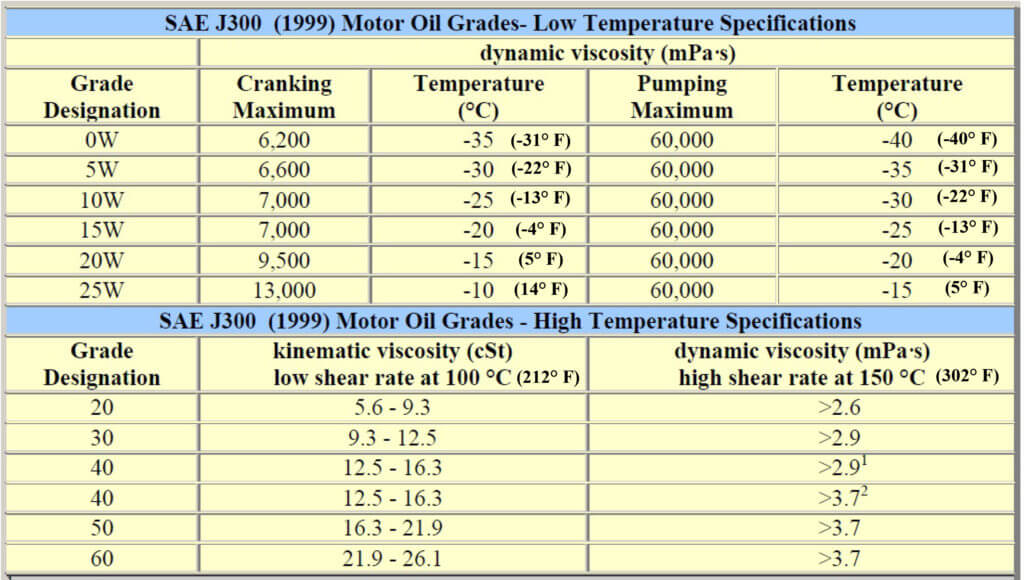
So, a 5W-30 grade oil thickens less than a 10W-30 grade oil in cold weather. That means a 5W-30 oil will allow your engine to crank faster and the oil pump can pump it easier than a 10W-30 oil at the same cold temperature.
At higher temperatures, a 5W-30 grade thins out more quickly than a 5W-40 grade oil at the same high temperature.
API Service Classifications
The American Petroleum Institute (API) provides service classifications for motor oils, which indicate the oil’s performance in terms of engine protection and compatibility. These classifications are divided into two main categories: “S” for gasoline engines (Service) and “C” for diesel engines (Commercial).
API “S” Ratings: These are for gasoline engines, and the ratings range from SA (the lowest) to SP (the highest and most recent). Each letter in the API service classification represents an improvement in oil performance, such as better oxidation stability, wear protection, and sludge control. The most recent standard, API SP, includes enhanced protection against low-speed pre-ignition (LSPI) and timing chain wear, which are critical for modern turbocharged engines.
API “C” Ratings: These are for diesel engines, and the ratings range from CA to CK-4, with each successive letter indicating an improvement in performance. For example, API CJ-4 oils provide better protection against soot, oxidation, and wear than older API classifications.
When choosing motor oil, it’s essential to select one that meets or exceeds the API classification recommended by your vehicle manufacturer. Using an oil with a lower rating than specified can lead to inadequate protection and potential engine damage.
ILSAC Standards
The International Lubricant Standardization and Approval Committee (ILSAC) sets additional standards for motor oils, particularly focusing on fuel economy and emissions reduction. The ILSAC ratings are denoted by the letters “GF” followed by a number, such as GF-5 or GF-6.
GF-5: Introduced in 2010, this standard focused on improved fuel economy, enhanced protection for emission control systems, and better protection against engine deposits.
GF-6: This standard, which came into effect in 2020, offers even greater protection against LSPI, improved fuel economy, and better protection for engines operating under modern driving conditions, such as frequent stop-and-go driving and extended idling.
ILSAC-rated oils are usually recommended for newer vehicles, especially those with turbocharged engines and direct fuel injection systems. Always consult your vehicle’s owner manual to determine whether an ILSAC-rated oil is required.
OEM-Specific Specifications
In addition to the standard specifications provided by organizations like SAE, API, and ILSAC, many vehicle manufacturers have their own specific oil requirements. These Original Equipment Manufacturer (OEM) specifications are tailored to meet the unique demands of their engines.
For example:
BMW requires motor oils that meet their “Longlife” specifications, such as BMW Longlife-01 or Longlife-04.
Mercedes-Benz has their MB 229.5 and MB 229.51 specifications.
Volkswagen uses standards like VW 502.00 and VW 507.00.
Using oil that meets these OEM specifications is critical for maintaining your vehicle’s warranty and ensuring the engine performs as intended. Always check the owner’s manual for the correct oil specification and avoid using oil that doesn’t meet the required standards.
Viscosity index (VI)
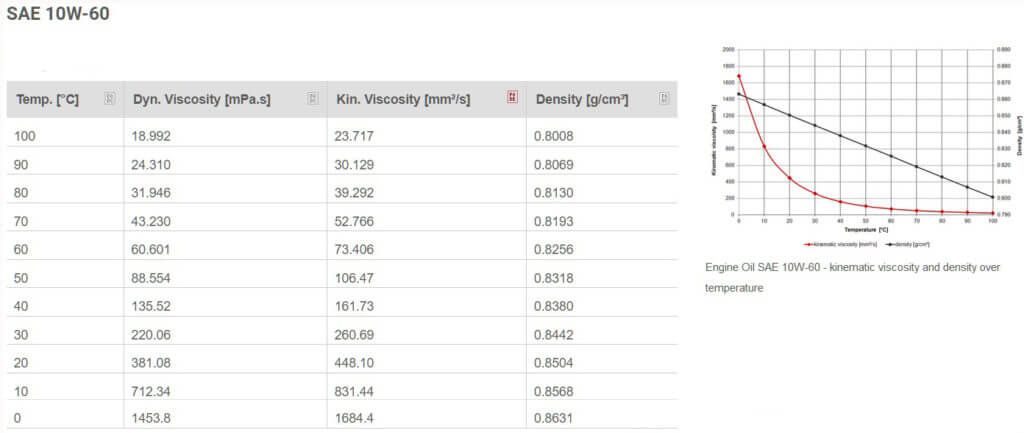
All oil thins as it warms up. The rate at which the oil thins is expressed by its viscosity index. If the oil has a very slow rate of thinning as temperature increases, then its VI is high. In other words, an oil with high VI maintains a more consistent viscosity over a wide temperature range.
The effect of temperature on oil viscosity is NOT uniform
Oil thinning or thickening is not linear. For example, an oil’s kinematic viscosity will change MORE between 50°F and 59°F than it will between 176°F and 185°F.
The VI of motor oil ranges from -60 to as much as 400, depending on the types of viscosity modifiers used by the refinery or oil blender. Typically, motor oil contains between 5% to 20% viscosity improver additives.
This is important. People often think that the first and second numbers are both kinematic values. They’re not. The number before the W is the oil’s absolute viscosity while cranking based on ASTM TEST D5293 cold-cranking simulator) and pumping viscosity based on ASTM D4684, ASTM D3829, ASTM D6821 or ASTM D6896 (mini rotary viscometer). The cold-cranking simulates the cold start of an engine at various temperatures based on the projected viscosity of the oil being tested. In other words, testers don’t use the same temperature for each oil.
For example, to achieve a 0W rating, the oil must not exceed a maximum of 6200 mPa (megapascal) cranking viscosity at -31°F (-35°C) and a maximum pumping viscosity of 60,000 mPa at -40° F/C.
See this chart to understand how two oils with the same first number can have two different absolute viscosities.
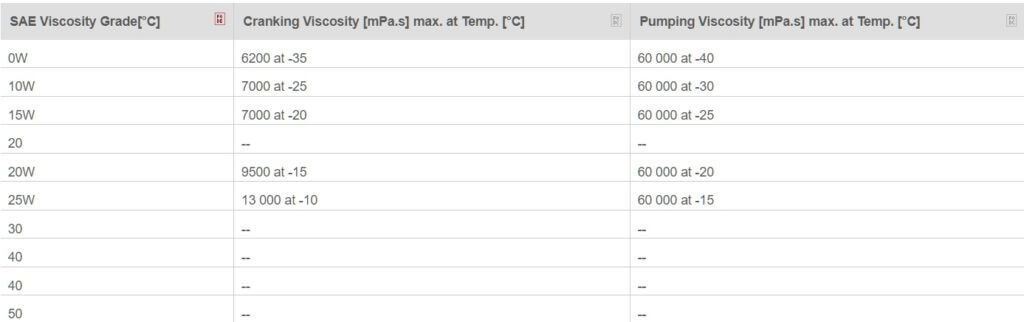
So a 5W oil will ALWAYS provide better cranking and pump ability than a 10W at ALL temperatures. Obviously, it’s more important to use a 0W or 5W oil in colder climates to help cranking and pump ability, but a 0W or 5W also helps cranking and pump ability in warmer temperatures as well.
Types of Viscosity Index Modifiers
Straight grade and multi-grade oil contain viscosity modifiers for both conventional and synthetic oil. Manufacturers use a variety of products, like oil-soluble polymers or copolymers.
Pour-point and pour-point depressants
An oil’s pour point is the temperature at which the oil no longer flows. Pour point depressant additives slow oil thickening at lower temperatures by retarding the crystallization of the paraffinic components of oil. This lowers pour point temperatures.
Viscosity Index Improvers (VII)
VII improvers are usually long-chain, high-molecular-weight polymer molecules that change their shape with temperature changes. When cold, they are folded tightly or coiled. When they’re in the cold state, they don’t increase oil viscosity. However, as the temperature of the oil rises, the molecules “uncoil/unfold.” So they take up more space and increase the friction of the motor oil to compensate for the oil’s heat thinning characteristics. In other words, they act as a thickener to reduce oil thinning.
• olefin copolymers (OCP)
• polyalkyl methacrylates (PAMA)
• poly isobutylenes (PIB)
• styrene block polymers
• methylmethacrylate (MMA)
• polybutadiene rubber (PBR)
• cis-polyisoprene (a synthetic rubber)
• polyvinyl palmitate
• polyvinyl caprylate,
• copolymers of vinyl palmitate with vinyl acetate,
But there’s a downside to polymer VIIs. The higher the molecular weight of the polymer, the more it expands. But the higher the molecular weight, the more they’re prone to “shearing” as they flow between two moving parts. If an oil refiner/blender uses a higher concentration of high molecular weight VII polymers, the more they can prevent oil thinning when the oil is new. But as the oil accumulates miles, the shearing damages the polymers and actually reduces its ability to maintain the stated viscosity. Therefore, long-chain polymers break down fairly quickly due to “shear” between moving parts. In fact, over a short period of time, the shear caused by the engine can make a 5w30 oil act like 5w20 (or lower) oil. This leads to a decrease in engine protection.
On the flip side, a blender/refiner my add some high molecular weight polymers along with low molecular weight polymers in conjunction with a higher viscosity base stock to provide a balance between high temp thinning and longer oil life. In other words, it’s a recipe that’s up to the individual refiner/blender.
In summary
Modern motor oil specifications are more than just a listing of the oil’s viscosity. They also refer to the oil’s servcie rating by API and ILSAC.
Motor oil is a blend of base stock oil with additives to reduce thinning at higher temperatures and other additives to reduce thickening at colder temperatures. In addition too viscosity related additives, refiners and blenders add, anti-corrosive, friction modifying, detergent and anti-foaming additives.
The choice of the base stock viscosity and quality, along with the types and quantities of additives are completely up to the refiner or independent blender. It’s a recipe that’s based on the price of the raw materials and the quality reputation the refiner or blender wishes to achieve.
©, 2020 Rick Muscoplat
Posted on by Rick Muscoplat