
Understanding the Function of an Engine Thermostat
The Function of an Engine Thermostat: Essential Knowledge for Every Driver
The engine thermostat is a small but vital component in your vehicle’s cooling system. Despite its modest size, the thermostat plays a crucial role in regulating the engine’s temperature, ensuring it operates efficiently and safely. Without a properly functioning thermostat, an engine can quickly become either too hot or too cold, both of which can lead to significant problems. Understanding the function of an engine thermostat is essential for any driver looking to maintain their vehicle’s performance and longevity.
What is an Engine Thermostat?
An engine thermostat is a valve that sits at the top of the cylinder head in most engines. It regulates the flow of coolant between the engine and radiator, based on the engine’s temperature. The thermostat is typically a simple, spring-loaded device that opens and closes fully or partially depending on the temperature of the coolant. Most thermostats are designed to open at a specific temperature, usually between 180°F and 200°F (82°C to 93°C), which is the optimal operating temperature range for most internal combustion engines. In short the function of an engine thermostat is to maintain the engine temperature is the optimal temperature range for efficient operation.
The Parts Of An Engine Thermostat
The main component of an engine thermostat is a copper tube filled with a
mixture of wax and copper particles. The copper tube, called a “pellet,” is sealed at the bottom and has a rubber seal and guide at the top. The bottom portion of a stainless steel piston is inserted into a rubber
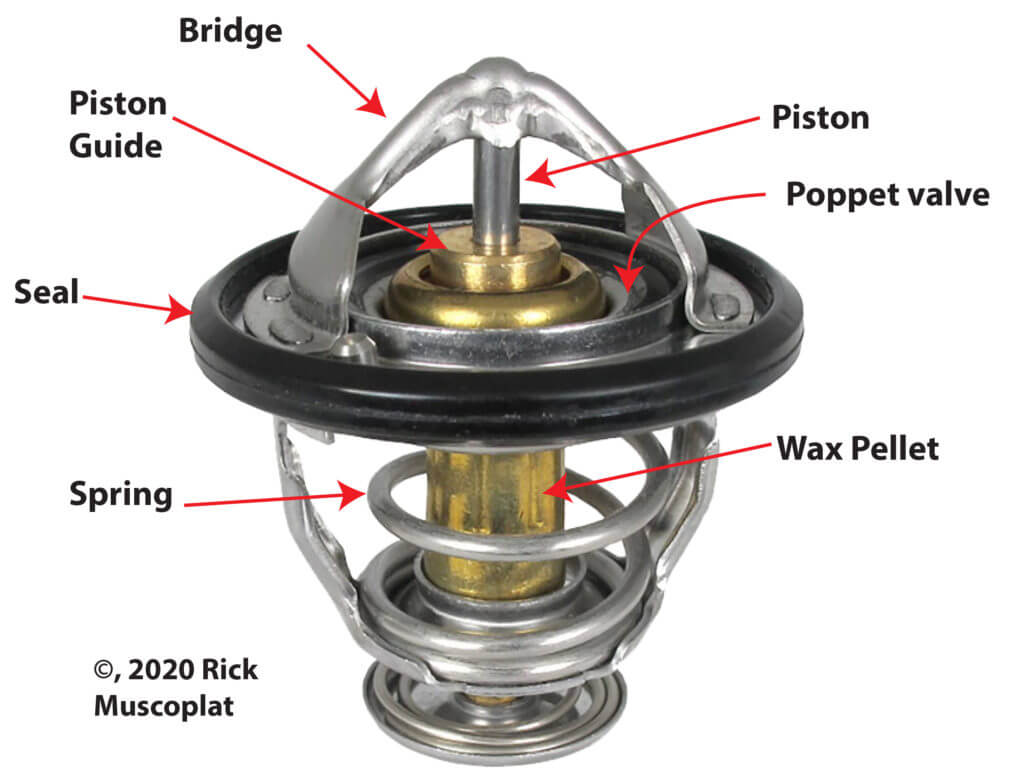
“bag” that is pressed into the wax and the top is affixed to the bridge. The pellet and acts as the “motor” that opens and closes the poppet valve.
The wax pellet is connected to a circular disc called the poppet valve. The poppet valve seats against the thermostat frame to close off coolant flow.
How a thermostat works
The thermostat’s operation is based on the principle of thermal expansion. The wax inside the pellet melts and expands as the engine temperature rises. This expansion pushes against a small rod, which in turn moves the thermostat valve to the open position.
The thermostat remains closed when the engine is cold, preventing coolant from flowing to the radiator. This allows the engine to warm up quickly by circulating the coolant within the block. As the engine reaches its optimal operating temperature, the thermostat gradually opens, allowing coolant to flow through the radiator, where it is cooled and then recirculated back into the engine. This process ensures the engine maintains a consistent temperature, preventing it from overheating or running too cold. Again, this is the function of an engine thermostat; to keep the engine at a consistent temperature.
As the engine coolant drops in temperature, the wax cools and contracts, reducing internal pressure. Since there’s now less internal pressure pushing the pellet and poppet down, the spring force pushes the poppet up, closing off the coolant flow.
Common Issues with Engine Thermostats
Like any mechanical component, engine thermostats can fail over time. Understanding the signs of a faulty thermostat can help you prevent more serious engine problems.
• Thermostat Stuck Open— If the thermostat is stuck in the open position, the engine may take longer to reach its operating temperature, or it may not reach it at all. This can lead to poor fuel efficiency, increased emissions, and excessive engine wear. You might notice the temperature gauge remaining low even after driving for some time, or you might experience poor heater performance in cold weather.
• Thermostat Stuck Closed— A thermostat that is stuck in the closed position can prevent coolant from flowing to the radiator, leading to engine overheating. This is a serious issue that can cause extensive engine damage if not addressed promptly. Signs of a stuck-closed thermostat include a rapidly rising temperature gauge, engine overheating, or steam coming from under the hood.
• Erratic Temperature Fluctuations— A failing thermostat can sometimes cause erratic temperature readings, with the engine temperature fluctuating between hot and cold. This could indicate that the thermostat is not opening and closing properly, and it may need to be replaced.
• Coolant Leaks— In some cases, a faulty thermostat can cause coolant to leak from a failed thermostat housing gasket. This can lead to low coolant levels, resulting in overheating or engine damage.
©, 2020 Rick Muscoplat