
Understanding the P1345 Trouble Code and its Significance
How to Diagnose and Fix the P1345 Trouble Code
The P1345 Trouble Code is an “enhanced” or “manufacturer-specific” Trouble Code and may not be read by Trouble Code readers or scan tools that only read generic OBDII trouble Trouble Codes. The Trouble Code indicates an issue related to the camshaft position (CMP) and crankshaft position (CKP) correlation. The official definition is: Sensor Circuit Malfunction/crankshaft Position – Camshaft Position Correlation
This Trouble Code can appear on various vehicle makes and models, and the specific meaning can vary slightly depending on the manufacturer. However, it generally points to a problem with the timing between the camshaft and crankshaft, which can lead to engine performance issues.
On older engines without variable valve timing (VVT), this Trouble Code might indicate a stretched timing belt or chain since the sensors are detecting a mismatch between the crank and camshaft. However, in a modern vehicle with VVT, a P1345 Trouble Code is usually caused by a faulty VVT solenoid, oil control valve, or cam phaser mechanism. If you’re like to know more about what these parts do and how VVT systems work, scroll down.
Symptoms of a P1345 trouble Trouble Code
• Check engine light on
• Rough idle
• Stalling
• Lack of power
• Engine noise/rattling
Primary causes of P1345 Trouble Code
• Sludge buildup or a plugged screen in the oil control solenoid— The oil control solenoid is the critical component and the one most likely to fail. Why? Because its operation is based on the assumption that you’ve used the recommended oil type and viscosity and that you change your oil according to the car maker’s recommendations.
• A loose or missing crank damper bolt— This is quite rare.
• The wrong oil viscosity or neglected oil changes — If you use the wrong oil viscosity, the E
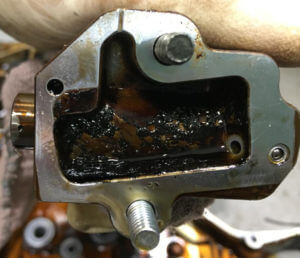
Sludge in the VVT oil control solenoid screen causes a P1345 Trouble Code
CM will command a certain duty cycle for the solenoid, expecting it to pulse a specified amount of oil into the chambers of the phaser mechanism. A different oil viscosity will result in a different fill rate and that can cause a correlation error.
If you don’t change your oil on time, it can develop sludge that clogs the fine passages in the VVT solenoid, preventing it from dispensing the proper amount of oil.
Lastly, not changing your oil on time can cause significant wear in the VVT solenoid, again causing it to dispense an improper amount of oil into the phaser chambers.
How to diagnose a P1345 Trouble Code
In most cases, the cause is a sludged or faulty oil control or VVT solenoid.
• Check the oil level in the crankcase using the dipstick— If it’s low, top it off
• Check the oil condition— If it’s overdue for an oil change or you’ve used the wrong viscosity, change the oil and filter before proceeding, and then clear the Trouble Code. Drive it to see if the Trouble Code returns.
• Remove the solenoid and check for debris clogging the screen— You can try cleaning, but usually the solenoid has significant wear from the neglected oil. It’s often best to replace the solenoid if you find debris in the screen. Then clear the Trouble Code and test drive. If the Trouble Code doesn’t return, you’ve fixed the symptom. The cause was negelcted oil changes. Up your game on oil changes.
• Check the oil control pressure sensor for signs of leakage— Not all carmakers use an oil control pressure sensor. If they do, it will be located near the VVT solenoid. The diaphragm can leak over time, causing a drop in pressure at the VVT. The fix is to replace the leaking oil control pressure sensor.
Conditions for setting the P1345 trouble Trouble Code
• The engine has been running for more than 16 seconds.
• The minimum voltage is 11 volts.
• The variable camphaser is commanded to zero.
• The deviation between the crankshaft and the camshaft positions exceeds a calibrated amount.
• The camphaser solenoid stuck open
• The camphaser stuck in a position other than 0 degrees
• The camphaser does not return to 0 degrees within 16 seconds
What is variable valve timing?
Variable valve timing mechanisms are capable of advancing and retarding camshaft timing on the fly to match driver input for power, while maintaining proper emissions. There are two basic types of VVT systems: sprocket/phaser and valve lift.
Sprocket/phaser VVT system
Most domestic car makers use this system. Sprocket/phaser systems use two devices. The sprocket/phaser replaces the traditional camshaft gear used at the end of the camshaft. Just like an ordinary camshaft gear, the sprocket/phaser connects to the timing chain to rotate the camshaft. While the outer sprocket is rotated by the timing chain, the inner portion can advance or retard the camshaft based on oil pressure fed to an internal cylinder by the oil control solenoid.
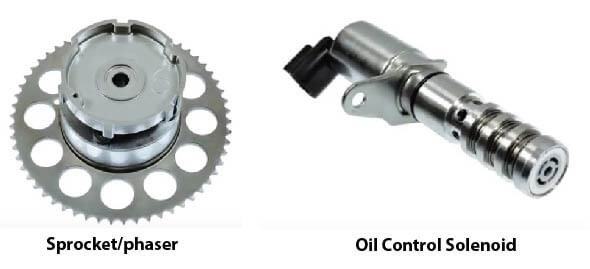
The oil control or VVT solenoid is what pulses the oil into the chamber of the sprocket/phaser device. That’s what advances or retards camshaft timing
The oil control solenoid is connected to a main oil gallery. The PCM uses the oil control solenoid to regulate oil pressure into the sprocket/phaser. The regulation is performed by pulse width modulation, a technique that varies the valve open versus valve closed time by connecting and disconnecting the ground portion of the solenoid circuit. For example, a PCM may connect the ground side of the circuit (which opens the solenoid passages) for 5/10ths of a second and disconnects it for 5/10ths of a second to achieve a 50% duty cycle.
Honda Valve lift VVT systems
Honda calls this their VTEC system. Some version of valve rocker or valve follower lift is used by other Japanese and European car makers, this system uses a camshaft with more lobes. The system may have multiple rocker arms for a single cylinder. The valve lift system uses oil pressure to lift a rocker arm off the camshaft, thereby disabling or changing the valve open/close timing for a particular valve.
An oil control valve is used to operate the valve lift mechanism and it can be a simple on/off or pulse width modulated system.
©, 2018 Rick Muscoplat
Posted on by Rick Muscoplat