
Water Pump Weep Hole Leak: Is The Pump Failing?
What a Water Pump Weep Hole Leak Is Really Telling You
Quick Summary
Seeing coolant near your water pump can be alarming, but a water pump weep hole leak isn’t automatically a death sentence for the pump. In many cases, a slight weep is normal and helps keep the pump’s internal seals lubricated and cool. The real concern is the coolant level and how quickly it rises. In this article, I’ll explain exactly what a water pump weep hole leak means, what causes it, when it’s harmless, and when a water pump leak is a warning that failure is coming.
Article
Why the Internet Is Confused About Water Pump Weep Hole Leaks
If you’ve searched online about coolant coming from the water pump, you’ve probably seen wildly conflicting advice. Some sources insist that any coolant at the weep hole means immediate replacement, while others claim it’s completely normal. The truth—like most things in automotive repair—falls somewhere in between.
I’ve diagnosed and replaced hundreds of water pumps over the years, and I can tell you with confidence that a water pump weep hole leak can be both normal and a warning sign. Understanding which one you’re dealing with requires knowing how the pump is built and how its seals actually work.
How Water Pump Seals Really Work
Modern water pumps rely on a two-piece carbon-ceramic seal system to keep coolant out of the bearing assembly. One half of the seal is stationary inside the pump housing, while the other rotates with the pump shaft. A spring maintains a constant pressure between the two surfaces, keeping them sealed as the shaft spins.
Here’s the part most people don’t realize: coolant is intentionally allowed to enter this seal area. Through capillary action, a tiny amount of coolant migrates between the seal faces. That coolant acts as both a lubricant and a coolant for the seal itself. Without it, the seal would overheat and fail quickly.
That’s why a small water pump weep hole leak can be completely normal.
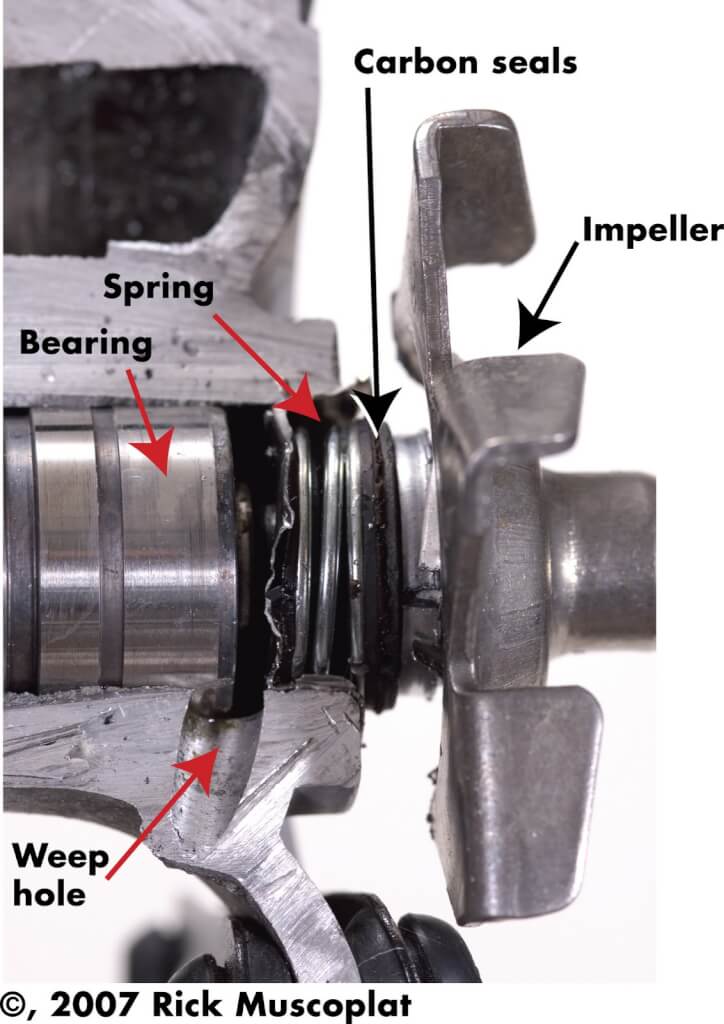
Water pump seals and weep hole
What the Weep Hole Actually Does
The weep hole is not a manufacturing defect or a design flaw. It’s a deliberate feature built into the water pump housing. Its job is to provide a controlled escape path for coolant, preventing pressure or leakage from forcing it into the bearing area, where it would cause catastrophic failure.
When everything is working properly, a trace amount of coolant may exit the weep hole and evaporate before you ever see it. Sometimes it leaves behind a chalky or crusty residue. That residue alone does not necessarily indicate a serious water pump leak.
The weep hole also serves as an early warning system. If the internal seal begins to wear excessively, coolant escapes through the weep hole instead of contaminating the pump bearings. In that sense, the water pump weep hole leak is doing you a favor by letting you know what’s happening inside the pump.
The Difference Between a Normal Weep and a Real Water Pump Leak
This is where experience matters. A few drops of coolant, an occasional damp spot, or dried coolant residue around the weep hole are generally considered normal—especially on a newer pump or one that’s undergone temperature cycling.
However, when coolant starts dripping steadily or forming a puddle directly under the pump, that’s no longer a weep. That’s a true water pump leak, and it means the internal seal is failing at a rate that can no longer be ignored.
If you’re frequently adding coolant, smelling coolant after shutdown, or seeing visible drips on the ground, the water pump weep hole leak has crossed the threshold for a repair now.
What Causes a Water Pump Weep Hole Leak to Get Worse
Time and mileage are the most significant contributors. Water pump seals wear just like brake pads or belts. As mileage accumulates, the sealing surfaces lose their ability to stay perfectly mated, allowing more coolant to escape.
Coolant condition plays a massive role as well. Old, acidic, or contaminated coolant accelerates seal wear. Rust particles, scale, and debris act like sandpaper on the seal faces. I’ve seen pumps fail tens of thousands of miles early simply because the coolant was neglected.
Excessive cooling system pressure can also turn a minor weep into a full-blown water pump leak. A faulty radiator cap, combustion gases entering the cooling system, or overheating can all spike pressure and force coolant past the seals faster than they were designed to handle.
Is a Water Pump Weep Hole Leak Something to Worry About?
A small, occasional water pump weep hole leak is something to monitor, not panic over. I always advise checking the coolant level regularly and watching the area for changes. If the leak stabilizes or disappears, it was likely a normal lubrication event.
A growing leak, visible dripping, or repeated coolant loss is a different story. At that point, the water pump leak indicates the seal is on borrowed time. Ignoring it risks sudden failure, overheating, and potential engine damage.
When I Recommend Replacing the Water Pump
If I see a steady drip from the weep hole, visible coolant trails, or customer complaints of repeated coolant loss, I don’t wait. Water pumps rarely heal themselves once seal wear reaches that stage. Replacing a cylinder head before catastrophic failure is always cheaper than replacing a warped cylinder head.
Timing matters too. If the timing belt drives the water pump and you’re anywhere near the belt service interval, it’s smart to address the water pump weep hole leak proactively.
Final Thoughts From the Shop Floor
A water pump weep hole leak isn’t automatically a bad water pump—but it’s never something to ignore. Understanding the difference between a normal weep and a true water pump leak can save you from unnecessary repairs or catastrophic engine damage.
If you see coolant at the weep hole, don’t rely on internet panic. Watch the amount, monitor coolant levels, and look for changes. When the leak turns into a drip or a puddle, that’s your signal to act.
©, 2024 Rick Muscoplat
Posted on by Rick Muscoplat