
What an Oxygen Sensor Does and How it Works
How Oxygen Sensors Work and How to Diagnose Them Correctly
Quick Summary
An oxygen sensor’s job is to measure how much oxygen remains in the exhaust after combustion and report that information to the engine computer (ECM/PCM). The ECM uses this data to adjust the air-fuel mixture in real time so the engine runs efficiently and cleanly.
An oxygen sensor’s job in a car is to measure how much oxygen remains in the exhaust after combustion and report that information to the engine computer (ECM/PCM). The ECM uses this data to adjust the air-fuel mixture in real time so the engine runs efficiently and cleanly.
While it may seem like a small component, the oxygen sensor has a significant impact on how efficiently your engine burns fuel and the amount of pollution it produces. This article will explore the role of an oxygen sensor in your car’s air/fuel system, how an oxygen sensor works, its importance in a vehicle’s emissions system, what happens when it malfunctions, and why it’s often replaced when there’s nothing wrong with it.
Why a modern engine needs an oxygen sensor
If you ran an engine in a lab, where everything like air temperature, fuel temperature, air pressure, engine speed, and load stayed the same, you could set one perfect air/fuel ratio for best performance and low emissions. In that kind of setup, you wouldn’t even need an oxygen sensor.
But real driving isn’t like that. On the road, everything is always changing:
• Air temperature constantly changes — Your engine pulls in air from just above the road, and that air can be much hotter or cooler depending on road conditions. For example, on a hot day, shaded asphalt might warm the air to 105–115°F, while sun-baked pavement can heat it up to 160–180°F.
Air temperature affects air density and the fuel’s vaporization rate.
• Air density changes — As the air gets hotter or cooler, its density changes too, which affects how much oxygen the engine gets.
• Vehicle weight changes — Adding passengers or cargo increases the weight and that changes how hard the engine has to work and how much fuel it needs.
• Engine RPM and engine load vary — You speed up, slow down, climb and descend hills, encounter rough patches of road, slow or stop in traffic, and pass other vehicles, all of which change how much power (air and fuel) the engine needs.
So the engine control module (ECM) is constantly recalculating fuel delivery based on these variables
1) Ambient air temperature— Using the temperature sensor inside either the Mass Airflow Sensor (MAF) or the Incoming Air Temperature (IAT) sensor.
2) Engine Temperature— Using the Engine Coolant Temperature (ECT) sensor, the
3) Air Mass— Using the data from the MAF sensor or the Manifold Absolute Sensor (MAP), which measures the difference between intake manifold pressure before engine startup (barometric pressure) and manifold vacuum after startup. The difference between the two readings is absolute pressure; the difference between the volume of air sucked in by the piston and the volume of air being pushed in by barometric pressure.
4) Load Demand/Throttle Position— By monitoring the Throttle Position Sensor (TPS), the ECM knows how much power the driver is requesting.
It’s The Oxygen Sensor’s Job To Measure The Amount Of Oxygen In the Exhaust Stream And Report That to the ECM. That’s all it does
An oxygen sensor measures how much oxygen is left in the exhaust after combustion. The ECM uses that data to self-correct. Here’s how that works;
High oxygen reading in the exhaust
• A high level of oxygen in the exhaust means the air/fuel mixture was too lean (either too much air or not enough fuel) for the conditions. As a result, all the fuel burned, but the burn didn’t use up all the oxygen. So the excess oxygen flowed into the exhaust, where the oxygen sensor measured it.
Low Oxygen reading in the exhaust
• A low level of oxygen in the exhaust (or no oxygen in the exhaust) means the air/fuel mixture was too rich (either too little air and/or too much fuel) for the conditions. The fuel burned all the available oxygen, causing combustion to end too soon. So the oxygen sensor doesn’t see any or enough oxygen in the exhaust stream.
Oxygen levels in the exhaust are always changing
If the engine ran with a set load and speed, you wouldn’t need an oxygen sensor. You could adjust the air/fuel ratio to get a good burn and stay within emissions standards. But those conditions never exist when driving a vehicle. The driver is always pressing or releasing the gas pedal and the vehicle always encounters hills or valleys. So, the ECM must constantly change how much fuel it adds to the incoming air. It uses the oxygen sensor to see how accurate its air-fuel calculations are and to adjust them for a better burn.
How an oxygen sensor works
When you start a cold engine, the computer calculates air/fuel based on engine temperature, ambient air temperature, and MAF/MAP sensor readings. The oxygen sensor must heat up to approximately 600°F before it can accurately measure oxygen in the exhaust. Carmakers add a heater to the oxygen sensor to help it heat up faster. Once the engine coolant temperature reaches a set temp and the oxygen sensor heater heats up the oxygen sensor, the computer starts calculating air/fuel based on the oxygen sensor feedback.
The oxygen sensor monitors the exhaust and reports back to the computer approximately 100 times per second. That helps the computer reduce or increase fuel as needed to maintain vehicle speed and load.
Narrowband oxygen sensors
These sensors are made with a zirconia 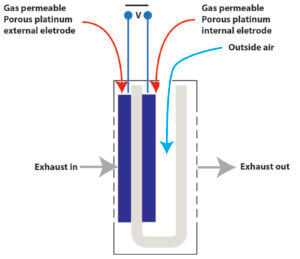 thimble that produces a voltage that’s directly proportional to the amount of oxygen in the exhaust. It’s made from a ceramic cylinder with a porous platinum-plated electrode on the inside of the cylinder and another electrode on the outside of the cylinder. Outside air enters the inside of the cylinder, and exhaust is exposed to the outside electrode.
When the exhaust mixture is too rich, there are fewer oxygen ions in the exhaust and more oxygen ions in the outside air. Exhaust oxygen ions are negatively charged so that the oxygen sensor will generate a very low or no voltage. In a lean exhaust condition with too little fuel in the combustion chamber, the exhaust will contain more oxygen ions. Those will pass through the electrodes and create up to 1 volt of power.
The lifespan of the narrowband oxygen sensor
Typical narrowband oxygen has a lifespan of about 100,000 miles. Oxygen sensors can be damaged by excessive oil, coolant, or silicon from RTV sealants. Contrary to popular belief, oxygen sensors cannot be cleaned. You can apply a cleaner and they may look clean. But in reality, once a sensor is contaminated by oil, coolant, or silicone, it is permanently damaged and must be replaced.
In effect, a narrowband oxygen sensor constantly swings between rich and lean (0-volts and 1-volt), with 0.45-volts being a perfect air/fuel mixture.
Wideband oxygen sensors
A wideband oxygen sensor works differently. First, to operate properly, wideband oxygen sensors must reach temps of 1,292°F to 1,472°F to operate properly. Like narrowband sensors, wideband sensors also have a heater to help the sensor reach those temps faster and maintain that temperature.
A wideband oxygen sensor heater consumes about 8 amps and is usually pulse width modulated by the PCM to vary the amount of heat needed to keep it at operating temperature. So a wideband sensor will use more power when the engine is cold than when hot. If the heater fails to keep the sensor at temperature, the PCM will set a P0125 trouble code. If you see that code, first check the fuse to the sensor heater.
How a wideband oxygen sensor works
Instead of reporting rapid voltage swings, it provides a gradual current change that can be positive or negative. The signal gradually moves to a positive value when the exhaust is lean. When the exhaust is stoichiometric (14.7:1), the current flow stops. As the exhaust becomes rich, the current becomes negative.
The PCM supplies the wideband sensor with a reference voltage (usually 3.3 volts or 2.6 volts) through two wires. The sensor then alters the reference voltage based on the exhaust oxygen content and sends its results through a separate pair of wires to the PCM. If the return signal is less than the reference voltage, the sensor reports a rich condition. If the signal is above the reference voltage, the sensor reports a lean condition.
©, 2021 Rick Muscoplat
Posted on by Rick Muscoplat