
What Causes a Car to Overheat? Common Causes
What Causes Your Car to Overheat — Advice from a Pro
Quick Summary
Overheating is almost always the result of a breakdown in airflow, coolant flow, or heat transfer. A radiator that “looks fine” can still fail under load if airflow is restricted, coolant circulation is compromised, or ambient conditions overwhelm the system. So, understanding what causes your car to overheat means you need to understand thermal management—not just guess and replace parts.
Article
Car Overheating Isn’t a Mystery—It’s Physics
Over the years, I’ve diagnosed countless overheating complaints, and one thing never changes: the radiator gets blamed first. I get it—it’s big, visible, and expensive. But when people ask me what causes a car to overheat, I explain that the radiator itself is just a heat exchanger. It doesn’t create cooling; it only sheds heat that the rest of the system delivers to it.
If your engine overheats, something has interrupted that process. Either heat isn’t being carried away from the engine efficiently, or the radiator can’t get rid of it fast enough. Once you start thinking in thermodynamic terms rather than in terms of failed parts, overheating problems become much easier to diagnose.
How Heat Is Supposed to Leave the Engine
To understand what causes a car to overheat, you first need to understand how it doesn’t. The cooling system relies on three critical elements working together: temperature difference, airflow, and coolant circulation.
The radiator can shed heat only when there’s a temperature difference between the coolant and the ambient air. That temperature difference—what engineers call delta T—is everything. On a mild day, the radiator has a considerable advantage. On a 100-degree day in stop-and-go traffic with the AC running, that advantage disappears quickly.
Radiator design also matters, but only when airflow and coolant flow are matched to it. I’ve seen oversized aftermarket radiators exacerbate overheating because the fan and shroud can’t move enough air through the core. Bigger isn’t always better.
Airflow itself is often the silent killer. Missing air dams, bent shrouds, blocked condenser fins, or debris trapped between the cooling stack can starve the radiator even at highway speed. When someone asks me what causes a car to overheat at highway speeds, airflow restriction is always high on my list.
Coolant flow matters just as much. Too slow, and the coolant superheats. Too fast, and it doesn’t spend enough time in the radiator to release heat. The balance between flow and dwell time is critical—and often overlooked.
Real-World Reasons a Car Overheats
In the real world, overheating usually comes from problems you can’t see at a glance. Modern vehicles stack multiple heat exchangers together: the AC condenser, radiator, transmission cooler, and sometimes an intercooler. Dirt, bugs, and road debris get trapped between those layers. From the front, everything looks clean—but airflow is choked.
I’ve also seen plenty of radiators ruined by crushed fins. A pressure washer, a minor front-end impact, or even factory handling damage can collapse fins and drastically reduce cooling efficiency. When people ask what causes a car to overheat after replacing the radiator, this is often the answer.
Active grille shutters are another sneaky failure. If they stick closed at highway speeds, the radiator is essentially suffocating. Many of these failures never set a fault code, which makes diagnosis tricky if you’re not watching live data.
Fans are another common trap. A fan that spins isn’t necessarily a fan that works. Variable-speed fans can run but move far less air than commanded. I always verify fan RPM, current draw, and duty cycle. If a car overheats at idle but runs fine on the highway, fan performance is almost always involved.
Coolant Flow Problems That Cause Overheating
If airflow checks out, I shift my focus to coolant circulation. Thermostats—both mechanical and electronically controlled—can fail slowly. A thermostat that opens late or incompletely under load can cause overheating without ever triggering a warning light.
Water pumps are just as deceptive. I’ve seen worn plastic impellers slip on the shaft, pumps cavitate under load, and drive belts glaze just enough to reduce pump speed. Any of those can explain what causes a car to overheat while driving, but not at idle.
Air pockets are another overlooked issue. Improper bleeding or combustion gases leaking into the cooling system introduce air, which reduces heat transfer. Internal blockages caused by poor coolant selection, hard tap water, or stop-leak products can coat the radiator and heater core with insulating deposits that no flush can fully remove.
Real-World Failures That Make Your Car Overheat
Even when the radiator looks fine, several hidden issues can cause a car to overheat:
Stack Contamination
Modern cars use a cooling stack: radiator,  condenser, transmission cooler, maybe an intercooler. Debris builds up between them. If you can’t see it, you won’t suspect it—but it’s often the culprit.
Crushed or Bent Fins
Pressure-washing damage, minor impacts, or manufacturing defects can collapse cooling fins. That drastically reduces surface area and airflow efficiency.
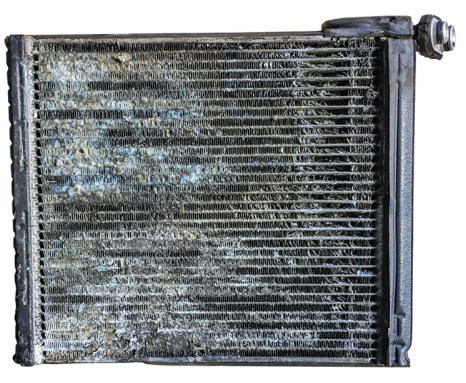
Clogged condenser fins
Faulty Active Grille Shutters
If your shutters stay closed at highway speeds, the radiator’s starved for air. These failures often don’t trigger a check engine light.
Fan Problems
Just because a fan spins doesn’t mean it’s working. Measure RPM, current draw, and control signals. Variable-speed fans, in particular, can appear to operate but not move enough air.
How I Diagnose What Causes a Car to Overheat
Scan Tool Analysis— I monitor the engine coolant temperature (ECT), fan duty cycle, commanded versus actual thermostat position, ambient air temperature, and intake air temperature. These indicate how much heat the system is trying to reject—and whether it’s succeeding.
Thermal Imaging and Temp Guns—I check the inlet and outlet tank temperatures. A 20–40°F drop across the radiator is expected. Anything less means heat isn’t being shed—then I ask why.
Heater Core Flow Check—If the heater isn’t producing hot air, you may have a restriction, an air bubble, or a pump issue.
Fan Function Verification—Using a scan tool or ammeter, I verify ramp-up behavior under load and AC conditions. If your car overheats at idle but not on the highway, you’re likely dealing with a fan or airflow issue.
Environmental and Load-Based Overheating
Sometimes, the cooling system isn’t broken—it’s just overwhelmed.
AC Condenser Pre-Heat—Your AC system dumps 20–40°F of heat into the airflow before it even reaches the radiator. On a 95°F day in traffic, the radiator might be dealing with 120–135°F “ambient.”
High-Load, Low-Speed Scenarios— Towing, steep grades, or extended idle with the AC blasting? You’re pushing the system to its engineered limit. A stock radiator might not be enough anymore.
Altitude and Humidity— Thin air and high humidity both reduce delta T and cooling efficiency. It’s another factor when diagnosing why a car overheats, even when the system appears intact.
Pro Diagnostic Tip—Don’t Just Replace the Radiator
If a new radiator doesn’t solve the overheating, ask yourself:
• Is the airflow path obstructed?
• Is the coolant flow restricted or aerated?
• Has the engine’s heat output increased due to performance mods or load changes?
• Is the fan doing its job at low speeds?
Diagnosing Coolant Flow Problems
If the radiator’s getting airflow but the car overheats, you need to inspect coolant flow.
Thermostat Malfunction— Mechanical and electronically controlled stats can fail in ways that don’t always trip a DTC. A slow-to-open stat under load is a silent killer.
Water Pump Defects— Worn impellers,  belt slippage, or faulty pulleys reduce coolant circulation. Don’t overlook the drive system.
Air Pockets and Vapor Lock— Improper bleeding or combustion gas intrusion can introduce air. That air kills flow and heat transfer.
Internal Blockage—Improper coolant mix, hard tap water, and sealants can coat the core’s interior with an insulating buildup.
When the System Isn’t Broken—Just Overwhelmed
Sometimes, the answer to what causes a car to overheat isn’t failure at all—it’s conditions. The AC condenser can dump 20–40 degrees of heat into the airflow before it ever reaches the radiator. Add high ambient temps, towing, steep grades, or extended idle, and even a healthy system can hit its limits.
Altitude and humidity matter too. Thin air and moist air both reduce cooling efficiency, which explains why some vehicles only overheat on vacations or mountain trips.
Engine Overheating Is a System Failure, Not a Part Failure
When a car overheats, it’s rarely because one component suddenly “went bad.” It’s because airflow, coolant flow, and ambient conditions are no longer in balance. Understanding what causes a car to overheat means thinking in systems, not parts. That’s how you fix it once—and keep it from coming back.
If you want to avoid future headaches, here’s how to keep your cooling system dialed in:
Regularly Clean the Cooling Stack—Use compressed air and a light rinse, not high-pressure water—to avoid damaging the fins.
Use Proper Coolant Mixtures— Avoid tap water. Use distilled water and correct mix ratios to prevent internal scaling.
Avoid Over-Reliance on Stop Leak Products— They can plug up micro passages in modern radiators and heater cores.
Check for Software Updates— Some manufacturers issue fan calibration updates or PCM logic changes that improve cooling control under specific conditions.
©, 2025 Rick Muscoplat
Posted on by Rick Muscoplat