
What Causes Uneven Brake Rotor Wear
What Causes Uneven Brake Rotor Wear? (Outer Edge, Inner Edge, and Banding
Quick Summary
If you’re seeing uneven brake rotor wear, here’s what it usually means:
1) Wear only on the outer edge of the rotor
• Rust in the abutment — The pad ears (T-heads) are seized in the abutment, preventing full application. The pad tilts during braking, and pressure is applied only to the top portion of the pad and rotor. The bottom of the pad doesn’t touch the rotor, so there’s less rotor wear or even rust.
• Seized caliper slide pin(s) — The seized/corroded caliper slide pins prevent the caliper from applying the full brake pad evenly to the rotor. During braking, the caliper tilts slightly, pulling the upper portion of the outer pad at an angle toward the top of the rotor, causing excessive wear.
• Brake pad delamination due to rust jacking — The friction material becomes detached from the backing plate. This can be caused by adhesive failure, but it is more commonly due to a low-quality backing plate that rusts. Rust expands as it forms (a process called rust jacking), causing the friction material to lift away from the backing plate. The result is high and low spots on the pad, leaving only a portion of the pad in contact with the rotor.
2) Wear only on the inner portion of the rotor near the rotor hat
• Rust in the abutment — The pad ears (T-heads) are seized in the abutment, preventing full application. The pad tilts during braking, and pressure is applied only to the bottom portion of the pad and rotor. The top of the pad doesn’t touch the rotor, so there’s less rotor wear or even rust.
• Seized caliper slide pin(s) — The seized/corroded caliper slide pins prevent the caliper from applying the full brake pad evenly to the rotor. During braking, the caliper tilts slightly, pulling the outer pad at an angle toward the top of the rotor, and the bottom portion of the inboard pad at an angle toward the bottom face of the inboard rotor.
• Brake pad delamination due to rust jacking — The friction material becomes detached from the backing plate. This can be caused by adhesive failure, but it is more commonly due to a low-quality backing plate that rusts. Rust expands as it forms (a process called rust jacking), causing the friction material to lift away from the backing plate. The result is high and low spots on the pad, leaving only a portion of the pad in contact with the rotor.
3) A shiny band on the rotor with rust elsewhere
• Rock embedment — A rock caught between the brake pad and the rotor prevents full pad contact with the rotor. The rock wears a band into the rotor, leaving the rest of the rotor untouched.
• Backing plate flex — Low-quality brake pads often have thinner backing plates that can bend if there’s any binding in the T-head areas. That causes a bow-out condition, in which only a portion of the pad’s center contacts the rotor.
• Brake pad delamination due to rust jacking — The friction material becomes detached from the backing plate. This can be caused by adhesive failure, but it is more commonly due to a low-quality backing plate that rusts. Rust expands as it forms (a process called rust jacking), causing the friction material to lift away from the backing plate. The result is high and low spots on the pad, leaving only a portion of the pad in contact with the rotor.
Most uneven wear problems trace back to caliper movement issues or poor installation—not the rotor itself
I’ve diagnosed thousands of brake issues, and uneven rotor wear always tells a story. You just have to know how to read it.
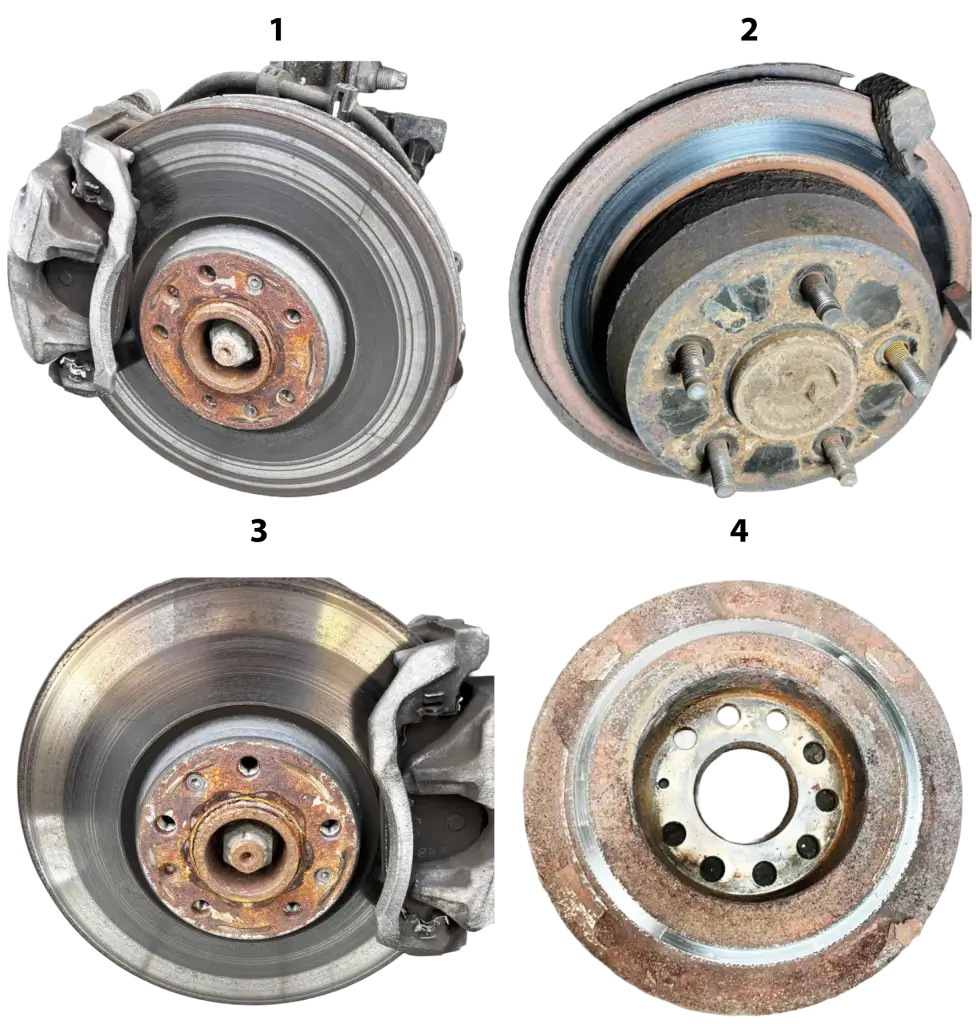
Uneven brake rotor wear
When everything is working correctly, the brake pads press evenly across the entire rotor face. That creates a smooth, consistent wear pattern.
But when something interferes with that contact, you get uneven brake rotor wear—and that shows up as:
• Banding (partial shiny areas) with areas of rust — Images 1 & 4 above
• Outer edge wear — Image 3
• Inner edge wear — Image 2
This isn’t random. It’s mechanical—and predictable.
What Causes Wear on the Inner or Outer Edge of a Brake Rotor
When I see wear only on the outer edge of the rotor, I immediately suspect limited pad contact.
1) Rust in the abutment or the abutment hardware— which prevents the brake pad from fully contacting the rotor.

Rust on the abutment or the anti-rattle clips can prevent the brake pad from moving and applying fully, causing uneven rotor wear
The rust causes the pad to tilt, contacting only the outer or inner edge of the rotor.
The Fix:
• Remove the anti-rattle clips from the abutment and clean off the rust.
• Apply a light coat of dielectric high-temperature brake grease to the abutment to slow down future corrosion.
• Install new abutment hardware
• Install new brake pads
2) Seized caliper slide pin(s) — When the caliper pins seize, the caliper
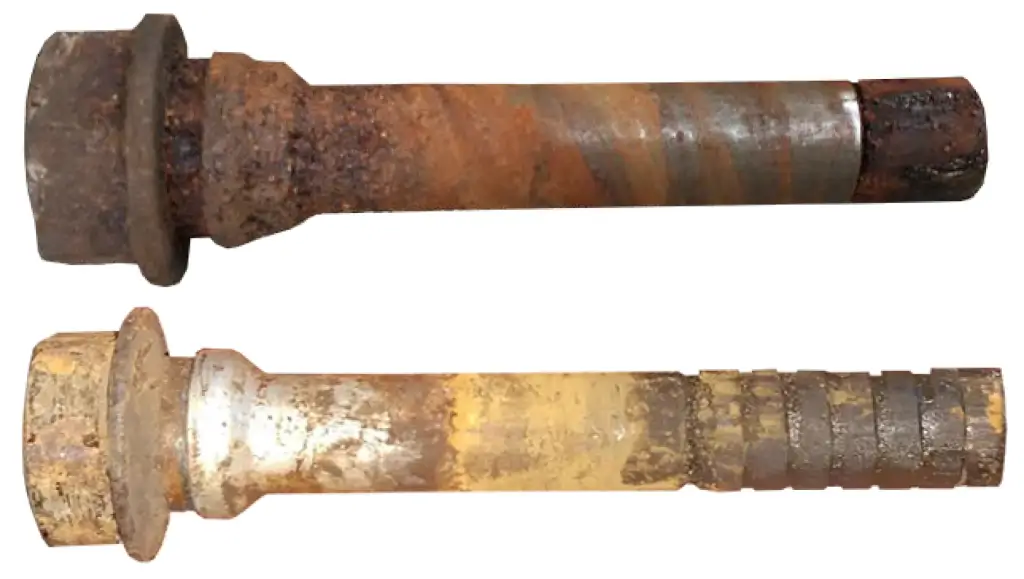
Corroded caliper slide pins
can’t apply even pressure to the brake pads, so the caliper tilts slightly, causing the outer pad to apply only to the top half of the outboard rotor and the bottom portion of the inboard rotor
The Fix:
• Replace rusted caliper slide pins with new ones.
• Always replace the slide pin boots when performing a brake job. Old boots allow water to get in and corrode the pins.
• Clean the caliper pin bores to remove old grease and add a fresh coating of high-temperature synthetic brake grease to the pins
3) Brake pad delamination due to rust jacking — The friction material becomes detached from the backing plate.

The brake pad backing plate has rusted. “Rust jacking” (expanding rust) causes the friction material to debond from the backing plate. The friction material cracks, causing uneven friction material on the rotor application, which causes a grinding noise and uneven rotor wear.
This can be caused by adhesive failure, but it is more commonly due to a low-quality backing plate that rusts. Rust expands as it forms (a process called rust jacking), causing the friction material to lift away from the backing plate. The result is high and low spots on the pad, leaving only a portion of the pad in contact with the rotor.
The Fix:
Replace delaminated brake pads with higher quality pads built on galvanized steel backing plates and attached with a mechanical attachment system.
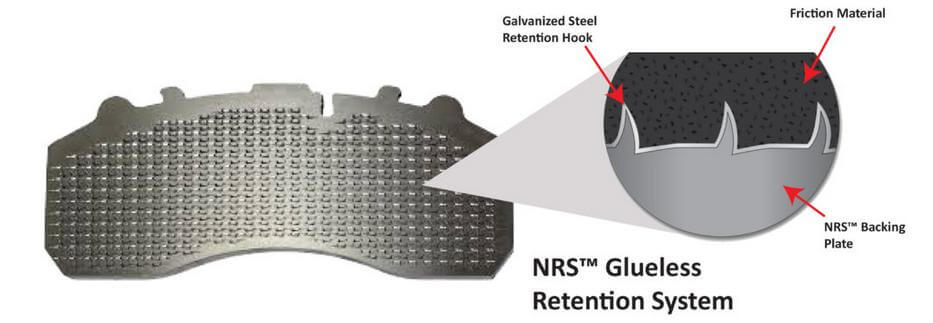
This image shows a galvanized backing plate with the NRS attachment system
4) Disc Thickness Variation Due to Lateral Runout — The rotor isn’t sitting perfectly parallel with the wheel hub.
Lateral runout or uneven clamping forces are the two most 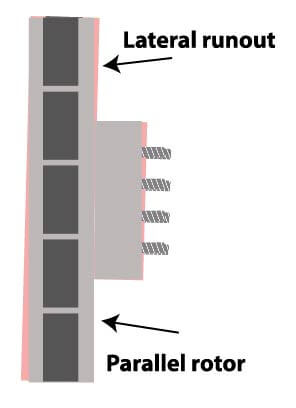 common causes of disc thickness variation. Lateral runout is a condition where the rotor doesn’t sit perfectly parallel to the wheel hub. That causes the rotor to rotate in a wobbly pattern.
As the inner face of the rotor contacts the inner brake pad, it accumulates an additional layer of brake friction material if the brake pad is formulated with an adherent compound. If the brake pad is made with an abrasive formula, it will wear the inner face of the rotor, reducing its thickness each time it hits the inner pad. The opposite condition occurs on the opposite face.
The Fix:
• Always clean rust off the wheel hub when performing a brake job
• Use a torque wrench to ensure even torque on the lug nuts
Other Causes of Uneven Brake Rotor Wear
Embedded Debris — A small rock or metal fragment in the pad can:
• Cut grooves into the rotor
• Causes localized wear
Improper Installation — I see this all the time:
• No lubrication on slide pins
• Dirty or rusty caliper brackets
• Pads forced into place
How I Diagnose Uneven Brake Rotor Wear (My Process)
When I see uneven brake rotor wear, I don’t guess—I verify. Here’s my exact process:
Step 1: Compare inner vs outer pad wear
Step 2: Check slide pin movement
Step 3: Inspect caliper piston operation
Step 4: Look for pad binding in the abutment bracket
Step 5: Evaluate rotor surface pattern
The wear pattern always points to the root cause.
©, 2026 Rick Muscoplat
Posted on by Rick Muscoplat