
What is the yellow sludge under your oil cap?
Why Yellow Sludge in the Oil Cap Appears in Winter
Quick Summary (Read This First):
Finding yellow sludge or gunk in the oil cap can be alarming, but in most cases, it’s normal and not a sign of a blown head gasket. What you’re seeing is oil mist and moisture forming an emulsion due to condensation, especially in cold weather and short-trip driving. The dipstick—not the oil cap—is the real truth teller. If the dipstick oil looks normal, you’re almost certainly not dealing with a head gasket leak.
Article
The Yellow Gunk Under Your Oil Cap Doesn’t Automatically Mean a Bad Head Gasket
I’ve lost count of how many times someone has come to me convinced their engine was toast after finding yellow sludge in the oil cap. The panic is understandable—anything yellow, milky, or gooey inside an engine can be the sign of a blown head gasket leak. But here’s the reality: in my experience, most cases of yellow gunk in the oil cap have nothing to do with a failed head gasket at all.
That yellow or tan mayonnaise-like substance is usually an oil emulsion, oil mist, and moisture that’s combined and condensed in the oil fill cap. It’s common in cold weather, especially if you drive short trips. Before you assume the worst, you need to understand what it is, why it forms, and how to distinguish harmless condensation from a true head gasket leak.
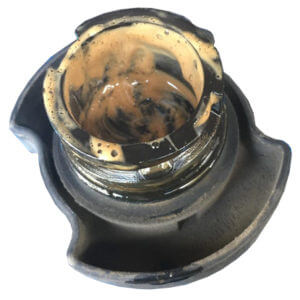
Yellow gunk under the oil cap
What Is Yellow Sludge in the Oil Cap, Really?
Moisture is a normal byproduct of combustion. Every time your engine runs, water vapor is created. Some of that moisture sneaks past the piston rings as blow-by and enters the crankcase, where it mixes with oil mist, forming a yellow/milky looking get called oil emulsion. When the engine shuts off, that hot vapor rises to the top of the engine. In cold weather, the plastic oil fill cap cools faster than the engine, so the oil/moisture mixture condenses on the colder cap. —most notably the oil fill cap.
Cold Weather and Short Trips: The Perfect Storm
Engine oil needs time to reach a

The congealed oil and water can also have a brownish/yellow appearance
temperature high enough to boil off moisture in the crankcase. In warm weather, that might take five miles. In winter, it can take ten miles or more. If your driving consists of quick errands, school drop-offs, or short commutes, the engine never gets hot enough for long enough to evaporate the water.
The result? Moisture remains suspended in the oil vapor, condenses, and eventually turns into yellow gunk in the oil cap. Yellow gunk only in the cap? Normal. Milky oil on the dipstick? Serious.
The Dipstick Tells the Truth—Not the Oil Cap
This is where I tell people to stop panicking and start diagnosing. The oil cap is not where to check for a head gasket leak. The dipstick is.
If you see yellow sludge in the oil cap but the oil on the dipstick looks normal—amber, brown, or dark brown with a smooth texture—you’re not dealing with a head gasket leak. Period.
However, if the oil on the dipstick looks frothy, milky, or like a chocolate milkshake, that’s a different story. That indicates coolant mixing with oil throughout the crankcase, which can indicate a head gasket leak or another internal coolant leak.
How Blow-By Contributes to Yellow Gunk
Every engine has blow-by—even brand-new engines. During cold starts, engines run with a richer air/fuel mixture, which increases moisture production. Combustion gases slip past the piston rings and enter the crankcase, carrying water vapor, fuel vapor, and combustion byproducts.
If the engine reaches full operating temperature, that moisture evaporates and exits through the PCV system. If it doesn’t, the moisture remains and contributes to yellow sludge in the oil cap.
This is why vehicles that only do short trips are prime candidates for yellow gunk in the oil cap, even when they’re mechanically healthy.
When Yellow Sludge Does Point to a Head Gasket Leak
Now let’s be clear—there are times when yellow sludge in the oil cap can be associated with a head gasket leak, but it’s never the only symptom.
A real head gasket leak typically presents additional red flags: unexplained coolant loss, overheating, white exhaust smoke, misfires on startup, or milky oil throughout the engine—not just in the cap. You may also see rising oil levels or bubbling in the coolant reservoir.
The key takeaway is this: a head gasket leak affects the entire lubrication system, not just the oil cap.
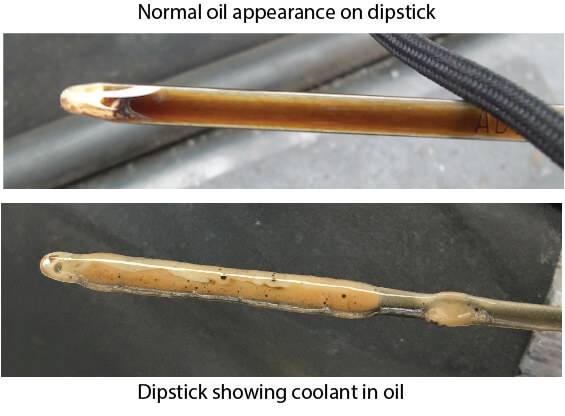
Normal oil on the dipstick and dipstick with oil and coolant
How to Prevent Yellow Gunk in the Oil Cap
Drive the car long enough for the oil to heat soak fully. Take it out on the highway. Let it run. Give the moisture time to burn off.
Regular oil changes also help because fresh oil resists emulsification better than old, contaminated oil. But don’t confuse prevention with repair—there’s nothing “broken” when you see yellow sludge in the oil cap caused by condensation.
Emulsion Definition: An emulsion is a mixture of two or more liquids that usually don’t  mix, like oil and water. The liquids are broken into tiny droplets that are suspended in the other liquid
When you turn off the engine, the hot emulsion rises to the top of the engine, where it condenses in the colder oil fill cap. Why the oil fill cap? Because it cools faster than the hot engine.
©, 2018 Rick Muscoplat
Posted on by Rick Muscoplat