
When to do a Cylinder Leakdown Test
When to Perform a Cylinder Leakdown Test
A cylinder leakdown test is one of the best diagnostic tools for determining the exact cause of compression loss in an engine. A traditional

Cylinder leakdown tester
compression test tells you how much pressure a cylinder can build but doesn’t tell you why the compression is off-spec. A cylinder leakdown test, on the other hand, pinpoints why the pressure is being lost and where it’s escaping. Here are the key situations where performing a cylinder leakdown test is necessary:
Perform a Cylinder Leakdown Test If You Find Low Compression Using a Compression Tester
If a cranking compression test reveals that one or more cylinders have significantly lower pressure than the others, a cylinder leakdown test helps identify the root cause.
See my article on how to conduct a cylinder leakdown test.
Compression loss can result from:
• Worn cam lobes
• Weak or broken valve springs
• Worn or broken piston rings
• Burned, stuck, or bent intake or exhaust valves
• A head gasket leak
• Cracks in the cylinder head or block
A leakdown test isolates the problem by indicating where the air is escaping.
Perform a Cylinder Leakdown Test To Find The Cause Of An Engine Misfire or Rough Idle
You’ve got a misfire code, swapped out the spark plug and ignition coil, and the misfire is still there. You’ve ruled out an ECM failure. What’s left? You’ve obviously got some kind of mechanical failure. So you conduct a compression test and find low compression in one or more cylinders. Before you rip into the engine, now is the time to conduct a cylinder leakdown test to rule out:
• A leaking intake valve disrupting the air/fuel mixture
• An exhaust valve that isn’t fully closing, reducing combustion efficiency
• A piston ring issue causing low compression and incomplete combustion
• A cam or valve spring issue.
Find Head Gasket Failure
A blown head gasket can cause compression to leak between cylinders or into the cooling system. Symptoms include:
• Overheating with no apparent cause
• White smoke from the exhaust (burning coolant)
•Bubbling in the radiator or coolant reservoir
• Oil contaminated with coolant (milky appearance)
A leakdown test can help diagnose a head gasket failure by listening for air escaping into the cooling system (bubbling in the radiator) or between adjacent cylinders.
Conduct a Cylinder Leakdown Test if You Have Excessive Oil Consumption or Blue Smoke from Exhaust
If an engine is burning excessive oil or producing blue smoke, it could be due to worn piston rings or valve stem seals. A cylinder leakdown test helps differentiate between these two possibilities:
• If air leaks past the piston rings and into the crankcase (heard at the dipstick tube or oil filler cap), the rings are likely worn.
• If air leaks past the intake or exhaust valves, the problem may be valve-related rather than ring-related.
This test is especially useful before committing to major repairs like a ring job or valve replacement.
6. Diagnosing Hard Starting or No-Start Conditions
If an engine cranks but refuses to start, low cylinder pressure could be the reason. Cylinder leakdown testing determines if:
Compression loss is due to a mechanical failure (rings, valves, or head gasket)
Air is escaping into the intake or exhaust, preventing proper combustion
The engine has suffered catastrophic damage (such as a broken valve or piston)
This test is invaluable when ruling out internal mechanical issues as the cause of a no-start condition.
Evaluating Engine Health Before a Rebuild or Purchase
Before rebuilding an engine or purchasing a used vehicle, I always recommend a cylinder leakdown testing.
What the Results Mean
If your cylinder leakdown test shows more than 30% leakdown across multiple cylinders, a rebuild is usually necessary. On the other hand, if leakage is below 10% and consistent across all cylinders, the engine is in great shape.
Use the Test To Confirm Your Work Before Calling It Done
If I’ve performed major engine work, like replacing a head gasket, valve job, or piston ring replacement—I always do this test to ensure I’ve fixed the problem. It’s a great final check before reassembling and running an engine, helping to prevent costly rework.
Where To Get A Compression Tester and Leakdown Tester
Rent or buy these testers from a local auto parts store or online. You can buy both of these testers from Amazon.
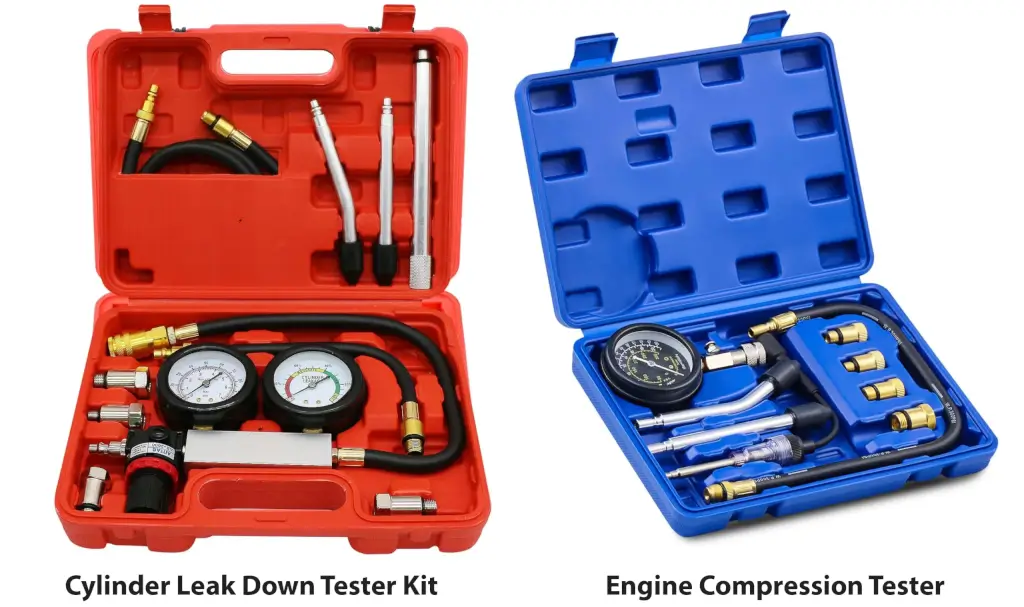
Cylinder Leakdown Tester and a Compression Tester
Find the Multi-Function Cylinder Leak Down Tester at Amazon for $37
Find the Orion Motor Tech Engine Compression Tester at Amazon for $22
NOTICE: Ricksfreeautorepairadvice receives a commission on products purchased from these links.
Take Aways From This Article
A cylinder leakdown test is one of the most valuable diagnostic tools for pinpointing internal engine issues. Whether troubleshooting low compression, diagnosing a misfire, or evaluating an engine’s overall health, this test provides definitive answers about an engine’s sealing ability.
If you suspect compression loss but don’t know where it’s coming from, a cylinder leakdown test will tell you exactly what’s wrong—and what needs to be fixed.
©, 2025 Rick Muscoplat
Posted on by Rick Muscoplat