
Which Brake Fluid to Buy? The Truth About DOT Ratings
Brake Fluid Viscosity Explained: Why It Matters More Than Boiling Point
Quick Summary:
Modern ABS, Electronic Stability Control (ESC), and Advanced Driver Assistance Systems (ADAS) systems depend on extremely precise hydraulic response times. The wrong brake fluid viscosity can slow down those corrections, increase stopping distances, and even affect system diagnostics. Always match the viscosity and specification required by the vehicle manufacturer.
Article
Brake Fluid Viscosity: Why It Matters More Than You Think
For years, I’ve heard people ask, “Which brake fluid to buy?” Most assume the answer comes down to boiling point or brand name. That’s outdated thinking. In modern vehicles, the real story is brake fluid viscosity.
Brake fluid is regulated by both the Department of Transportation (DOT) and the International Standards Organization (ISO). Both specify minimum dry and wet boiling points and define viscosity limits across a wide temperature range. For decades, these specs were nearly identical, and frankly, fluid choice wasn’t complicated. But brake systems evolved.
ABS became standard. Then ESC. Now we have ADAS features like automatic emergency braking that make split-second corrections. And that’s where brake fluid viscosity stopped being a background detail and became a critical engineering variable.
The Real Difference Between DOT 4, DOT 4 LV, and DOT 5.1
DIYers often think that DOT 5.1 must be “better” that either DOT 3 or 4, because the number is higher. That’s not how it works.
While there are slight differences in 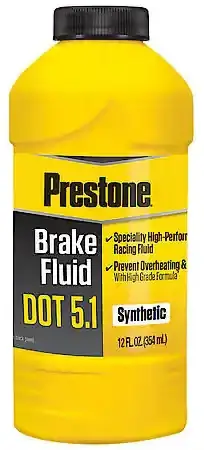 wet and dry boiling points, the most important distinction is brake fluid viscosity.
Think of viscosity as the rate at which hydraulic pressure can move through the system. In older brake systems, this wasn’t nearly as critical. But today, inside every ABS modulator you’ll find a network of valves—often 12 or more—plus pumps and accumulators. These components work together in milliseconds to control wheel slip, maintain stability, and execute ADAS interventions.
If the viscosity is outside spec, the system can become sluggish. That affects correction timing and potentially increases stopping distance
Why Viscosity Matters More Than Boiling Point
Yes, boiling point matters, especially in prolonged hard braking. But in a modern vehicle with ABS, ESC, and automatic emergency braking, the braking system’s response time is critical to avoid an accident, and that response time is directly related to fluid viscosity. Keep in mind that in a panic stop on a wet road, milliseconds matter.
Modern braking systems are designed for a s specific viscosity fluid. If you deviate from that, the system’s response time changes.
Understanding Common Brake Fluid Types
Let’s talk about three common glycol-based options: DOT 4, DOT 4 LV, and DOT 5.1.
DOT 4 — Standard DOT 4 fluids are designed for vehicles equipped with ABS. They offer solid boiling protection and corrosion-resistance. For many older vehicles, DOT 4 is perfectly appropriate—assuming that’s what the manufacturer specifies.
DOT 4 LV (Low Viscosity) — DOT 4 LV is engineered specifically for modern ABS and ESP systems. The “LV” stands for low viscosity, and that’s the key. At colder temperatures, especially, lower brake fluid viscosity allows faster hydraulic response.
If you live in a cold climate or drive a newer vehicle with advanced stability control, this is often the right answer for which brake fluid to buy.
DOT 5.1 — DOT 5.1 is also glycol-based and fully compatible with DOT 4 systems. It offers high performance, excellent cold-temperature behavior, and strong corrosion protection. Importantly, DOT 5.1 shares similar low brake fluid viscosity characteristics with DOT 4 LV. In many cases, it can be used where DOT 4 LV is specified—again, provided the manufacturer allows it.
But DOT 5 Is Not DOT 5.1. I’ve seen too many expensive mistakes here. DOT 5 is silicone-based. It is not hygroscopic, meaning it doesn’t absorb moisture. That sounds good—until you realize that water then pools in low points of the system, causing corrosion.
DOT 5 is typically intended for specialty or storage applications, not modern automotive brake systems
How Brake Fluid Viscosity Affects Cold Weather Performance
One of the most overlooked aspects of brake fluid viscosity is cold-temperature behavior.
Viscosity increases as temperature drops. In sub-freezing conditions, thick fluid slows system response. That’s why low-viscosity formulas were developed—to maintain rapid valve actuation even in winter climates.
In a vehicle equipped with automatic emergency braking, the software assumes corrections happen in microseconds. If the hydraulic side lags, the electronics can’t compensate. That’s not something you’ll notice in normal braking. But in a crisis? It matters.
So, Which Brake Fluid to Buy?
Check the owner’s manual. Second, confirm the DOT specification. Third, verify OE approvals on the product data sheet. Do not assume a higher number equals better performance. Do not assume all DOT 4 fluids have identical brake fluid viscosity. And absolutely do not substitute silicone DOT 5 unless the system is designed for it.
Because today’s brake systems aren’t just hydraulic. They’re electro-hydraulic. And brake fluid viscosity is part of the software equation.
©, 2026 Rick Muscoplat
Posted on by Rick Muscoplat