
Which Car Battery Brand Is Best for Your Vehicle?
Why Car Battery Brand Doesn’t Equal Quality
Quick Summary
Stop obsessing over car battery brands. The brand matters far less than you think. Here’s why:
1) There are only 3 car battery manufacturers in the U.S., and they supply almost 90% of all the big box and auto parts retailers.
2) Battery manufacturers build different quality levels under multiple brand labels, so the brand doesn’t tell you which car battery is best.
3) The battery specifications and warranty are much better indicators of the battery’s quality level.
In this article, I’ll give you some realistic tips on how to shop for a battery; tips that have nothing to do with a battery’s branding.
Article
Which Car Battery Brand Is Best? The Truth Nobody Tells You
I’ve installed lots of batteries in my career, and here’s the truth most people never hear: the car battery brand printed on the label rarely tells the whole story. You may think you’re choosing between DieHard, Duralast, Interstate, or EverStart — but in reality, 90% of all U.S. automotive batteries come from just three manufacturers. Those same companies build many private-label options that vary in quality depending on what the retailer orders.
I’ve even witnessed auto parts store clerks swapping out brand labels on batteries. In other words, the brand is somewhat irrelevant.
The Three Companies Behind Nearly Every Car Battery Brand
Clarios (formerly Johnson Controls), Stryten (formerly Exide), and East Penn Manufacturing produce the majority of replacement car batteries in the U.S. market. Even when you think you’re picking a trusted car battery brand, it may just be another label wrapped around a battery they already make:
• Clarios builds the bulk of the “premium” car battery brands you see in auto parts stores.
• Stryten produces the Exide and many mass-market store-brand batteries.
• East Penn is behind highly respected names like Deka, along with their own private-label lineup.
Those three manufacturers offer their own brands as well as private-label batteries under many different store brands like Duralast for AutoZone, AutoCraft for Advance Auto Parts, DieHard for Sears, Duracell for Sam’s Club, EverStart for Walmart, and Interstate for Costco.
Understand that the quality of a private-labeled battery is determined by the auto part or big box battery buyer, not by the battery manufacturer.
This is why two batteries wearing the same car battery brand may perform completely differently — even in the same group size. Retailers choose the quality level that hits a price point. That’s the harsh truth: battery branding is marketing.
Consumer Reports tested many brands of batteries and found that even within the same brand, battery quality varied depending on the auto parts store or big box store that sold it.
So don’t get hung up on the brand name. Instead, rely on the battery’s specifications, such as CCA, Reserve rating, and warranty. Period.
How I Judge a Battery: Warranty First
The Overall Trend: Warranties Have Become Shorter and Less Generous
Over the last 10–15 years, many battery makers and retailers have quietly reduced both the length and terms of their battery warranties. For example, some aftermarket batteries that previously promised a 60-month or 42-month no-questions-asked warranty have dropped that to 36 months. Or, they’ve changed the terms so it’s a 1-year over-the-counter free replacement, with pro-rating in years 2 and 3.
In short, I’m seeing an industry-wide contraction of warranty generosity, especially on budget-friendly batteries.
Why battery warranties are changing
I often hear drivers say that battery companies have cut corners and lowered quality. But that’s not what’s happening. Today’s batteries aren’t failing because they’re worse — they’re failing faster because modern vehicles place a far greater electrical load on them than ever before. More electronics, more computer modules, and more parasitic draw mean batteries lead a more stressful life, which is why warranties have been shortened.
In addition to much higher electrical loads, drivers have also changed their usage habits. As we saw during the pandemic, more people are working remotely and using their vehicles only occasionally, usually for short trips to the store rather than long commutes. When you combine longer periods of non-use with shorter trips, you wind up with a battery that’s never fully charged. That causes sulfation, the #2 killer of lead acid batteries. That’s not something battery manufacturers can cover in their warranties.
How I Judge a Battery: Specifications Second
• CCA (Cold Cranking Amps) — This spec tells you how well the battery cranks your engine in freezing weather. Buy at least the CCAs listed in your owner’s manual. But don’t go overboard; more is not always better. Here’s why:
To achieve more CCAs in the same group size, manufacturers use thinner plates to increase the total surface area exposed to the electrolyte. However, thinner plates are more prone to physical shedding, warping, and corrosion. That decreases the battery’s overall lifespan, especially in hot climates
So choosing the highest CCA number possible isn’t always an upgrade — get the right CCA for your vehicle.
• Reserve Capacity (RC) — This tells you how long the battery can power electronics on its own. A high RC rating is especially important for:
Stop-start systems
Power-hungry aftermarket accessories
Long idle times in traffic
How I Judge a Battery: Battery Type
Always buy the battery type your car’s manufacturer specifies — not what your buddy recommends. When you switch to a different battery technology, you can actually shorten its lifespan rather than improve performance. You may think you’re upgrading by installing an AGM battery in an older vehicle designed for a standard starting, lighting, ignition (SLI) battery. But AGM batteries are far more sensitive to heat and overcharging than SLI batteries. They’re engineered to work with modern vehicles that have smart, temperature-compensated charging systems. Install an AGM in an older car without a computerized battery management system, and the alternator will continuously overcharge it. That overcharging leads to overheating and electrolyte loss — both of which drastically reduce the battery’s lifespan.
But don’t downgrade either —
Cars that come with EFB or AGM batteries usually have:
• More electronic modules
• Electric power steering
• Heated seats, cameras, radar systems, etc.
SLI batteries struggle to meet these continuous load demands. So you’ll experience dim lights, warning messages, and even a rough idle when accessories are in use.
Worse yet, you’ll dramatically shorten the battery’s life because it will be constantly undercharged and sulfated.
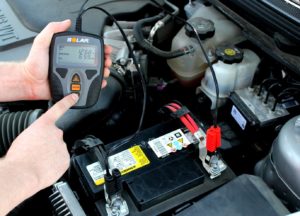
Find the car battery group size for your car
Start by identifying the correct battery group size specified for your vehicle. That group size ensures the battery fits securely in the tray and that the terminals line up properly with your battery cables.
Once you have the right size, match the original battery’s Cold Cranking Amps (CCA) rating as closely as possible.
What Cold cranking amps (CCA) means
This number represents the number of amps a battery can deliver at 0 ° F for 30
seconds without dropping below 7.2 volts. Buy a battery with the highest CCA rating for your group size.
What Reserve Capacity (RC) means
The number of minutes a fully charged battery at 80 ° F will discharge 25 amps until the battery drops below 10.5 volts. This rating is usually found on deep-cycle marine batteries as amp-hours (AH). This represents an amp draw for 20 Hours. If you have a 100 AH-rated battery that draws 5 amps and provides that draw for 20 hours, it’s a 100 AH battery.
Just be aware that current draw and draw time aren’t directly related. For example, if you draw 100 amps from a 100AH battery, it will NOT provide power for 1 hour. As the draw increases, the actual AH rating decreases. For a 100-amp draw, a 100-AH battery will really only provide 64 AH.
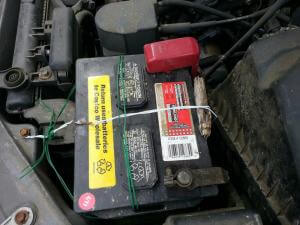
This coat hanger isn’t an acceptable battery hold-down
So ignore the brand and read the specs. Follow this procedure before disconnecting the battery terminals. And KEEP THE RECEIPT in case the battery fails.
Want to know the average life of a car battery?
*AC Delco makes batteries for all GM products and sells some batteries through its distribution network. However, as far as I know, they do not private-label their products for auto parts stores.
©, 2015 Rick Muscoplat
Posted on by Rick Muscoplat