
Why the Gas Pump Nozzle Shuts Off Before Tank is Full
What Causes the Gas Pump Nozzle to Shut Off Early When You Fill Your Gas Tank
Quick Summary:
The gas pump nozzle is designed to shut off when it detects too much vapor backpressure, indicating that your gas tank is full. The evaporative emissions system in your car is designed to absorb fuel vapors as you add fuel. The vapors are stored in a canister filled with activated charcoal. Later, as you drive, the EVAP system has purge and vent valves open to pull fresh air into the canister and burn off the vapors in your engine, so the canister is ready for your next fill-up. If there’s a fault in the purge or vent valve, the tubing, or the charcoal canister, the system can’t purge the vapor-soaked charcoal, causing backpressure that shuts off the pump nozzle early.
Article
As an automotive diagnostic expert, I hear this complaint constantly: “Every time I try to fill up, the gas pump nozzle shuts off early, and I still can’t fill the gas tank!”
Gas pumps use an automatic shutoff system to prevent gasoline from overflowing. The nozzle has a tiny sensing port that detects changes in pressure or a splash of fuel. If vapors or fuel block that port, the nozzle thinks the tank is full — click — fueling stops.
When everything in your evaporative emissions system (EVAP) is working properly, vapors are absorbed in a charcoal canister, and the pump nozzle only clicks off when the tank is full. But when EVAP parts fail, pressure builds up in the filler neck, and the pump nozzle shuts off before the tank is full.
The Top 3 Failures That Cause The Pump Nozzle to Shut Off Early
1) Purge valve failure —If the purge valve fails to open during a purge operation, the charcoal canister will be filled with vapor, and the vapor during fill-up will cause backpressure that shuts off the pump nozzle. A failed purge valve is the most common cause of a gas nozzle that shuts off early.
2) Vent valve failure — If the vent valve fails to open during the purge cycle, the vapors remain in the charcoal canister, preventing the absorption of the additional vapors during fill-up. That causes the pump nozzle to shut off early.
3) Damaged Charcoal Canister or hoses — A breach of the screen in the canister can cause charcoal particles to spread through the EVAP system, clogging the purge valve and preventing a full purge cycle. I
When the system can’t complete a purge cycle, you’ll often see one or more of these trouble codes:
P0441 Evaporative Emission Control System Incorrect Purge Flow
P0446 Evaporative Emission Control System (EVAP) vent control circuit malfunction
P0440 Evaporative Emission Control System Malfunction
P0455 Evaporative Emission Control System Leak Detected (gross leak)
P0456 Evaporative Emissions System Small Leak Detected
How to Diagnose the Root Cause Of Your Fill-Up Failure
Locate and check the purge valve — It’s usually located in the
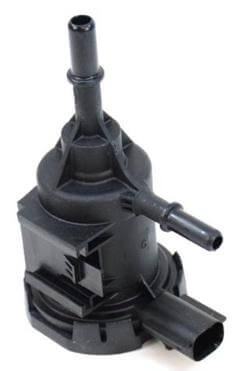
Look for the purge valve in the engine compartment near the intake manifold. It usually has two hoses and an electrical connector.
engine compartment, with at least two hoses and an electrical connector. Remove the hoses and check for signs of charcoal particles. If you find any, that’s a sign the charcoal canister is damaged and must be replaced. After replacement, flush all the charcoal debris from the lines and install a new purge valve.
Check the purge valve operation — The purge valve is an electrically operated solenoid valve. Using jumper wires, connect battery voltage to the valve’s terminals to check if the valve opens and closes when powered/depowered. If the valve doesn’t operate, replace it.
If it does operate, check for leakage using a handheld vacuum pump. The valve should hold a vacuum when closed. If it leaks, replace it.
Check the vent valve— It’s usually located near the charcoal canister. Check for obstructions in the

Vent Valve
vent valve inlet. Spiders like to build nests in the inlet port, and that prevents fresh air from entering the canister during the purge cycle. If you find obstructions, clean the inlet and hose. Next, apply power and ground to check the vent valve operation. Replace the valve if it fails the test.
Check the Charcoal Canister — Look for signs of cracks. If you don’t see any, remove the canister from the vehicle and gently tilt/shake it. If liquid fuel drips out, the canister is damaged and must be replaced. Also, check for airflow by disconnecting the vapor line from the fuel tank and the purge line running toward the engine compartment. Then, try blowing gentle air through the tank port.
You should feel unrestricted airflow exiting from the purge port. If the canister is bad, it will block airflow or cause a high restriction. Or, you might see dust or charcoal particles coming out.
WARNING: Never use compressed air for this test — it can rupture the canister
©, 2018 Rick Muscopl
Posted on by Rick Muscoplat