
Why Your Window Goes Up but Not Down
Car Window Goes Up but Not Down (or Down but Not Up)? Here’s How I Diagnose the Problem
Quick Summary
If your car window goes up but not down, or it goes down but won’t come back up, don’t assume you need a new window regulator. In most cases, the problem is electrical rather than mechanical. A worn driver’s master switch, broken wiring in the door hinge, a faulty passenger switch, or a failing window motor are the most common causes. Here’s how I diagnose the problem quickly without replacing good parts.
Car Window Goes Up but Not Down? Start Here
One of the most common power window problems I see is a window that works in only one direction. It may roll down normally but refuse to go back up, or it goes up perfectly but won’t go down.
Most people immediately blame the window motor or regulator. After diagnosing power windows for decades, I’ve found those parts are often innocent. Modern power windows rely on reversing the electrical polarity to change the motor’s direction. If power or ground is interrupted in only one direction, the window will move one way but not the other.
That’s why understanding how the system works saves time and money.
How Power Windows Work
Power window motors are permanent-magnet DC motors.
• One polarity makes the window go up.
• Reverse the polarity, and the window goes down.
The driver’s master switch, passenger switch, wiring harness, and motor all work together to reverse voltage. If any one component fails to reverse polarity, the motor can only turn in one direction.
The Most Common Causes
1. Worn Driver’s Master Switch — The driver’s master s
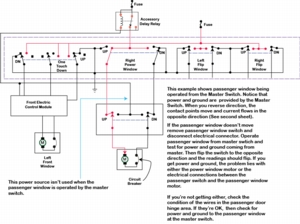
This is a typical window wiring diagram for a Ford vehicle. Click the image to open the PDF and follow along.
witch is the most heavily used electrical switch in the vehicle. Dirt, moisture, worn contacts, and years of use eventually prevent it from sending power in both directions.
If all windows operate normally except one, or the affected window only works one way from both switches, the master switch should be your first suspect.
2. Broken Door-Hinge Wiring — Every time you open the driver’s door, the wiring flexes inside the rubber boot between the door and body. Eventually, one or more wires break internally.
I’ve found broken hinge wires responsible for a surprising number of power window problems. Since one wire may carry current for “up” and another for “down,” a broken conductor can leave the window operating in only one direction.
3. Bad Passenger Switch — If the driver’s switch operates the window correctly but the passenger switch doesn’t—or vice versa—the passenger switch may have worn contacts that can’t reverse polarity. Fortunately, these switches are usually inexpensive and easy to replace.
4. Failing Motor — Window motors don’t always quit completely. Sometimes they develop worn brushes or “dead spots” that allow them to run one direction but not the other.
If proper voltage reaches the motor in both directions but it still won’t operate, replace the motor.
5. Binding Regulator — Although less common, a bent regulator, damaged cable, or worn guide can place enough resistance on the motor that the window only travels one direction or stalls completely.
If you hear the motor running but the glass barely moves, inspect the regulator before replacing electrical components.
How I Diagnose the Problem
I always follow the same process:
• Check the power window fuse(s).
• Test both the driver’s and passenger switches.
• Verify voltage at the window motor.
• Inspect wiring inside the driver’s door hinge boot.
• Check the regulator for binding.
Using a digital multimeter, you should see approximately 12 volts with one polarity for “up” and the opposite polarity for “down.” If polarity doesn’t reverse, you’ve isolated the electrical problem.
Common Mistakes
• Replacing the regulator before testing voltage.
• Assuming the motor is bad because the window only moves one way.
• Ignoring broken wires hidden inside the door boot.
• Replacing only the passenger switch without testing the master switch.
A few minutes with a multimeter can prevent the unnecessary replacement of expensive parts.
How to Fix a Window That Goes Up but Not Down
Depending on what you find during your testing, the repair usually involves one of these:
• Replace the driver’s master switch.
• Repair broken hinge-area wiring using solder and heat-shrink tubing.
• Replace the passenger switch.
• Install a new motor.
• Replace a damaged regulator assembly.
Final Thoughts
When a car window goes up but not down, the problem is usually much simpler than most drivers expect. In my experience, electrical faults account for far more failures than bad regulators. By testing the switches, wiring, and motor in a logical order,
© 2012 Rick Muscoplat
Posted on by Rick Muscoplat