
Why Your Blower Motor Runs When Car Is Off
Blower Motor Won’t Turn Off When the Car Is Off? Here’s What’s Really Going On
Quick Summary
If your blower motor won’t turn off after you shut down the engine and remove the key, don’t assume the blower motor itself has failed. On vehicles equipped with automatic climate control, one of the first things I suspect is a failed blower motor control module.
1) On variable-speed HVAC systems, a failed blower motor control module is a prime suspect. They usually fail in the full ON position
2) A blower motor that keeps running when the car is off can drain the battery surprisingly quickly.
3) Other possibilities include
• Stuck blower relay
• Wiring short
• HVAC control module fault.
If the fan runs at or near full speed and ignores the climate-control settings, that points even more strongly toward an electronic blower speed controller problem.
Pulling the correct blower fuse or disconnecting the blower circuit can temporarily prevent a dead battery, but it does not repair the underlying problem.
Before buying a blower motor, diagnose the control side of the circuit. A motor that continues spinning may simply be doing exactly what an electrical fault is commanding it to do.
Why Some Cars Default to Fan ON and Others Don’t
On some brands, when the blower speed controller fails, the fan won’t run at any speed. On others—especially GM and Ford—the default failure mode is ON.
So when a blower motor runs when the car is off, it’s not because the carmaker intended it that way for convenience. It’s simply how that particular solid-state controller fails electrically. Internally shorted transistors can provide a constant ground path, and that’s all the blower motor needs to run.
How the heater fan motor controller works
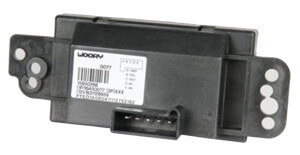
Electronic variable speed heater fan motor control
To understand why a blower motor runs when the car is off, you need to understand how variable blower speed is achieved.
In modern automatic climate control systems, fan speed is controlled electronically. The HVAC module sends a command signal to the blower motor controller. That controller doesn’t vary voltage—it pulses the ground side of the circuit.
At low speed, the ground is connected briefly and disconnected longer. At high speed, the ground stays connected almost continuously. The blower motor always has power; the controller decides how often it can complete the circuit.
When the controller fails internally, the pulsed ground can become a constant ground. And just like that, the blower motor never shuts off. That’s exactly why a blower motor runs when the car is off.
How to Stop the Fan Temporarily Before It Kills the Battery
If you’re dealing with a blower motor that runs when the car is off and you need a temporary fix, you do have a couple of options.
You can pull the blower motor fuse or unplug the blower motor controller. Either one will stop the fan immediately. I’ve had customers do this overnight or for a weekend until parts arrive.
Just remember: this is a stopgap, not a repair. The underlying electrical fault persists.
The blower fan controller isn’t cheap
Here’s the part people don’t love hearing. Blower motor controllers aren’t cheap. A GM blower motor control processor, for example, can retail for around $280. That surprises people because the part doesn’t look very impressive.
I’ve seen rebuilt units advertised online, usually from places calling themselves HVAC rebuilders. While I know reputable PCM rebuilders, I don’t personally have long-term experience with rebuilt blower controllers. That means you’re rolling the dice a bit.
On newer GM vehicles, the controller is located near the heater fan motor. On older vehicles, the controller is sometimes mounted in the engine compartment near the firewall.
Final Thoughts from the Shop Floor
When a blower motor runs when the car is off, it’s not a mystery, and it’s not a haunted car. It’s a predictable failure mode of modern electronic HVAC systems. Once you understand how the blower motor controller works—and how it fails—the diagnosis becomes straightforward.
Fix it sooner rather than later. I’ve replaced far too many batteries that were killed overnight by a fan that never shut off.
© 2012 Rick Muscoplat