
2014 F150 Fuse Box Diagram: Exploring the Fuse Boxes
2014 F150 Fuse Box Diagram: Find the correct fuse for the circuit you’re working on
In your 2014 Ford F150, you’ve got two fuse boxes to keep track of: the Battery Junction Box, which is also called the Power Distribution Box under the hood, and the Body Control Module (BCM)/Passenger Compartment Fuse Panel.
Let’s start with the one under the hood. Just pop it open and take a look near in the center of the engine compartment above the radiator. You’ll find the power distribution box there. It’s like the nerve center for your truck’s major systems—things like engine management, emissions, and ABS brakes are all controlled by the fuses in this box.
Now, for the second fuse box, crawl under the dash on the passenger side. It’s tucked away in the footwell. This one takes care of all the interior electrical stuff like the radio, power windows/locks, climate controls, and those handy courtesy lights. It’s essential to give both of these fuse boxes a once-over every so often to make sure none of the fuses are blown. If your electrical gadgets aren’t acting right, it might be a sign that something’s amiss with the fuses.
To learn more about automotive fuses, see this article
To learn how to check a fuse visually or without removing it, see this article
Find the most commonly replaced fuses here
The fuse box diagram and table below show all 62 fuses and all the relays. But most DIYers are looking for fuses and relays for the lights, power ports, and the blower motor. I’ve listed the most commonly checked/replaced fuses here to save time. I’ve also listed the most commonly replaced bulbs. A blown fuse or bulb are the two most common reasons for lighting issues.
BCM = Body Control Module under the dash. BJB = Battery Junction Box under the hood
• Backup Light: Fuse #15 (BCM) 15A
• Blower Motor: Fuse #51 40A (BJB)
• Front Parking Lamps: Fuse 30 15A (BCM)
• Headlight Low Beam Passenger Side: Fuse #16 20A (BJB), Bulb #HID
• Headlight Low Beam Driver’s Side: Fuse #35 20A (BJB), Bulb #HID
• Headlights High Beam: Fuse #39 15A (BCM)
• Horn: Fuse #22 20A (BCM)
• Rear Parking lamps: Fuse #40 10A (BCM), Front park turn bulb #3157A (amber)
• Power Ports: Rear: Fuse #72 20A (BJB), 110V power point Fuse #33 40A (BJB), Auxiliary on Instrument Panel: Fuse #22 20A (BJB), Auxiliary on Instrument Panel: Fuse #65 20A (BJB), Center Console #66 20A (BJB)
•Right turn signals and stop lamps Fuse #13 15A (BCM)
•Left Turn Signals and stop lamps Fuse #14 15A(BCM)
2014 F150 Fuse Box Diagram for the Battery Junction Box

How to find your fuse and the devices served by that fuse
There are 85 fuse and relay slots in the Battery Junction Box. There are several ways to find the fuse you want in the chart below.
1) Enter a search term in the search box.
2) If you’d like to scroll all the fuses, change the number of entries to 100 in “Show Entries” box. Or, click NEXT at the bottom right of the table to scroll 10 items at a time.
| Fuse number | Amperage | Circuits protected |
|---|---|---|
| F1 | Relay | Powertrain control module (3.7L, 5.0L and 6.2L engines) |
| F2 | Relay | Starter |
| F3 | Relay | Blower motor |
| F4 | Relay | Rear window defroster |
| F5 | Relay | Electric fan (high speed) |
| F6 | Relay | Trailer tow park lamp |
| F7 | Relay | Run/start |
| F8 | Relay | Fuel pump |
| F9 | Relay | Trailer tow battery charger |
| F10 | Relay | Powertrain control module (3.5L engine) |
| F11 | 30 | Power running board motors |
| F12 | 40/50 | Electric fan (3.7L, 5.0L)/Electric fan (3.5L, 6.2L with max trailer tow, SVT Raptor) |
| F13 | 30 | Starter relay power |
| F14 | 30 | Passenger power seat |
| F15 | 40/50 | Electric fan (3.7L, 5.0L)/ Electric fan (3.5L, 6.2L with max trailer tow, SVT Raptor) |
| F16 | 20 | High-intensity discharge headlamp – passenger side |
| F17 | 30 | Trailer brake control |
| F18 | 30 | Auxiliary switch 1 (SVT Raptor) |
| F19 | 30 | Auxiliary switch 2 (SVT Raptor) |
| F20 | 20 | 4x4 module (electronic shift) |
| F21 | 30 | Trailer tow battery charge relay power |
| F22 | 20 | Auxiliary power point (instrument panel) |
| F23 | Relay | Air conditioner clutch |
| F24 | — | Not used |
| F25 | — | Not used |
| F26 | 10 | Powertrain control module – keep alive power and relay coil, canister vent solenoid (3.7L, 5.0L and 6.2L engines) |
| F27 | 20 | Fuel pump relay power |
| F28 | 10 | Auxiliary switch 4 (SVT Raptor) |
| F29 | 10 | 4x4 integrated wheel end solenoid |
| F30 | 10 | Air conditioner clutch relay power |
| F31 | 15 | Run/start relay power |
| F32 | 40 | Rear window defroster relay power, Heated mirror relay power |
| F33 | 40 | 110-volt AC power point |
| F34 | 40/50 | Powertrain control module relay power (3.7L, 5.0L and 6.2L engines)/ Powertrain control module relay power (3.5L engine) |
| F35 | 20 | High-intensity discharge headlamps – driver side |
| F36 | 30 | Roll stability control / Anti-lock brake system |
| F37 | Relay | Trailer tow left stop/turn |
| F38 | Relay | Trailer tow right stop/turn |
| F39 | Relay | Trailer tow back-up lamps |
| F40 | Relay | Electric fan |
| F41 | 15 | Front camera washer (SVT Raptor) |
| F42 | 5 | Run/start relay coil |
| F43 | 43 | Trailer tow back-up lamp relay power |
| F44 | 15 | Auxiliary switch 3 (SVT Raptor), Trailer tow power folding mirrors |
| F45 | 10 | Alternator sensor (3.5L, 3.7L and 5.0L engines) |
| F46 | 10 | Brake on/off switch |
| F47 | 60 | Roll stability control / Anti-lock brake system module |
| F48 | 20 | Moonroof |
| F49 | 30 | Wiper relay power |
| F50 | — | Not used |
| F51 | 40 | Blower motor relay power |
| F52 | 5 | Run/start – Electronic power assist steering, Blower relay coil |
| F53 | 5 | Run/start – Powertrain control module |
| F54 | 5 | Run/start – 4x4 module, Back-up lamps, Roll stability control /Anti-lock brake system, Trailer tow battery charge relay coil, Rear window defroster relay coil, Front camera washer relay coil (SVT Raptor) |
| F55 | — | Not used |
| F56 | 15 | Heated mirrors |
| F57 | — | Not used |
| F58 | — | Not used |
| F59 | — | Not used |
| F60 | — | Not used |
| F61 | — | Not used |
| F62 | Relay | Wiper motor |
| F63 | 25 | Electric fan relay power |
| F64 | — | Not used |
| F65 | 20 | Auxiliary power point (instrument panel) |
| F66 | 20 | Auxiliary power point (inside center console) |
| F67 | 20 | Trailer tow park lamps relay power |
| F68 | 25 | 4x4 module, 4x2 elocker module |
| F69 | 30 | Front heated or heated/cooled seats |
| F70 | — | Not used |
| F71 | 20 | Heated rear seats |
| F72 | 20 | Auxiliary power point (rear) |
| F73 | 20 | Trailer tow stop/turn lamps relay power |
| F74 | 30 | Driver power seat/memory module |
| F75 | 15/25 | Powertrain control module – voltage power 1 (3.7L, 5.0L, 6.2L engines)/ Powertrain control module – voltage power 1 (3.5L engine) |
| F76 | 20 | Powertrain control module – Voltage power 2: General powertrain components (Mass air flow/Intake air temp sensor - 3.7L, 5.0L, 6.2L engines) (Canister vent solenoid - 3.5L engine) |
| F77 | 10 | Powertrain control module – Voltage power 3 (Emission related powertrain components, Electric fan relays coil) |
| F78 | 15/20 | Powertrain control module – Voltage power 4 – Ignition coils (3.5L, 3.7L, 5.0L engines) / Powertrain control module – Voltage power 4 – Ignition coils (6.2L engine) |
| F79 | 5 | Rain sensor |
| F80 | — | Not used |
| F81 | — | Not used |
| F82 | — | Not used |
| F83 | — | Not used |
| F84 | — | Not used |
| F85 | Relay | Electric fan (low speed) |
A note about fuses, battery power and keep alive memory
If you disconnect the battery or remove the PCM fuses from the fuse box, the PCM will lose its adaptive memory and baseline throttle body position. You can avoid this by providing backup power using a jumper pack and an inexpensive OBDII cable. See this article for more information on providing backup power to prevent the loss of adaptive memory. Or, you can perform a throttle body relearn procedure and then drive the vehicle so it can relearn the new adaptive memory settings. See this article for instructions on how to perform a 2012 Mustang throttle body relearn procedure.
2014 F150 Fuse Box Diagram for the Passenger Compartment Fuse Box/Body Control Module

2012 Mustang Fuse Box Diagram Body Control Module
There are 49 fuse slots in BCM, but only ten show to save space and speed up page loading. To navigate the table, change the number of entries showing, enter the device you’re searching for, or scroll the table using the next or previous buttons at the bottom of the table.
| Fuse number | Amperage | Circuits protected |
|---|---|---|
| F1 | 30 | Driver side front window |
| F2 | 15 | SYNC , Display module (8 inch) |
| F3 | 30 | Passenger side front window |
| F4 | 10 | Interior lamps |
| F5 | 20 | Memory module |
| F6 | — | Not used |
| F7 | 7.5 | Exterior rear view mirror switch, Driver Seat Module (DSM) |
| F8 | — | Not used |
| F9 | 10 | Radio display, GPS module, Electric finish panel module |
| F10 | 10 | Run/acc relay |
| F11 | 10 | Instrument Panel Cluster (IPC) |
| F12 | 15 | Interior lighting, Puddle lamps, Backlighting, Cargo lamp |
| F13 | 15 | Right turn signals/stop lamps |
| F14 | 15 | Left turn signals/stop lamps |
| F15 | 15 | Reverse lights, High-mounted stop lamp |
| F16 | 10 | Right low-beam headlamp |
| F17 | 10 | Left headlamp - low beam |
| F18 | 10 | Brake-shift interlock, Keypad illumination, Powertrain control module wake-up, Passive anti-theft system |
| F19 | 20 | Audio amplifier |
| F20 | 20 | Power door locks |
| F21 | — | Not used |
| F22 | 20 | Horn |
| F23 | 15 | Steering Column Control Module (SCCM) |
| F24 | 15 | Datalink connector, Steering wheel control module |
| F25 | — | Not used |
| F26 | 5 | Radio frequency module |
| F27 | — | Not used |
| F28 | 15 | Ignition switch |
| F29 | 20 | Radio |
| F30 | 15 | Front parking lamps |
| F31 | 5 | Brake on/off – Instrument panel, Engine |
| F32 | 15 | Delay/accessory – moonroof, power windows, locks, Automatic dimming mirror/Compass, Trailer tow power telescope mirrors |
| F33 | 10 | Rear heated seats |
| F34 | 10 | Reverse sensing system, 4x4 switch, Rear video, Off-road indicator (SVT Raptor), Front video (SVT Raptor), Camera splice module (SVT Raptor) |
| F35 | 5 | Hill descent switch (SVT Raptor) |
| F36 | 10 | Restraint control module, Occupant classification system module |
| F37 | 10 | Trailer brake control |
| F38 | 10 | Delayed accessory – 110-volt power point, Radio |
| F39 | 15 | Headlamps - high beam |
| F40 | 10 | Rear park lamps |
| F41 | 7.5 | Passenger airbag deactivation indicator, Auxiliary switch (SVT Raptor) |
| F42 | 5 | Overdrive cancel switch |
| F43 | 10 | Not used |
| F44 | 10 | Not used |
| F45 | 5 | Not used |
| F46 | 10 | Climate controls module |
| F47 | 15 | Fog lamps, Exterior mirror turn signals |
| F48 | 30A circuit breaker | Power windows, Power sliding back window |
| F49 | Relay | Delayed accessory |
Relay Diagram for the Auxiliary Relay Box
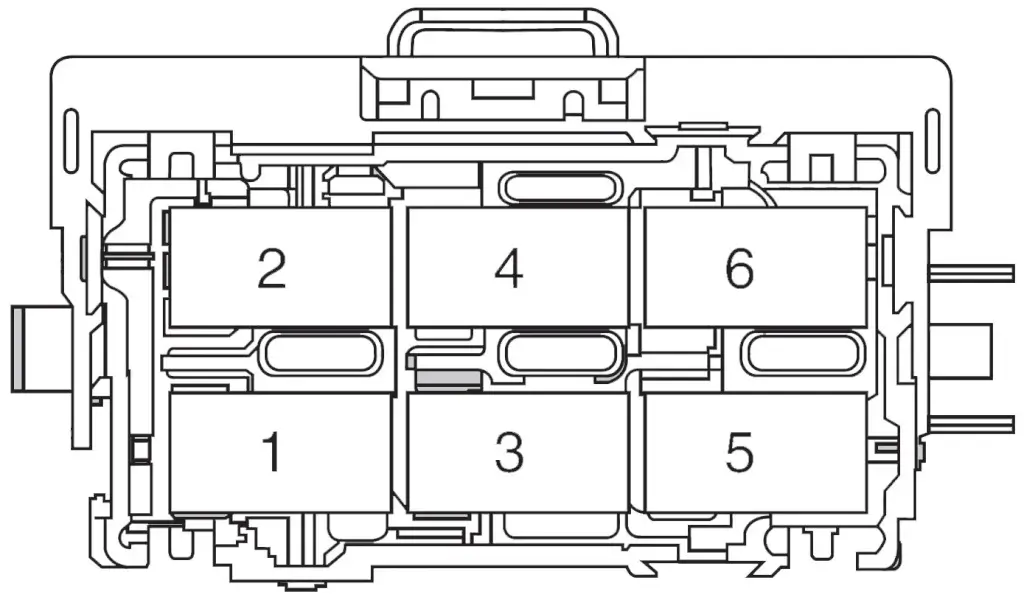
1 Auxiliary switch 1
2 Relay Auxiliary switch 2
3 Relay Auxiliary switch 3
4 Relay Auxiliary switch 4
5 Front camera washer
Looking for more information on your 2014 F150? Click here for the Firing Order, Engine Layout Diagram, Spark Plug Gap and Spark Plug Torque specs.
The 2014 F150 fuse box diagram compared to later years
The 2014 F-150 fuse box diagram resembles the 2013 F-150 fuse box diagram. However, Ford made substantial changes to the 2015 F-150 fuse box.
If you’re working on a later model F150 Fuse Box, please refer to the updated diagram.
Tips to diagnose electrical issues on your 2014 F150
If your power windows don’t work
• In previous model years, Ford used a 30A circuit breaker to provide power to the windows. However, starting in the 2014 F150, they went back to using fuses for the front windows.
The fuse for the driver’s side power window is #1 30A in the BCM, and the #3 30A for the passenger side window. However, Ford still uses a 30A circuit breaker for the rear passenger and driver’s side windows and the power sliding rear window.
The circuit breaker is located in the BCM in slot 48.
If your blower motor doesn’t work
The blower motor gets its power from the blower motor relay #3 in the battery junction/power distribution box.
If the circuit you’re working on contains a relay
• A simple way to test a relay is to swap in a similarly shaped relay and see if the component works.
• If that doesn’t work, remove the relay and test for power to the relay control coil and contacts using a multimeter. For more information on relay testing, see this article.
©, 2018 Rick Muscoplat