
8 Warning Signs Your Car Battery Is Dead or Dying
The 8 Most Common Symptoms of a Dead or Dying Car Battery
Quick Summary
Here are the eight most common symptoms of a dead or dying car battery:
1) Rapid clicking when you turn the key to start
2) Single Click when you turn the key to start
3) No sounds when you turn the key to start
4) All dash lights light up and flicker when you turn the key to RUN or START
5) The engine cranks slowly
6) The battery case is bulging/swollen
7) The battery is leaking
8) The battery fails a battery test
Article
When your car refuses to start, it’s easy to blame the alternator or starter. But often, the symptoms of a dead car battery are the real culprit. Knowing these signs can save you time and money — and keep you from getting stranded.
Let’s dispel this common myth first
If your dashboard lights light up, that alone doesn’t mean your battery is good or fully charged! Why? Because it takes very little power to light up your dashboard lights. In many cases, it only uses a few amps. But starting your engine requires a minimum of 100 amps.
1) Rapid clicking when you turn the key is one of the top symptoms of a dead car battery
If you hear rapid clicking when you turn the key, that’s one of the classic symptoms of a dead car battery. The starter solenoid is receiving some power, but not enough to spin the motor. That rapid clicking is your warning that the voltage has dropped too low to crank the engine.
Before you condemn the battery, however, eliminate the possibility of corrosion on the terminals and posts by cleaning them. Remove the clamps, brush the posts with a wire brush, and reconnect them firmly. Corroded terminals can restrict current flow just enough to mimic a symptom of a dying car battery. If cleaning helps, the corrosion was the problem — not the battery.
2) A Single Click and Nothing More
This is one of the common symptoms of a dead car battery. A single click means the battery has enough power to operate the pull-in windings of the starter solenoid, but not enough to run the starter motor. In some cases, however, it can be a sign of a dead starter. So always get the battery tested
3) No Lights, No Click, Total Silence
When you turn the key and absolutely nothing happens — no dome light, no chime, no dash lights — that’s a dead giveaway. Total silence is the most severe symptom of a dead car battery. Either the battery is completely discharged, or there’s a significant connection failure. Check for loose or corroded terminals before assuming the battery itself is bad.
4) All the dash lights come on and flicker
Vehicle computers need a minimum of 9.6 volts to operate. If your battery is discharged, the computers go crazy. You’ll see flashing dash lights, hear clicking relays, and notice all kinds of strange sounds.
5) Slow cranking
Slow cranking — the sound of your starter turning sluggishly — is one of the earliest symptoms of a dying car battery. Modern conductance testers can accurately measure both voltage and internal resistance to determine the battery’s true condition.
Many people assume that if a battery shows 12.6 volts, it must be good. That’s not always true. Voltage only tells you the state of charge, not the state of health. A weak or sulfated battery might show full voltage but still fail to deliver enough current to start your car. Always rely on a proper load or conductance test for the real answer.
6) Flunks a battery test
Modern battery testers are very accurate. Yet I’m still amazed at the number of people who take their batteries to the auto parts store, have them tested, and then don’t believe the results. It’s usually because they think that if there’s voltage, it must be good. Not true. A battery can show voltage or power every time you turn on your dash lights, but that doesn’t mean it can produce enough amps to crank your engine at the proper speed.
7) Swollen battery case
A swollen or leaking battery case is a serious red flag and one of the more visible symptoms of a dead car battery. When a battery becomes severely discharged, it can freeze in cold weather, causing the sides to bulge or crack. If you see swelling, the battery is beyond repair and should be replaced immediately. Likewise, if you spot acid leaking around the terminals or seams, that battery is unsafe to use.
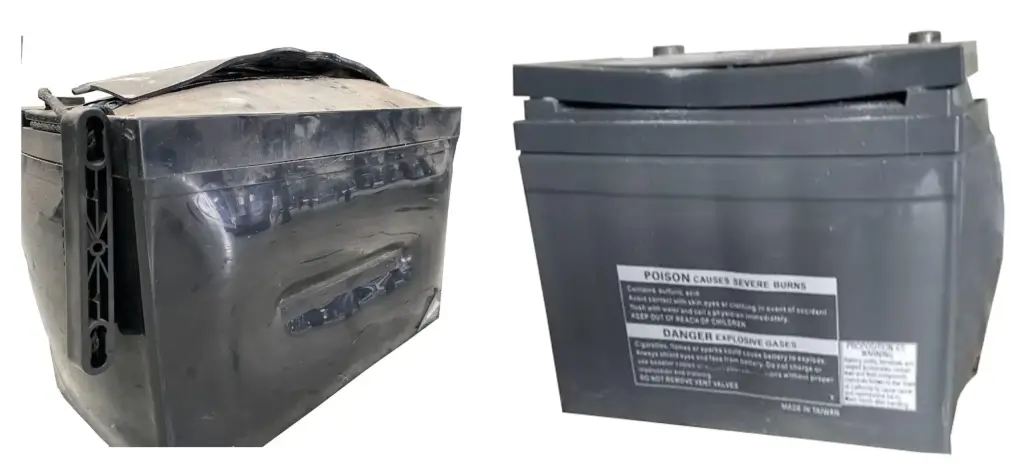
A swollen battery caused by freezing
8) Leaking
The acid in the battery should stay in the battery. If any leaks out, replace the battery.
How to Test a Suspect Battery
Use a digital voltmeter to check the battery’s state of charge:
12.6 volts = fully charged
12.2 volts = roughly 50% charged
Below 12.0 volts = dead
However, to determine its State-of-Health, use a battery tester that performs both load and conductance tests. This checks the internal plate condition and resistance. If your tester reports a failure or “replace,” trust it — a battery that fails an SOH test is on borrowed time.
When to Replace Your Battery
Late model vehicles have packed engine compartments that run hot. Heat is the #1 killer of car batteries. In addition, modern vehicles use a lot of power to run all the electrical accessories, multiple fuel pumps, and ADAS safety features, including radar and cameras. So, the average car battery life is now 3-4 years. If your battery is older than 4 years, you’re living on borrowed time.
© 2012 Rick Muscoplat
Posted on by Rick Muscoplat