
A catalytic converter delete won’t get you more power
The Truth About A Catalytic Converter Delete and Exhaust Backpressure
A catalytic converter delete will not reduce exhaust backpressure by any significant amount because the catalytic converter is not the most restrictive portion of your exhaust system. The muffler is.
It’s a myth that a catalytic converter delete can reduce backpressure
The myth is based on misunderstanding of modern catalytic converter design. The original catalytic converters used by Ford and GM were built using pellet bead beds. The alumina beads were coated with platinum and palladium, and the exhaust followed a tortured patch through the bead bed.
The beads were packed tightly enough to prevent vibration but loosely enough to allow exhaust flow. In the real world, the exhaust noise waves caused the beads to vibrate and abrade against one another, wearing them down to the point where they clogged the outlet louvers designed to keep the beads inside the converter. That caused a huge increase in exhaust backpressure.
The tortured exhaust path through a bead bed catalytic converter
The exhaust enters the pellet converter and immediately hits a partition. It then has to make two 90° turns before entering the bead bed through slotted louvers. At the outlet end of the converter, the exhaust exits the louvers and again takes two 90° turns before exiting to the resonator and muffler. This type of early converter introduced significant exhaust backpressure.
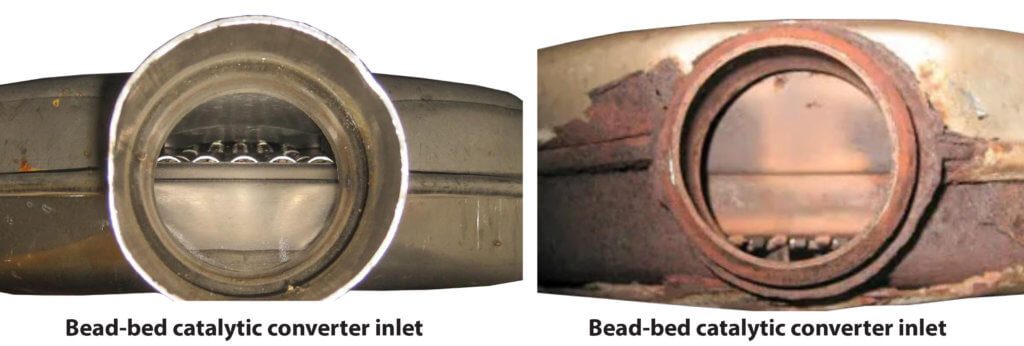
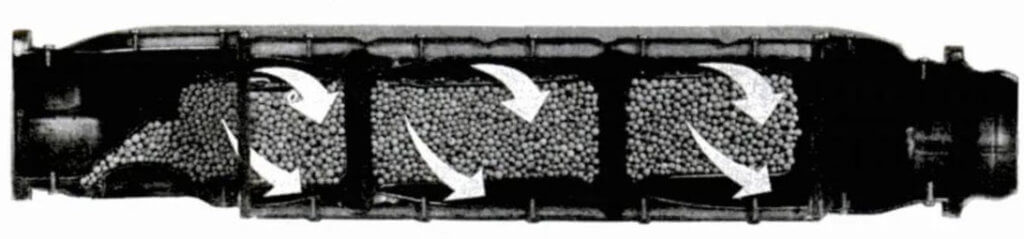
Exhaust flow through a bead-bed catalytic converter. Image Credit: Daniel Stern — curbsideclassic.com
Thanks to Daniel Stern, writer for curbsideclassic.com, for using the graphic showing exhaust flow through a pelletized catalytic converter. The original article can be found here. You can also find out more about Daniel and links to his articles here.
Flow-through catalytic converters are now the norm
By 1981, carmakers discontinued using bead-bed pellatized catalytic converters and switched to cordierite honeycomb monoliths that provided unrestricted flow for the exhaust gasses.
A properly sized, and functioning catalytic provides almost no back pressure
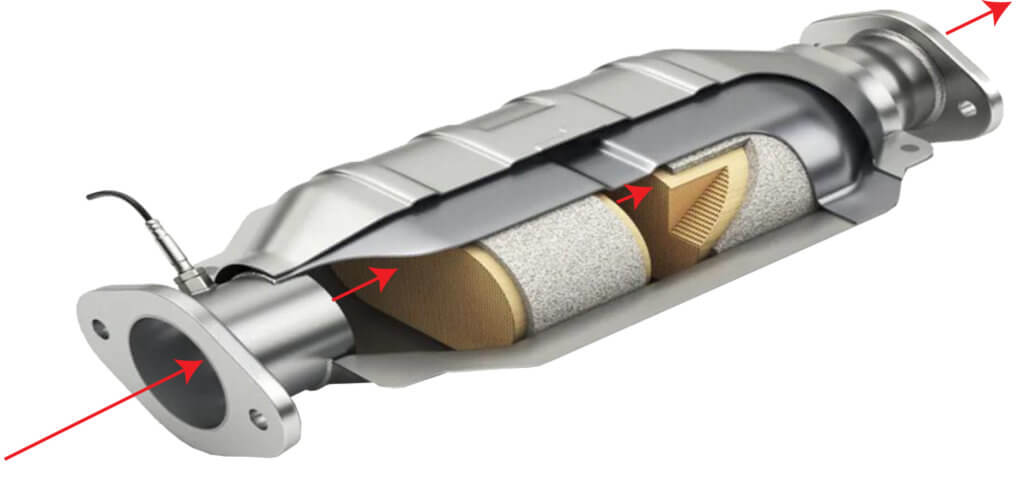
The muffler is the largest restriction in an exhaust system, not the catalytic converter
People continue to blame the catalytic converter for exhaust restriction based on the experience of the early bead-bed converters. But those old converters are long gone. Flow through catalytic converters doesn’t restrict exhaust flow like the bead bed designs. In fact, if you perform a cat delete, you won’t notice ANY reduction in exhaust pressure. Why? Because the muffler is the biggest restriction in a modern exhaust system, not the converter.
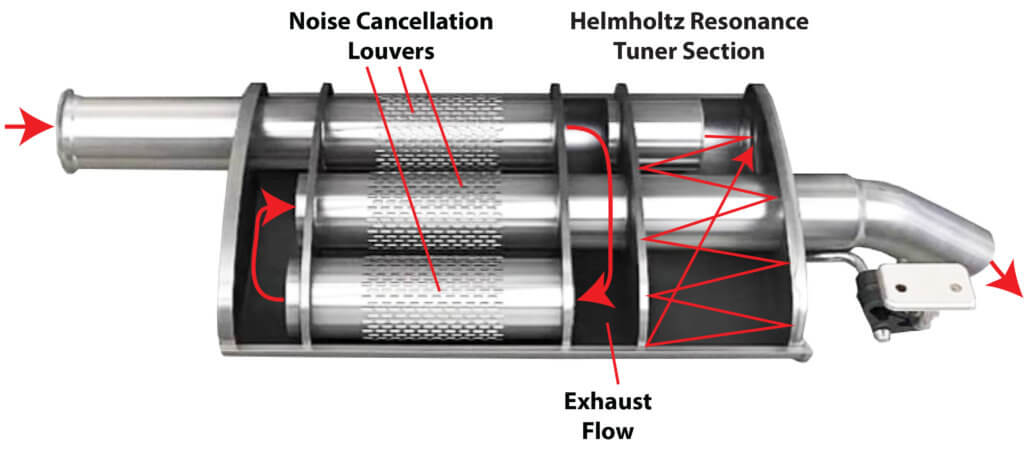
Exhaust flow through a muffler
The exhaust enters the muffler, travels through the first noise cancellation tube and turns 90° before it travels to the opposite side of the muffler. It then turns another 90° and enters the second noise cancellation tube. Upon leaving the 2nd noise cancellation tube the exhaust take two more 90° turns before entering the 3rd noise cancellation tube. It then leaves the muffler through the tailpipe.
The Helmholtz resonance tuner section is for noise cancellation. It has a domed formation that scatters the sound waves. But the Heimholtz tuner is really a dead end for the exhaust and it actually increases backpressure after the first noise cancellation tube.
The muffler produces backpressure
Backpressure isn’t really the correct term because there’s really no device that’s creating a backwards pressure. People use backpressure instead of the correct word, resistance to flow. In this case, a muffler on a stock engine is deigned to produce 1 to 1.5-psi. of resistance to exhaust flow. That’s far more than any flow-through catalytic converter.
If you own a post 1981 vehicle and think you’re going to reduce backpressure by deleting a flow-through catalytic converter, think again. If the converter isn’t clogged, removing it won’t do anything to improve performance!
©, 2022 Rick Muscoplat
Posted on by Rick Muscoplat