
A tire sidewall indentation is normal, a bulge isn’t
Understanding A Tire Sidewall Indentation: What You Need to Know
While inspecting your tires, you might notice a tire sidewall indentation (an undulation) or a slight dip on the sidewall. For many drivers, this can be alarming, as it raises concerns about the tire’s structural integrity and safety. However, not all tire sidewall indentations are dangerous, and understanding what causes them, how to differentiate between harmless indentations and serious issues, and when to take action can help ensure that your tires remain in good condition.
What Is a Tire Sidewall Indentation or undulation?
A tire sidewall indentation is a slight, localized depression or dip on the sidewall of the tire. It is typically shallow and does not affect the overall shape or contour of the tire. These indentations are often more noticeable on tires with larger sidewalls, such as those found on trucks, SUVs, or off-road vehicles. They are also more visible when the tires are inflated.
Tire indentation in the sidewall, or “tire undulation,” 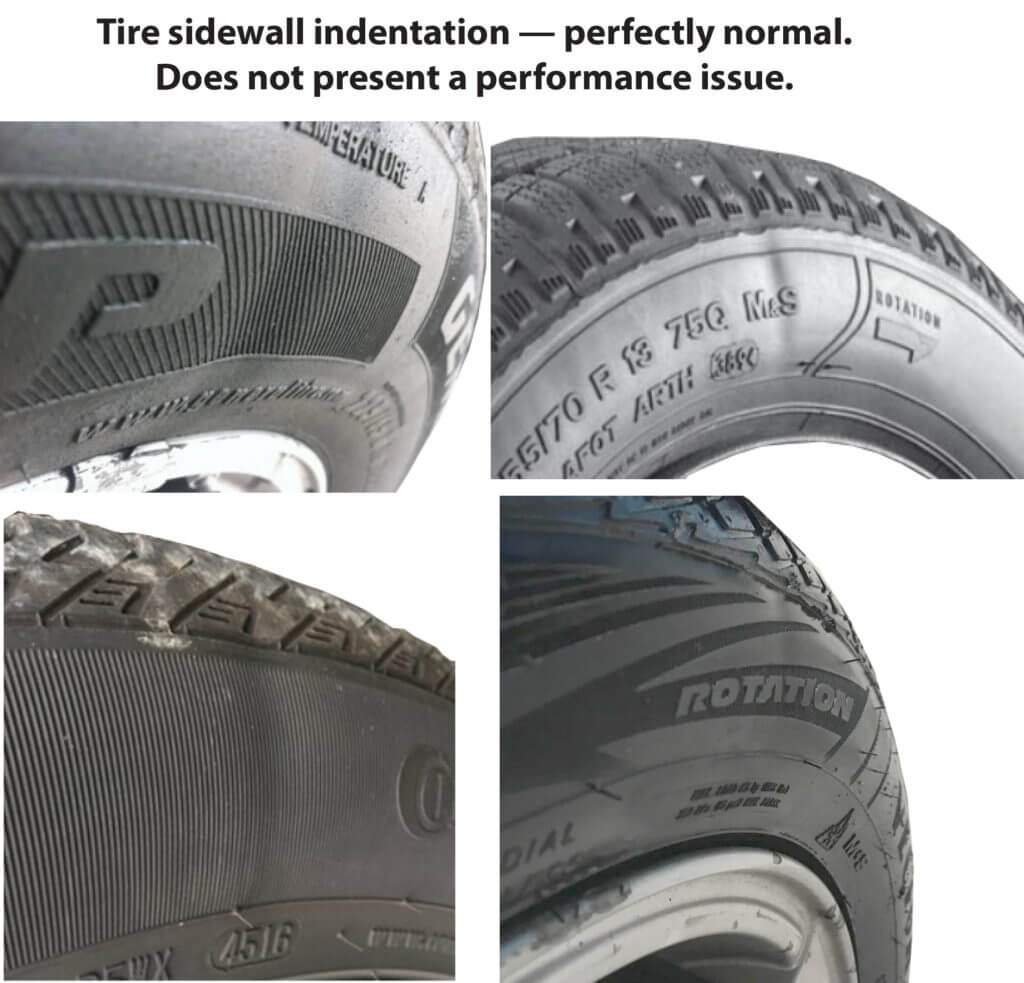 is a normal result of radial tire construction. The undulation is formed during the manufacturing process as tire plies are wrapped around a mold. The plies start at one tire bead, go up the sidewall, across the tread area, down the opposite sidewall, and finally to the opposite tire bead area. The pieces are wrapped side-by-side, and as the wrapping is finished, the final wrap overlaps the first ply. It’s this overlap you’re seeing that looks like an indentation. But it’s a perfectly normal visual result of tire manufacturing and is NOT a defect. It does not impact the performance of the tire.
The tire undulations are more noticeable on larger sidewalls
The tire sidewall indentation will be more noticeable on tires with larger sidewalls than on low-profile tires. They may also be more noticeable on tires with higher inflation pressures.
There’s a big difference between a tire undulation and a tire bulge
While a tire indentation is perfectly
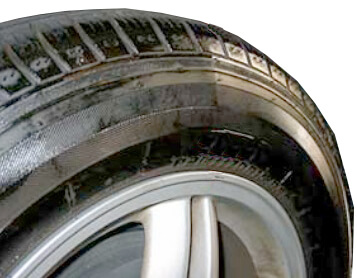
A bulge is much different than an indentation. A bulge is dangerous and the tire must be replaced ASAP
normal, a tire bulge is not. The tire in this image is unsafe and must be replaced. See this post for what causes a tire bulge.
Signs of Serious Problems
1) Bulges or Bubbles— If a bulge or bubble accompanies the indentation, this could indicate a more serious issue, such as a separation of the tire’s internal layers or a broken belt. Bulges and bubbles are often signs of internal damage that could lead to a tire blowout.
2) Cracks or Splits— Any cracks or splits near the indentation are a cause for concern. These could be signs of dry rot, impact damage, or structural failure, all of which can compromise the safety of the tire.
3) Irregular or Asymmetrical Indentations— If the indentation is irregular, asymmetrical, or accompanied by other deformations, it could be a sign of a manufacturing defect or damage. These should be inspected by a professional.
4) Loss of Air Pressure— If the tire is losing air pressure and there’s an indentation, it could indicate that the tire has been damaged. This should be addressed immediately.
©, 2020 Rick Muscoplat
Posted on by Rick Muscoplat