
AC Low Side Pressure is too Low: Explore the Causes
The Most Common Causes of Low Side Pressure Too Low
Quick Summary
When the low side pressure is too low, the root cause is usually low refrigerant due to a leak, a restriction at the expansion device, or poor evaporator performance. Normal low-side pressure typically sits around 30–40 psi, and when it drops too low, cooling performance suffers—or disappears entirely. The key is not guessing. I rely on pressure readings, temperature behavior, and system response tests to pinpoint the exact cause and fix it correctly.
My Real-World Take on Low Side Pressure Too Low
I’ve diagnosed more AC systems than I can count, and when I hook up gauges and see low side pressure too low, I don’t waste time guessing—I start thinking about flow and heat absorption.
The AC system works by moving heat. The low side is where the refrigerant absorbs heat inside the evaporator. When low side pressure is too low, it usually means one thing: not enough refrigerant is boiling off in the evaporator, or it’s not getting there in the first place.
Under normal conditions, I expect:
• Low side: 30–40 psi
• High side: varies with temperature (typically 150–250+ psi)
If the low side drops too far, the evaporator can actually get too cold, sometimes even freezing up. That’s a classic sign of low side pressure, too low.
What Happens When AC Low Side Pressure is Too Low?
1. You Get Poor Cooling Performance—When the low side pressure drops below the normal range (typically under 25 psi), there is insufficient refrigerant vapor in the evaporator to absorb heat from the cabin.
2. The Compressor Cycles Rapidly or the Compressor Clutch Won’t Engage—A low-pressure switch monitors the low-side pressure to protect the compressor. If the low-side AC pressure is low, the switch will cut power to the clutch coil, or, on variable displacement compressors, the low pressure causes the ECM to command the compressor to free-wheel.
3. You Get Little-to-No Airflow (and warm air) Due to Evaporator Coil Freezing (Icing)— An undercharged AC system means that the refrigerant spends too much time in the evaporator. It picks up enough heat to change from a low-pressure liquid into a low-pressure vapor. But because the charge is so low, the refrigerant stays in the evaporator longer than normal, absorbing even more heat and causing the evaporator coil to drop below freezing. Any moisture in the air then freezes on the evaporator coil’s surface and builds up until it chokes off airflow.
One way to detect evaporator icing is to examine the underside of your car when you park. As the ice melts, it drains out onto the ground, creating a small lake.
4. Compressor damage— Unlike an internal combustion engine, where the oil rings pull crankcase oil up the cylinder walls to lubricate the piston rings, AC systems rely on the refrigerant to carry oil to the top of the pistons, where it can lubricate the Teflon piston rings or the Scroll.
When an AC system loses refrigerant, it also loses oil. If you then operate the system when it’s low on charge, you’re actually operating it when it’s also low on oil. The result? A worn-out compressor.
5. Strange Noises— When the low side pressure is too low, the refrigerant flow becomes irregular. This causes hissing, bubbling, or gurgling sounds, especially noticeable when the compressor cycles on or off.
The First Thing I Check: Low Refrigerant (Leaks)
The number one cause of low side pressure too low is simple—low refrigerant. Refrigerant doesn’t get “used up.” If it’s low, it leaked out. Period.
When the refrigerant is low:
• There isn’t enough volume to absorb heat
• Pressure drops on the low side
• Cooling becomes weak or intermittent
I always inspect for:
• Oily residue at hose connections
• Leaks at the condenser or evaporator
• Compressor shaft seal leakage
If you’re dealing with low side pressure too low, start here. This is the most common root cause by far.
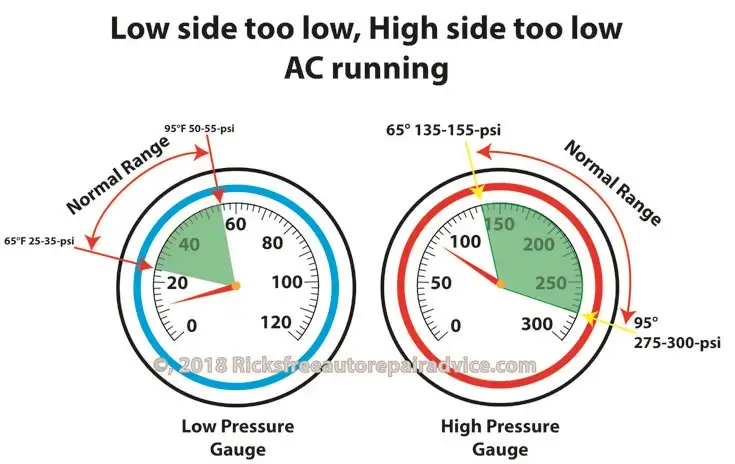
See this post to learn how to professionally diagnose your AC system to find the cause of low side pressure.
Restrictions Will Drive Low Side Pressure Too Low
The second major cause I see is a system restriction.
When the refrigerant can’t flow properly, the evaporator gets starved. That’s when low side pressure too low shows up.
• Common Restriction Points
• Expansion valve stuck closed
• Orifice tube clogged with debris
• Receiver/drier or accumulator blockage
When I diagnose this, I look for a pressure split:
• Low side: very low
• High side: often normal or high
That imbalance tells me the refrigerant isn’t flowing correctly.
Expansion Valve or Orifice Tube Failures
The metering device is critical. It controls how much refrigerant enters the evaporator.
If it fails closed or restricted:
• Not enough refrigerant enters the evaporator
• Heat absorption drops
• Low side pressure too low becomes obvious
My Diagnostic Approach
I check:
• Temperature drop across the valve
• Frost buildup at the restriction
• Pressure imbalance between the high and low side
A restricted metering device is one of the most common reasons I see low side pressure too low in otherwise sealed systems.
Evaporator Freeze-Up: A Symptom and a Cause
Here’s something many people miss. When the low side pressure drops too low, the evaporator can freeze. Ice buildup blocks airflow, which worsens cooling and further drops pressure.
It becomes a cycle:
• Low pressure → freezing
• Freezing → less airflow
• Less airflow → even lower pressure
What Causes Freeze-Up?
• Low refrigerant
• Weak blower motor
• Clogged cabin air filter
I always check airflow before I go deeper into diagnostics.
Weak Compressor or Pumping Issues
If the compressor can’t pull enough refrigerant through the system, you’ll see low side pressure too low.
This usually shows up as:
• Low low-side pressure
• Lower-than-normal high-side pressure
• Poor cooling
• What’s Happening Internally
• Worn internal components
• Leaking reed valves
• Reduced pumping efficiency
When I see both sides low, I start thinking of the compressor.
Moisture and Contamination Problems
Moisture in the system can freeze at the expansion device, creating a temporary restriction.
That leads to:
• Intermittent operation
• Fluctuating pressures
• Episodes of low side pressure too low
Contaminated refrigerant or debris can also clog components, causing the same issue.
When Low Low-Side Pressure Is (Partially) Normal
There are a few situations where low side pressure too low might not indicate a problem:
• Very low ambient temperatures
• Initial startup conditions
• Variable displacement compressors adjust output
But here’s my rule:
If cooling is poor and the low-side pressure persists, it’s not normal—it’s a problem that needs to be diagnosed.
My Step-by-Step Diagnostic Strategy
When I see low side pressure too low, I follow a consistent process:
• Verify pressure readings against ambient temperature
• Check for obvious refrigerant loss
• Inspect for airflow issues at the evaporator
• Look for signs of restriction (temperature and pressure clues)
• Evaluate compressor performance
• Confirm system contamination if needed
This approach eliminates guesswork and gets me to the root cause fast.
©, 2020 Rick Muscoplat
Posted on by Rick Muscoplat