
Low Side Pressure Too High: A Look at the Causes
The Most Common Causes of Low Side Pressure Too High
Quick Summary
When your car’s AC low side pressure is too high, the root cause comes down to one of a few issues:
• The system is overcharged
• Poor condenser cooling
• Air in the system
• Metering device problem.
Normal low-side pressure typically runs around 30–40 psi, and when the low side pressure creeps above 50 psi, cooling performance drops fast. The key is not guessing—I rely on pressure behavior, temperature, and system response tests to pinpoint the exact failure.
My Real-World Take on Low Side Pressure Too High
I’ve diagnosed hundreds of AC systems, and one thing I can tell you is this—when a low side pressure too high condition shows up on your gauges, the system is out of balance. Most DIYers expect low pressure when something’s wrong, but high low-side pressure is just as serious—and often more confusing.
The AC system is all about pressure differences. When those pressures equalize too much, the system loses its ability to absorb and reject heat. That’s exactly what’s happening when low side pressure too high shows up.
Under normal conditions, you should see:
• Low side: 30–40 psi (sometimes up to 50 psi on hot days)
• High side: 150–250+ psi depending on temperature
Once that low side climbs too high, cooling efficiency drops—and I know I’ve got a problem to chase down.
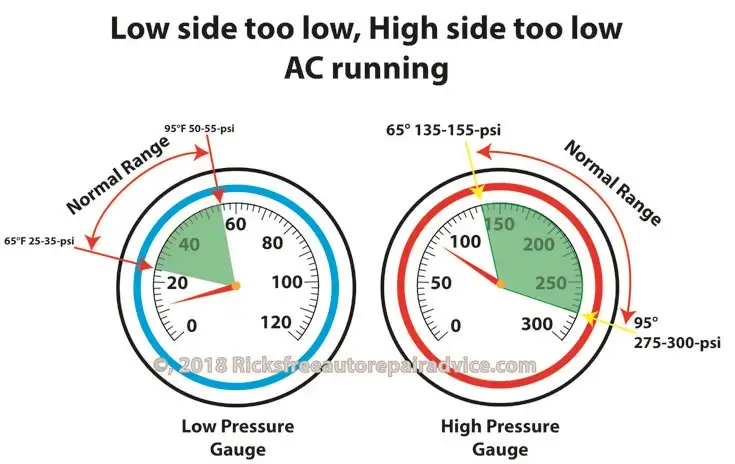
This image shows the normal range for the low side and high side pressures. If your AC low side pressure is too high, cooling efficiency will drop.
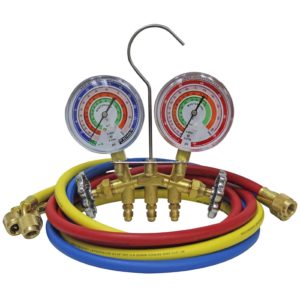
Use a manifold gauge set to check high and low side pressures in your car’s AC system
My Quick Test for Overcharged AC Systems
The most common reason I see for low side pressure too high is overcharging. It happens all the time when someone adds refrigerant based on pressure instead of weight.
When there’s too much refrigerant:
• The condenser can’t fully condense it
• Liquid backs up into the system
• Both high and low side pressures increase
How To Test For An Overcharge Condition
I spray water on the condenser while the system is running. If the pressures drop quickly, I know the system is overloaded.
If you’re dealing with low side pressure too high, this is one of the fastest ways to confirm overcharge. The only proper fix is to evacuate and recharge by weight—not guesswork.
Condenser Airflow Problems Will Drive Low Side Pressure Too High
This is the second most common issue I run into. If the condenser can’t reject heat, pressure builds across the entire system. That’s when low side pressure too high shows up—even though the real issue is airflow.
What I Check Immediately
• Cooling fan operation (especially at idle)
• Condenser fins for dirt or damage
• Debris blocking airflow
I’ve fixed plenty of systems where low side pressure too high disappeared just by cleaning the condenser or fixing a fan issue.
Make sure the condenser fan is spinning at full speed and the fins are clean. If you find bent fins, straighten them using a condenser fin comb. Fixing airflow issues will often correct the high-pressure problem.

Buy a set of fin combs to straighten your condenser’s bent fins. That will improve airflow and lower the pressure.
Air Contamination: The Hidden Cause
Air in the system is a big one—and most people overlook it. When refrigerant leaks out, air gets pulled in. Air doesn’t behave like refrigerant, so it disrupts the pressure/temperature relationship.
That’s when I start seeing:
• Erratic readings
• Elevated pressures
• Poor cooling
My Confirmation Method
I run the system, shut it off, and watch the high-side pressure. If it drops quickly and then creeps back up, I know air is present.
If you’re chasing low side pressure too high, don’t ignore contamination—it’s more common than people think.
Metering Device Problems (Expansion Valve or Orifice Tube)
The metering device controls how much refrigerant enters the evaporator. If it fails, the system loses control.
When it’s stuck open:
• Too much refrigerant floods the evaporator
• Pressure rises
• You get low side pressure too high
When it’s restricted:
• Pressures become unstable
• Cooling becomes inconsistent
This is one of those failures where I rely heavily on pressure patterns and temperature readings to confirm the diagnosis.
Don’t Overlook Evaporator Airflow
Here’s one that surprises a lot of people. A clogged cabin air filter or weak blower motor reduces airflow across the evaporator. When that happens:
• The evaporator can’t absorb heat efficiently
• Refrigerant doesn’t boil properly
• Pressure rises
Yes—this alone can cause low side pressure too high. It’s a simple fix, but it’s often missed.
Internal Compressor Problems
When I see low side pressure too high combined with weak high-side pressure, I start thinking compressor.
Specifically:
• Worn reed valves
• Internal leakage
Instead of maintaining a pressure difference, the compressor leaks high-pressure gas back into the low side. That’s when the system loses its ability to pump effectively.
Contamination: Wrong Refrigerant or Moisture
I’ve seen systems filled with the wrong refrigerant or even mixed refrigerants. That completely throws off pressure readings.
Moisture is another issue:
• It can freeze at the expansion device
• Cause intermittent restrictions
• Lead to fluctuating pressures
Both situations can result in low side pressure too high and inconsistent performance.
When High Low-Side Pressure Is (Partially) Normal
On extremely hot days—95°F and above—you’ll naturally see higher pressures.
But here’s my rule:
If low side pressure too high goes beyond about 50 psi and cooling is poor, it’s not normal anymore. It’s a sign something is wrong.
My Diagnostic Strategy (What I Actually Do)
When I diagnose low side pressure too high, I don’t guess. I follow a process:
• Verify pressures at known ambient temperature
• Check condenser airflow first (fast win)
• Look for signs of overcharge
• Test for air contamination
• Evaluate metering device behavior
• Confirm compressor performance
That step-by-step approach lets me pinpoint the root cause quickly—and fix it permanently.
©, 2020 Rick Muscoplat
Posted on by Rick Muscoplat